By
This is the first of 11 “Alex Notes” on my book —like Cliff’s Notes, but actually written by the author. Enjoy!
Get the Latest US Focused Energy News Delivered to You! It’s FREE:
(Some of you will remember that I started creating “Alex notes” as part of the Fossil Future book launch, but never got past Part 1. I’m doing them a bit differently this time around, and most importantly I’ll finish them!
Also, for those who preordered Fossil Future or who are premium subscribers to this newsletter, I’m doing a special live event “How to talk to anyone about climate change” on October 23. The invite will come to you next week.)
Our “knowledge system”—the people and institutions we rely upon to research, synthesize, disseminate, and evaluate expert knowledge—consistently ignores the massive, life-or-death benefits of fossil fuels.
(A summary of Fossil Future, Chapter 1)
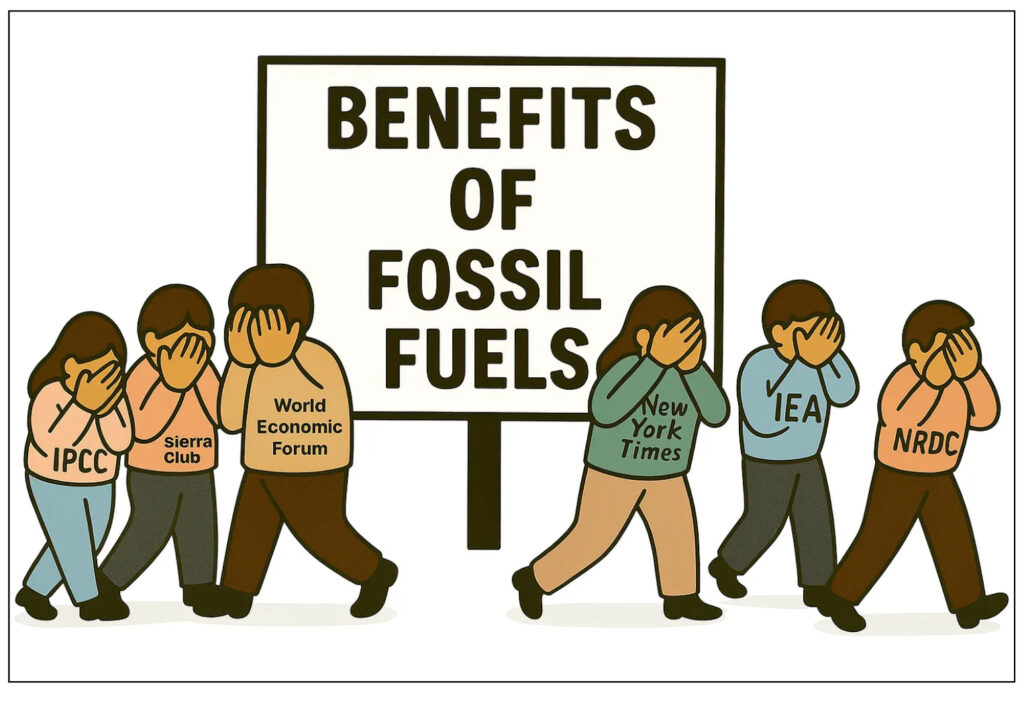
- Save the World With…Fossil Fuels?I am going to try to persuade you of something that might seem impossible: that one of the best things you can do to make the world a better place is to fight for more fossil fuel use—more use of oil, coal, and natural gas.
- Questioning the “Expert” Moral Case for Eliminating Fossil FuelsWe’re told rapidly eliminating fossil fuels is the expert consensus, but consider: 1) sometimes the alleged “expert” view is wrong, and 2) eliminating fossil fuels is a radical and potentially disastrous change.
- How to Know When the “Experts” Are WrongWe acquire alleged expert views via a “knowledge system” consisting of four phases—1) research, 2) synthesis, 3) dissemination, and 4) evaluation. 2, 3, and 4 are particularly prone to distortion—this holds true with fossil fuels.
- How Research WorksResearch, the foundation of any knowledge system, involves highly specialized knowledge that is hard for us to evaluate.
One clue that it’s being distorted is when a new view is attributed to all scientists, e.g., a 2° C increase will mean global catastrophe.
- There is a wide range of views among researchers about what level of warming leads to what consequences—including from Nobel Prize–winning climate economist William Nordhaus, who concluded that 2°C is not catastrophic and that trying to prevent it would do more harm than good.¹
- How Synthesis Can Go WrongSynthesis, in which the near-limitless amount of specialized knowledge is organized, refined, and condensed, can be distorted honestly or dishonestly.
One way to detect a syntheses error is when crucial variables or facts are omitted.
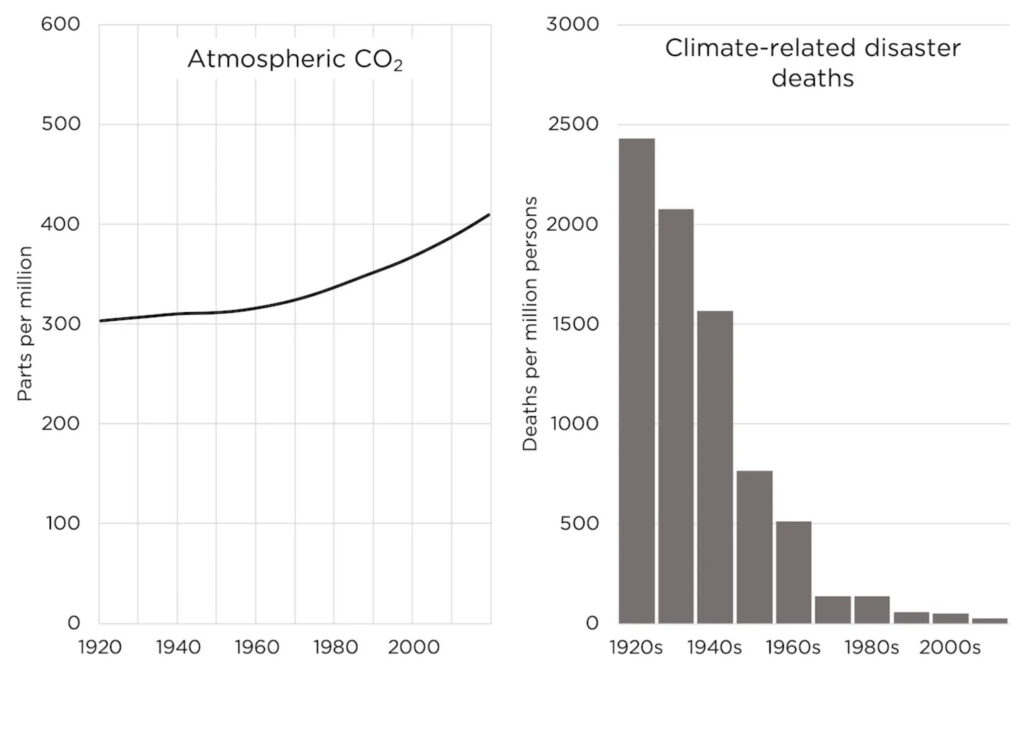
- An example of synthesizers omitting crucial facts is the latest “synthesis report” on human climate impacts from the Intergovernmental Panel on Climate Change (IPCC)—which leaves out the crucial fact that climate-related disaster deaths have fallen by 98% in the past century!²
- How Dissemination Can Go WrongDissemination, in which the essentials of synthesized research are communicated to the public, is frequently highly distorted.
One way to spot distortion is to even briefly check whether the sources cited are being accurately essentialized.
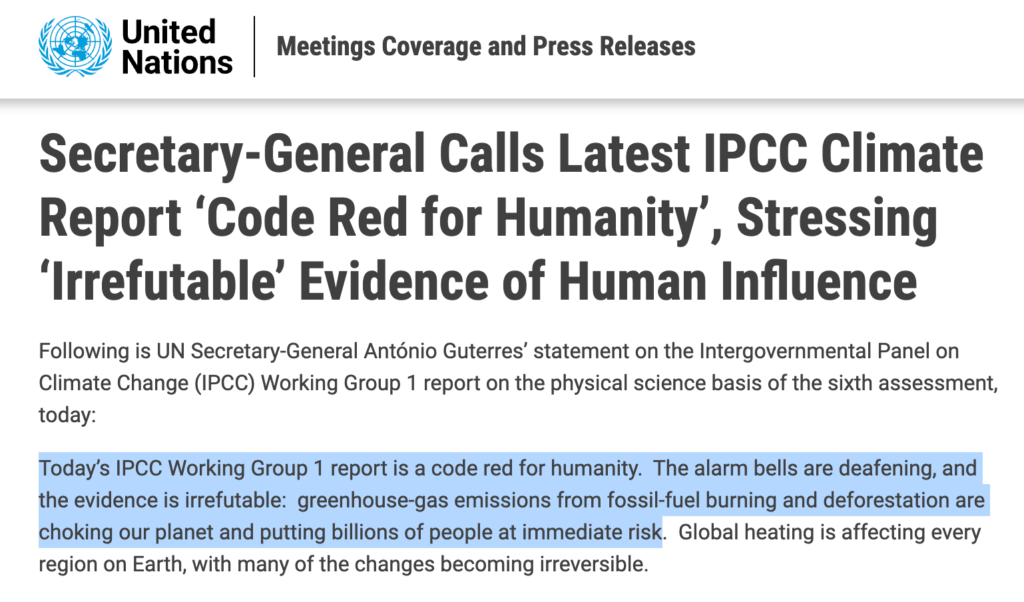
- An example of distorted dissemination is the UN Secretary-General’s portrayal of the latest IPCC synthesis report (”AR6”) as a “code red for humanity”—even though the content of the report, while tending toward exaggeration, showed nothing resembling an existential threat.³
- How Evaluation Can Go WrongEvaluation, in which institutions and people evaluate what to do about disseminated conclusions, must always be questioned.
Two errors to look out for are 1) using an anti-human “standard of evaluation” and 2) failing to consider the full context.
- An example of using an anti-human “standard of evaluation” is climate catastrophists’ focus on replacing fossil fuels with exclusively “green energy,” often opposing nuclear and large-scale hydro—the most effective forms of non-carbon energy.They value “green” over human life.
- An example of failing to consider the full context is our knowledge system’s consistent practice of calling for the rapid elimination of fossil fuels while failing to acknowledge their unique, massive, and desperately needed benefits.
- The Unique, Massive, and Desperately Needed Benefits of Fossil FuelsI knew our knowledge system was misevaluating fossil fuels when I learned 3 undeniable facts about fossil fuels’ benefits that are ignored or contradicted by our knowledge system’s case against fossil fuels.
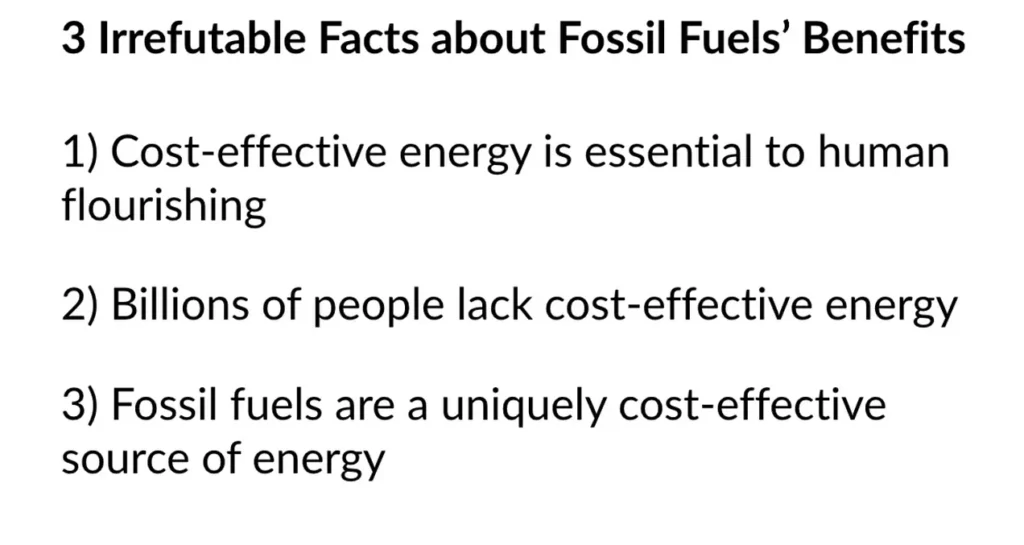
- Fossil Fuels Are a Uniquely Cost-Effective Source of EnergyFossil fuels are a uniquely cost-effective source of energy, providing energy that is 1) low-cost, 2) on-demand, 3) versatile, and 4) on a scale of billions of people in thousands of places.
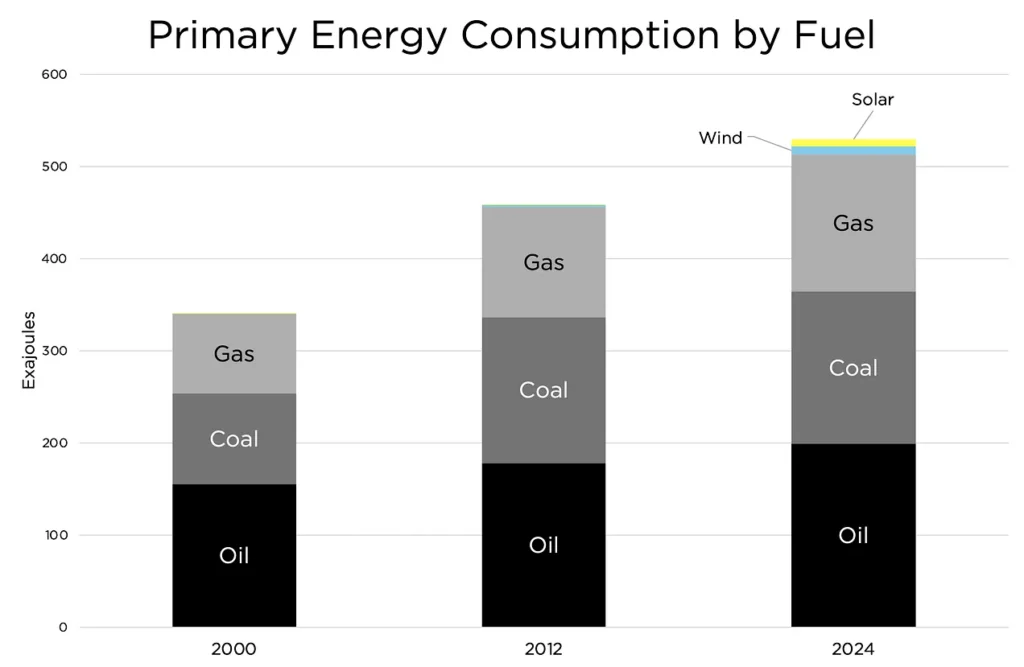
- The unique cost-effectiveness of fossil fuels is why despite 100+ years of aggressive competition, fossil fuels provide 80%+ of the world’s energy and are still growing fast, above all in places that care most about cost-effective energy, such as China.⁴
- Cost-Effective Energy Is Essential to Human FlourishingCost-effective energy is essential to human flourishing because the more cost-effective energy is, the more people can use “machine labor” to produce vital material values such as food, clothing, shelter, and medical care.
- For an example of the incredible power of machine labor, consider that a modern combine harvester can reap and thresh enough wheat to make 500,000 loaves of bread in a day—about a thousand times what a highly capable human can!⁵

- Billions of People Are Suffering and Dying for Lack of Cost-Effective EnergyBillions of people lack cost-effective energy, resulting in tragic amounts of suffering and death—such as premature babies dying because there is no reliable electricity for incubators.
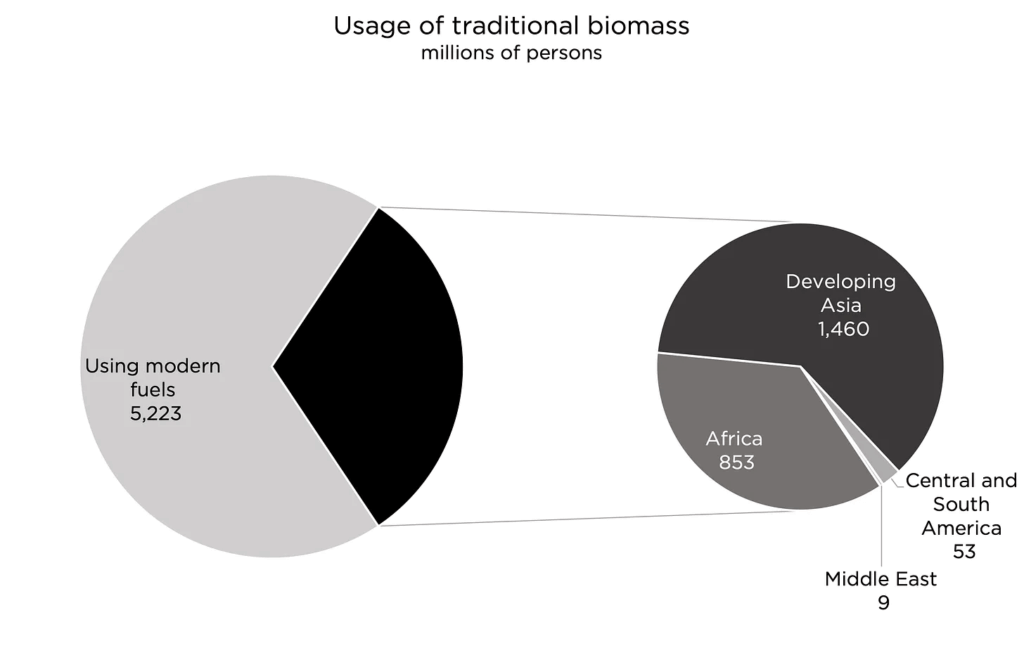
- 3 billion people use less electricity than a typical American refrigerator.Of those, almost 800 million are classified by the International Energy Agency as having no access to electricity.
And 2.4 billion people use primarily wood and animal dung for heating and cooking.⁶
- Do Our Designated Experts Really Ignore the Benefits of Fossil Fuels?Our “designated experts” (spokespeople for our knowledge system) ignore 1) the catastrophe that would come from losing fossil fuels’ benefits and 2) the failure of solar and wind to rapidly replace fossil fuels.
- In his book on fossil fuels and climate, The Madhouse Effect, “expert” Michael Mann explains how rising CO2 from fossil fuels will, in his view, do harm to food production.But incredibly, he 100% ignores the fact that today’s food abundance is utterly dependent on fossil fuels!⁷
- Ignoring the Benefits of All Cost-Effective EnergyThe ignoring of fossil fuels’ benefits is not an isolated incident but rather an instance of a systemic devaluation of and even hostility toward cost-effective energy as such by our knowledge system.
- Supporting Efforts to Eliminate Cost-Effective Nuclear EnergyOur knowledge system has long supported those who seek to eliminate clean, safe, non-carbon, proven nuclear energy—with no concern for the horrific consequences of losing both fossil fuel energy and nuclear energy.
- “Expert” Paul Ehrlich has fought vehemently to eliminate nuclear energy.In his 1975 article “An ecologist’s perspective on nuclear power,” Ehrlich wrote, “Giving society cheap, abundant energy at this point would be the moral equivalent of giving an idiot child a machine gun.”⁸
- Supporting Efforts to Eliminate Cost-Effective Hydro EnergyOur knowledge system excludes clean, non-carbon, proven hydroelectric energy from most “renewable” policies and supports shutting down hydro projects—with no concern for the cost-effective energy that would be lost.
- Indifference to “Green” Opposition to Solar and Wind
Our knowledge system expresses little concern about the widespread local opposition to its supposedly beloved solar and wind energy, or the fact that as a result many solar and wind projects face lengthy delays. - Ignoring Energy ExpertsNot only has our knowledge system designated energy-devaluers as experts, its designated experts are almost exclusively people who are not energy experts but rather “environmental experts”—experts on energy’s alleged negative environmental side-effects.
- A Broken Knowledge SystemOur knowledge system’s devaluing of and apparent hostility to cost-effective energy as such means it is guaranteed to give us bad guidance, and that it may be significantly misrepresenting fossil fuels negative climate side-effects.
- Our Knowledge System’s Apparent Hostility Toward Cost-Effective Energy Could Be Driving It to Overstate Fossil Fuels’ Negative Side-EffectsOur knowledge system is guaranteed to underestimate our ability to use cost-effective energy from fossil fuels to cope with climate danger.
- Our Knowledge System Might Be Dramatically Underestimating Our Ability to Use Cost-Effective Energy from Fossil Fuels to Cope with Its Climate Side-EffectsOur knowledge system may be driven by hostility toward cost-effective energy to exaggerate fossil fuels’ side-effects.
1 In 2018 Nordhaus used the DICE model to project abatement cost and climate damages for various policy scenarios. In this estimate, keeping the warming below 2.5°C would create abatement costs already slightly exceed estimated climate damages under a baseline scenario with practically no abatement. This clearly reflects the dangers of costly policies, like keeping warming below 2°C at any cost, causing higher cost to the economy than climate impacts.
2
For every million people on earth, annual deaths from climate-related causes (extreme temperature, drought, flood, storms, wildfires) declined 98%–from an average of 247 per year during the 1920s to 2.5 per year during the 2010s.
Data on disaster deaths come from EM-DAT, CRED / UCLouvain, Brussels, Belgium – (D. Guha-Sapir).
Population estimates for the 1920s from the , the Groningen Growth and Development Centre, Faculty of Economics and Business at University of Groningen. For years not shown, population is assumed to have grown at a steady rate.
Population estimates for the 2010s come from .
3
4
5
6
7
8
Share This:
More News Articles