On Energy Day at the 2025 United Nations Climate Change Conference, COP30, in Belém, Brazil, World Nuclear Association previewed findings from its forthcoming report, World Nuclear Outlook Report 2025.
The goal of tripling global nuclear capacity by 2050 was endorsed by 31 countries at COP28 and COP29. At the moment there are about 440 nuclear power reactors with a combined capacity of almost 397 GWe operating in 31 countries with at least 70 power reactors under construction, which will add another 77 GWe. Nuclear generation reached an all-time high of 2,667 TWh in 2024.
This study compiles national government targets and goals for nuclear capacity for 2050 and assesses them alongside plans for continued and extended operation of existing reactors, completion of those under construction, and realisation of planned and proposed projects.
The national government targets and goals for nuclear capacity for 2050 total 1,363 GWe. When nuclear capacity operable, under construction, planned or proposed that is not covered by government targets is also included, the total capacity for 2050 comes to 1,428 GWe, exceeding the 1,200 GWe target set in the Declaration to Triple Nuclear Energy. This assumes that the operation of existing reactors is extended up to 80 years.
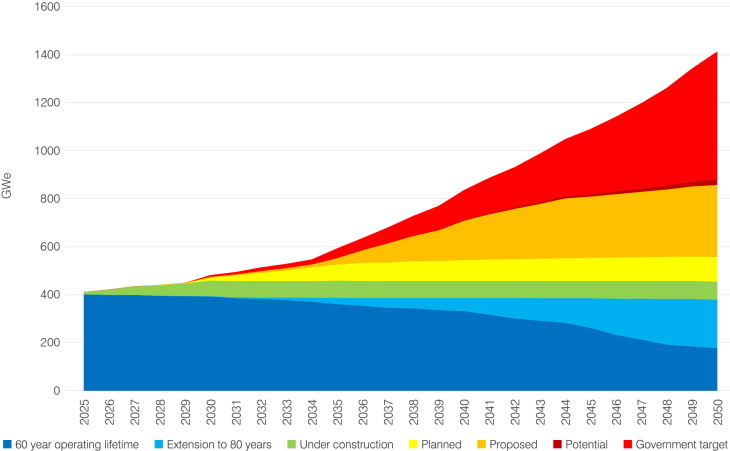
Assessment of global nuclear capacity (GWe) up to 2050 (Image: World Nuclear Association)
World Nuclear Association says the global capacity projected for 2050 is “heavily dependent on the actions of a small number of countries”, with China and the USA’s national goals responsible for more than half of the total global nuclear capacity in 2050. When the capacities projected for France, India, and Russia are added to those of China and the USA, these five countries would reach almost 1,000 GWe of nuclear capacity by 2050.
“Meeting these targets presents considerable challenges,” World Nuclear Association says. “Construction rates would need to accelerate, with new connection rates in 2050 being more than four times that required in 2030 and double the historic peak connection rates achieved in the mid-1980s.
“Achieving these goals would require action from governments and the nuclear industry. It would also require regulatory reform, and access to channelling large amounts of affordable financing to the entire nuclear value chain. Accelerated development will be required for the deployment of small modular reactors (SMRs) and advanced reactor technologies. To support deployment of the reactors, there would need to be strengthened and expanded supply chains and workforce. Significant investment and advances in the nuclear fuel cycle would also be needed, from mining to fuel fabrication, to provide the fuel required to meet the needs of the expanded global nuclear capacity.”
Speaking from COP as part of the launch of World Nuclear Outlook 2025, World Nuclear Association Director General Sama Bilbao y León said: “Our analysis indicates that at least tripling nuclear capacity by 2050 is achievable with the timely action of bold global industry leaders, forward-thinking governments, and an increasingly engaged civil society. This is our chance to build a cleaner, more secure energy future for everyone everywhere, powered by affordable 24/7, low-carbon nuclear energy.”
“Earlier this week IEA’s World Energy Outlook 2025, said ‘a common element across its scenarios is the revival of fortunes for nuclear energy’, recognising the tripling target,” World Nuclear Association said. “At the same time, IEA scenarios, including its Net Zero Emission case of 1,079 GWe by 2050, fall short of the ambition in the Declaration to Triple Nuclear and World Nuclear Association’s most recent stocktake. The best available industry data, reflecting the scale of government ambition for nuclear energy, are now compiled in the World Nuclear Outlook Report 2025, and are ready to be considered in future scenarios.”
The full report will be published later this year. A preview summary of the report and a presentation by Jonathan Cobb, the lead author of the report, .