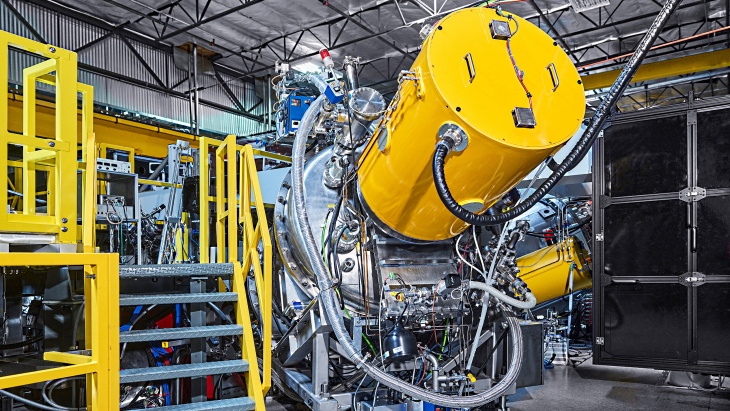
At the centre of the partnership is the new joint venture TAE Beam UK – a collaborative entity that will harness the partners’ collective scientific leadership, commercialisation experience and market innovation to develop this highly versatile advanced particle accelerator technology, beginning with neutral beams for fusion. The venture aims to design, develop, and ultimately manufacture and service neutral beams for a wide range of fusion approaches, as well as adapt the accelerator technology for state-of-the-art cancer therapeutics, and other applications like food safety and homeland security.
TAE’s approach to fusion combines advanced accelerator and plasma physics, and uses abundant, non-radioactive hydrogen-boron (p-B11) as a fuel source. The proprietary magnetic beam-driven field-reversed configuration (FRC) technology injects high-energy hydrogen atoms into the plasma to make the system more stable and better confined. This solution is compact and energy efficient, California-based TAE says.
For a fusion machine to produce electricity, it must keep plasma steadily confined at fusion-relevant conditions. On TAE’s current fusion machine, eight powerful neutral beams are placed at precise angles to meet those requirements. Inside each neutral beam canister, protons are accelerated and then combined with electrons to create a stream of neutral, high-energy hydrogen atoms (the ‘neutral beam’). Because the particles have no charge, they can bypass the fusion reactor’s magnetic field to provide heating, current drive and plasma stability. TAE is the first to use neutral beams for both FRC plasma formation and high-quality plasma sustainment – resulting in a streamlined design that is smaller, more efficient and more cost-effective.
The same accelerator technology that produced TAE’s sophisticated neutral beam system for fusion has also been adapted for TAE’s medical technology subsidiary, TAE Life Sciences, to provide a non-invasive, targeted treatment for complex and often inoperable cancers.
The new TAE Beam UK joint venture will operate out of UKAEA’s Culham Campus, in Oxfordshire, UK. UKAEA – which carries out fusion energy research on behalf of the UK government – plans to make an equity investment of GBP5.6 million (USD7.4 million) in this new venture, including engaging some of the world’s best scientists to work on this critical fusion technology and leverage expertise built up over decades of operating JET. TAE Beam UK is supported by TAE’s own nine-figure investment in the technology due to TAE’s own usage requirements over the next several years. The project aims to deliver the first short-pulse beams within 18-24 months of the start of work. The transaction remains subject to customary regulatory approvals.
“The UK has long been at the forefront of fusion innovation, and we’re proud to deepen our partnership with UKAEA,” said TAE Technologies CEO Michl Binderbauer. “The UK’s world-class scientific talent and unwavering commitment to commercialising fusion energy make the country an ideal partner as we scale neutral beam technology from lab to market. Together, we’re building critical infrastructure for the fusion supply chain and ensuring that the US-UK partnership can together remain central to the fusion economy of the future.”
UKAEA CEO Tim Bestwick added: “UKAEA is very much looking forward to working in partnership with TAE Technologies on developing neutral beams and commercialising this exciting technology, bringing jobs and growth to the UK. They have shown the way as a global leader in applying fusion technologies to other markets, and TAE Beam UK will join TAE Life Sciences and TAE Power Solutions as great examples of this innovation in action.”