“This marks the first fusion-energy PPA ever signed in Japan, representing a concrete step forward in the real-world adoption of fusion energy and signaling growing demand-side engagement in the emerging fusion energy value chain,” Helical said.
Founded in October 2021, Helical is building on research conducted by the National Institute for Fusion Science on the Helical Stellarator design. It aims to achieve “the world’s first practical power generation using fusion energy” through the Helix Programme, which aims to commercialise fusion energy using Japan’s unique “helical fusion reactor”. The programme aims to complete individual demonstrations of the two major development elements – the high-temperature superconducting magnet and the blanket/divertor – by the mid-2020s. In the 2030s, the programme plans to conduct integrated demonstrations using the final demonstration device, the Helix HARUKA, and achieve the world’s first practical fusion power generation device, the Helix KANATA.
A stellarator fusion reactor is different to a tokamak fusion reactor such as the Joint European Torus in the UK or the ITER device under construction in France. A tokamak is based on a uniform toroid shape, whereas a stellarator twists that shape in a figure-8. This gets round the problems tokamaks face when magnetic coils confining the plasma are necessarily less dense on the outside of the toroidal ring.
The Helix Programme defines three essential requirements for commercially viable fusion power: steady-state operation, net electricity output, and regular, efficient component maintenance. The Helical Stellarator is uniquely capable of meeting all three criteria with existing technologies, the company said.
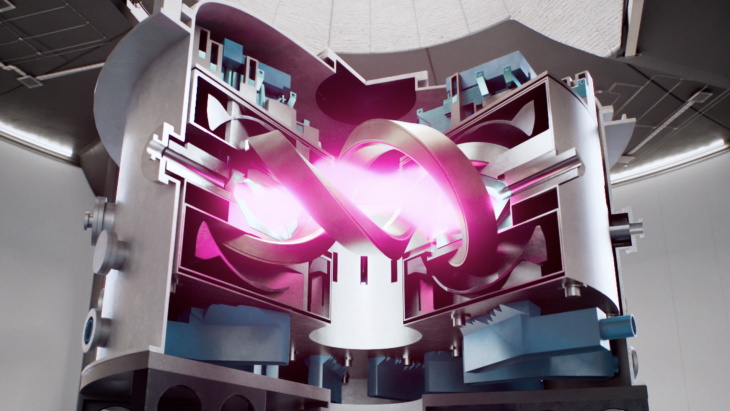
Helical Fusion’s planned first power generation plant, Helix KANATA (Image: Helical Fusion)
“Helical Fusion’s approach is grounded in over 60 years of Japanese national fusion research, enabling the company to outline a credible technical pathway to continuous, net-electricity operation,” the company said.
“The newly signed PPA demonstrates that this development plan has been concretely evaluated by a real electricity consumer: Aoki Super, which requires large amounts of electricity every day to operate its store networks,” Helical said. “Both companies share the view that fusion energy can underpin environmentally responsible retail operations that support everyday life. The agreement is also an important milestone for the Helix Programme, whose distinctive strength lies in mobilising Japan’s entire industrial value chain – from advanced manufacturing to end-users – to accelerate the realisation of fusion energy.”
To date, Helical Fusion has raised JPY5.2 billion (USD 34 million) in equity funding, bringing its cumulative fundraising – including grants and loans – to about USD38 million.
According to Aoki Super – which operates 50 community-based supermarkets across Aichi Prefecture – the supermarket industry requires a significant amount of energy for heating, cooling, lighting, and refrigeration/freezing equipment, making high energy consumption a major challenge.
“In light of this, we invested in Helical Fusion (in July 2025), a company that aims to solve fundamental energy problems through innovative nuclear fusion technology,” the company said.