The construction of Phase I (units 1 and 2) of the Bailong plant was among approvals for 11 new reactors granted by China’s State Council in August 2024. State Power Investment Corporation (SPIC) plans to build two CAP1000 pressurised water reactors – the Chinese version of the Westinghouse AP1000 – as the first phase of the plant. An investment of about CNY40 billion (USD5.6 billion) is planned for the two units, which are expected to take 56 months to construct. Excavation of about 66,000 cubic metres of earth to form the foundation pit – which will eventually be 12.2 metres deep and cover an area of about 3000 square metres – began in late December 2024.
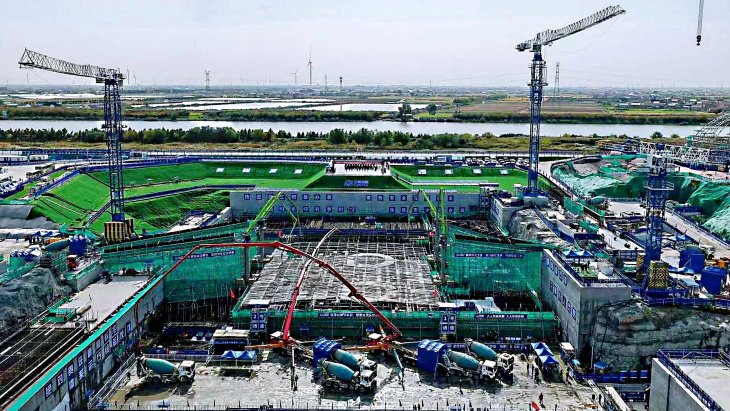
SPIC subsidiary Shanghai Nuclear Engineering Research & Design Institute (SNERDI) – joint general contractor for the project – announced it poured the first concrete on 22 December for the basemat of the nuclear island at Bailong unit 1. The company said a total of a 6,662 cubic metres of concrete was poured in a process lasting just over 64 hours.

(Image: SNERDI)
Located on Jiangshan Peninsula in Fangchenggang City, Guangxi Province, the Bailong plant is planned to have six units, with a total installed capacity of 8.62 GWe and a total investment of approximately CNY120 billion. The first phase of the project adopts the CAP1000 design, with each unit having a capacity of 1.25 million kilowatts. Four CAP1400 reactors are also proposed to be built at the site – located about 24 kilometres from the border with Vietnam and about 30 kilometres southwest of China General Nuclear’s Fangchenggang nuclear power plant – in later phases.
After the first phase of the project is completed and put into operation, it is expected to generate about 20 billion kilowatt-hours of electricity per year, which is equivalent to reducing standard coal consumption by about 6 million tonnes and carbon dioxide emissions by about 16 million tonnes per year. “It will play a positive role in optimising Guangxi’s energy structure and promoting energy conservation and emission reduction, and provide stable and reliable clean energy support for Guangxi to accelerate the construction of a national comprehensive energy security zone and serve the high-quality development of ethnic minority areas,” SPIC said.
SNERDI also poured the first concrete for the nuclear island basemat of Lufeng unit 2 on 22 December.

(Image: SNERDI)
The proposed construction of four 1250 MWe CAP1000 reactors (units 1-4) at the Lufeng site was approved by China’s National Development and Reform Commission in September 2014. However, the construction of units 1 and 2 did not receive State Council approval until August 2024. Approval for units 3 and 4 is still pending. First concrete for unit 1 was poured in February last year.
Contractor China Nuclear Construction Corporation 22 (CNI22) said about 6,635 cubic metres of concrete was expected to be poured in a process lasting about 68 hours to form the foundation of unit 2’s nuclear island, measuring about 89 metres long and 49 metres at its widest point.

(Image: SNERDI)
The Lufeng plant – located in Jieshi Town, Lufeng City, Guangdong Province – is planned to eventually have six 1,000-megawatt pressurised water reactor units.
In April 2022 the State Council approved construction of two HPR1000 (Hualong One) units at Lufeng as units 5 and 6. First concrete was poured for unit 5 on 8 September 2022 and that for unit 6 on 26 August 2023.
“Upon completion, [the plant] will further optimise the regional energy structure, alleviate power supply pressure, and provide a continuous and stable supply of clean energy for the economic development of the Greater Bay Area,” CNI22 said.