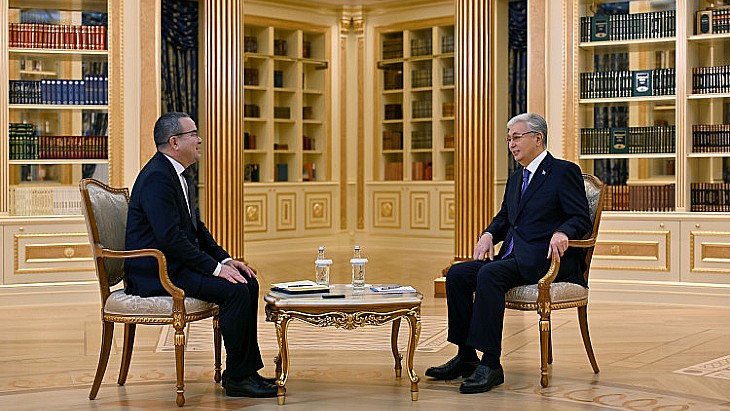
“Kazakhstan must become a digital power; it’s a matter of our shared survival as a civilised country in the new technological era. I’m convinced our people are mentally prepared for this kind of innovation,” President Kassym Jomart Tokayev said in his annual in-depth interview with the Kazakh print media on 5 January. This year, the wide-ranging interview was given to Turkistan, a long-established newspaper the president described as one of the most influential print publications in Kazakhstan.
Kazakhstan has “placed its bets on implementing artificial intelligence in the economy and public life” and has already made a “good head start” towards this, Tokayev said, with the Astana Hub innovation cluster, bringing together 2,000 companies already operational, total IT service exports in 2025 estimated at around USD1 billion, and a pilot zone for digital assets – called CryptoCity – being created, amongst other things.
The president said he has declared digital technologies and artificial intelligence a priority for Kazakhstan’s development. “This year will be a breakthrough year. I believe in the success of this exceptionally important undertaking,” he added.
But without reliable energy generation, Kazakhstan will not be able to transition to a new technological economic model: “Supercomputers, data centres, and automated industrial complexes require a great deal of energy. This is the reality of the new global technological order.
“The construction of several nuclear power plants is, on the one hand, a correction of the historical absurdity of being the world leader in uranium production without building a single nuclear power plant; on the other, it is a prestige boost for Kazakhstan. It should also be remembered that with the construction of nuclear power plants, we will train a new class of technical intelligentsia, which, in turn, will change the very essence of our state policy,” he said.
SMR cooperation
Kazakhstan is working towards the start of construction of its first nuclear power plant – named the Balkhash Nuclear Power Plant, following a competition run by the country’s Atomic Energy Agency – near the village of Ulken in the Almaty region. In June, Rosatom was selected as the leader of an international consortium to build the plant, using VVER-1200 pressurised water reactor technology. Public hearings on a second plant are under way, and the country has been broadening energy partnerships with other countries. Small modular reactors (SMRs) have also been an area of interest for the country, as highlighted at the 2024 World Nuclear Spotlight Kazakhstan event in Almaty.
On 22 December, the US Embassy and Consulate in Kazakhstan announced an expansion of the civil nuclear energy partnership between Kazakhstan and the USA to include an SMR feasibility study as well as the provision by US SMR vendors of a classroom simulator to the Kazakhstan Institute of Nuclear Physics in Almaty. Both projects are through the US Department of State’s Foundational Infrastructure for Responsible Use of Small Modular Reactor (SMR) Technology (FIRST) programme, an SMR capacity-building initiative launched in 2019. Kazakhstan has been a partner in the FIRST programme since 2022 and is the programme’s first partner in Central Asia
The simulator, from Holtec International Curtiss-Wright subsidiary WSC Inc, will be implemented by the International Science and Technology Center and will serve as a regional training hub to facilitate safe and secure SMR deployment across Central Asia, the Embassy said: “This new facility is a critical step in developing the workforce to expedite US SMR deployment with trustworthy vendors who meet the highest nuclear security, safety, and nonproliferation standards.”
The SMR feasibility study project launched by the FIRST programme, in partnership with US company Sargent & Lundy, will identify a shortlist of US SMR options suitable for deployment at potential sites in Kazakhstan.