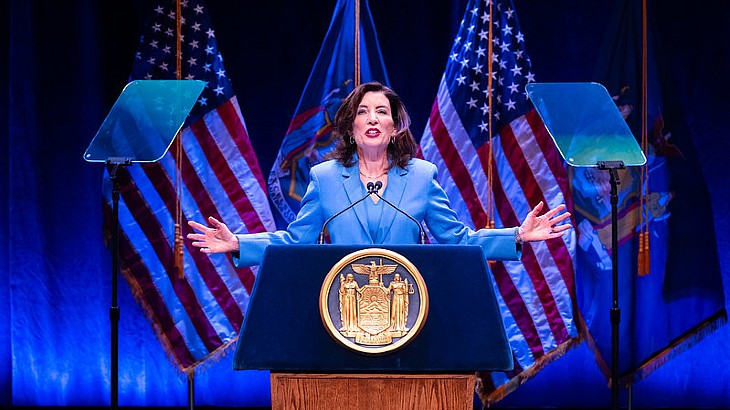
The initiative is one of more than 200 included in the newly released , which says: “As New York transitions to a zero-emission electric grid, the State must ensure reliable and cost-effective baseload power to keep homes, businesses, and critical infrastructure running at all hours. Governor Hochul will ensure that New York State leads in the race to harness safe and reliable advanced nuclear energy to power homes and businesses with zero-emissions electricity for generations to come.
“To catalyse progress towards those goals, the Governor will advance a new initiative, the Nuclear Reliability Backbone, directing State agencies to establish a clear pathway for additional advanced nuclear generation to support grid reliability. The Nuclear Reliability Backbone will be developed by a new Department of Public Service process to consider, review, and facilitate a cost-effective pathway to 4 gigawatts of new nuclear energy that will combine with existing nuclear generation and the New York Power Authority’s previously announced 1 gigawatt project, to create an 8.4 gigawatt ‘backbone’ of reliable energy for New Yorkers.
“This effort will provide firm, clean power that complements renewable energy resources and reduces reliance on fossil fuel generation. By creating a stable foundation of always-on energy, the Backbone will allow renewable resources to operate more efficiently and flexibly. Together, these actions will support a resilient, flexible, and zero-emission grid that meets New York’s growing energy needs.”
An additional initiative will be launched to develop a “skilled, in-state nuclear workforce through coordinated education and training pathways”. The NextGen Nuclear New York initiative will aim to align educational curriculums, credentials, and career pathways with industry needs, as well as supporting workforce transitions for existing energy workers and increasing public awareness of nuclear career opportunities.
In June, Hochul directed the New York Power Authority – the state’s public electric utility – to develop at least 1 GWe of advanced nuclear capacity in Upstate New York. Earlier this month, it announced it had received a “robust” response to two October 2025 Requests for Information seeking potential host communities and development partners, with 23 responses from potential developers or partners, and eight responses from Upstate New York communities.
John Carlson, Senior Northeast Regional Policy Manager at global nonprofit organisation Clean Air Task Force, said the action comes at a “pivotal moment” for New York. In December, an updated plan released by the state’s Energy Planning Board recognised a continuing role for nuclear to help the state meet its overall energy needs over the next 15 years.
“By tasking the Public Service Commission to develop the market frameworks to enable these new builds, Goveror Hochul is ensuring that ratepayer interests and affordability are at the forefront while building the clean, economical grid of the future, one that also supports workforce development, strengthens municipal tax bases, and delivers these economic benefits to local communities,” he said.
Four nuclear reactors – all operated by Constellation Energy – currently provide some 21.4% of all New York’s electricity, and 41.6% of its carbon-free electricity, according to information from the Nuclear Energy Institute.