The shipping industry consumes some 350 million tonnes of fossil fuel annually and accounts for about 3% of total worldwide carbon emissions. In July 2023, the shipping industry, via the International Maritime Organization, approved new targets for greenhouse gas emission reductions, aiming to reach net-zero emissions by, or around, 2050.
“Maritime nuclear power is a proven, advanced and safe energy source that can tackle one of the toughest challenges in the energy transition,” Lloyd’s Register said. “The next generation of advanced modular reactors will allow ships to sail for years without refuelling, with zero carbon emissions and rigorous safety built in from the start. Nuclear produces no carbon dioxide. Reactors run for years, not weeks. With no need to trade efficiency for emissions standards, ships can run at full design speed instead of slow steaming.”
Lloyd’s Register noted that more than 700 marine nuclear reactors are currently in operation in naval fleets worldwide. It says the challenge is to adapt that technology for commercial use.
“The UK has a long history of leading maritime innovation and is now in a strong position to support the safe adoption of maritime nuclear power,” it continued. “With trusted regulators, world-class engineering and shipbuilding, and decades of naval nuclear experience, it has the credibility to shape international standards from the start. From London’s capital markets to northern engineering hubs, the UK also offers a complete ecosystem to support nuclear shipping – covering design, regulation, finance and insurance.”
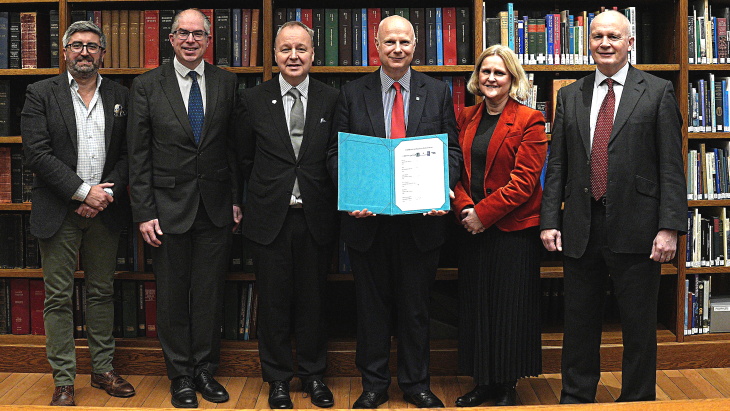
The new Maritime Nuclear Consortium – whose members include Rolls-Royce, Babcock International Group, Global Nuclear Security Partners, Stephenson Harwood, and NorthStandard – aims to help the UK lead the global race to decarbonise shipping.
“Without coordinated UK action, the chance to define the rules, create high-skilled jobs and anchor a global supply chain could be lost to faster competitors,” Lloyd’s Register said. “Acting now would give the UK first-mover advantage, and ensure those standards, jobs and supply chains are built here.”
The consortium’s first programme will: demonstrate a Statement of Design Acceptability for a generic, site-licensed advanced modular reactor; develop a class certification framework integrating nuclear and maritime regulation; define a security and safeguards architecture to meet regulatory requirements; establish insurability pathways for nuclear-powered vessels; and publish guidance for industry and government to accelerate safe adoption.
“Decarbonisation demands cleaner power, higher standards and a duty to the generations that follow,” said Lloyd’s Register CEO Nick Brown. “Nuclear is ready to meet that test. Used safely in naval fleets for decades, the next generation of advanced modular reactors brings tougher safeguards and the chance to bring nuclear power into everyday commercial shipping. If the UK leads on global standards, nuclear will mean more than zero-carbon ships. It will mean work in British shipyards, new business in the City, and lasting jobs for those who build, insure and sail the world’s fleet.”
Jake Thompson, Director, Rolls-Royce Advanced Modular Reactors, added: “Energy transition is a growing priority across multiple industries and nuclear is increasingly seen as part of the solution. We believe that the multi-sector collaboration from the Nuclear Maritime Consortium is a critical first step in the UK leading the development of the future international code for nuclear-powered vessels. Rolls-Royce is one of the world’s only nuclear reactor vendors with full lifecycle experience and end-to-end capability to credibly deliver these advanced technologies; based on proven, reliable power solutions in use across our business today.”
A report jointly published by Core Power, NorthStandard and Lloyd’s Register in February last year suggested how the UK could leverage its expertise in nuclear technology and maritime innovation to lead the global shift toward nuclear-powered shipping. The report – titled Advanced maritime nuclear: A unique opportunity for the UK – said that with the right investments and policies, the UK could develop a multi-billion-pound industry. The document proposed a policy framework for the UK government to support the deployment of advanced small nuclear reactors on commercial ships and floating nuclear power plants.