The main functions of the reactor internals are to provide support for fuel assemblies and other components in the reactor pressure vessel, and to guide the control rod drive mechanism.
China National Nuclear Corporation (CNNC) said there had been “a systematic review and meticulous planning of past project experience, all parties involved in the Liaoning Nuclear Power Joint Project scientifically organised and meticulously arranged the process, conducting a process simulation exercise covering the entire manufacturing process of reactor internals to identify and address potential risks in advance”.
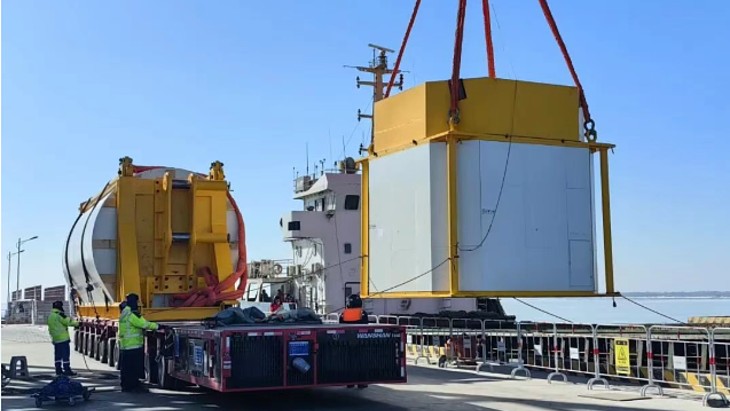
(Image: CNNC)
It said that “during implementation, the team closely monitored key aspects, actively coordinated resources, and ultimately ensured the accurate delivery of equipment, laying a solid foundation for the smooth progress of subsequent milestones and the implementation of the main installation work”.
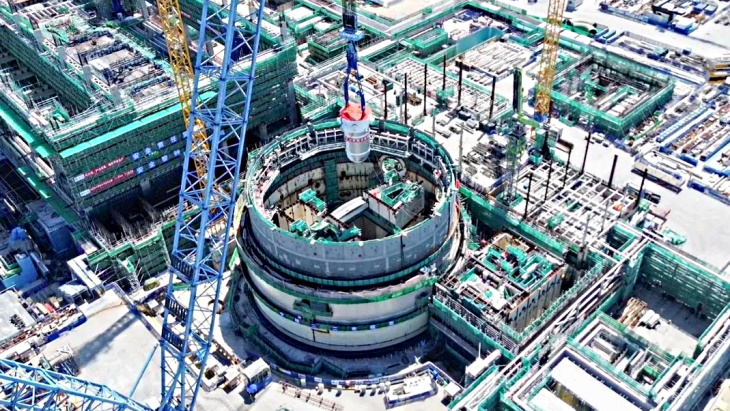
The reactor pressure vessel was installed in July (Image: CNNC)
Background
The Ministry of Ecology and Environment announced in November 2023 that the National Nuclear Safety Administration had decided to issue a construction licence for Xudabao units 1 and 2, which will both feature 1250 MWe CAP1000 reactors – the Chinese version of the Westinghouse AP1000. A ceremony was held later that month at the Xudabao site near Xingcheng City, Huludao, to mark the start of construction of unit 1.
The Xudabao project (also known as Xudapu) was originally expected to comprise six CAP1000 reactors, with units 1 and 2 in the first phase. Site preparation began in November 2010. The National Development and Reform Commission gave its approval for the project in January 2011. CNNC noted that the total investment in units 1 and 2 exceeds CNY48 billion (USD6.6 billion).
However, with a change in plans, construction of two Russian-supplied VVER-1200 reactors as Xudabao units 3 and 4 began in July 2021 and May 2022, respectively.
The Xudabao plant is owned by Liaoning Nuclear Power Company Ltd, in which CNNC holds a 70% stake with Datang International Power Generation Company holding 20% and State Development and Investment Corporation owning 10%. The general contractor is China Nuclear Power Engineering Company Ltd, a subsidiary of CNNC.
Two further CAP1000 reactors are proposed for units 5 and 6 at the Xudabao plant.