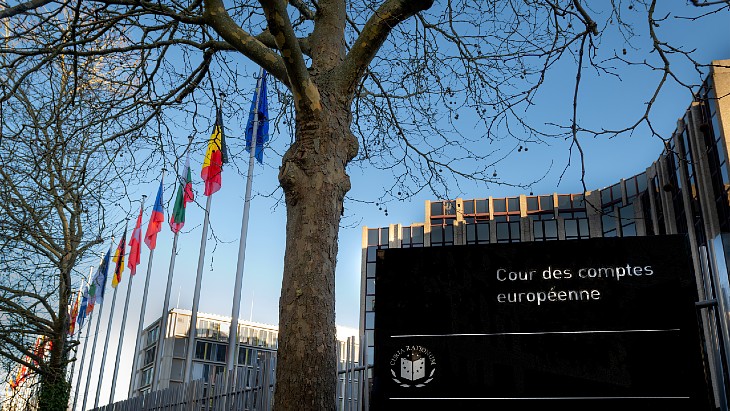
The European Court of Auditors’ (ECA’s) mission is to contribute to improving European Union (EU) financial management, promote accountability and transparency, and act as the independent guardian of the financial interests of EU citizens. Its role as the EU’s independent external auditor is to check that EU funds are correctly accounted for, are raised and spent in accordance with the relevant rules and regulations and have achieved value for money.
The EU has historically been an active promoter of international nuclear safety cooperation. EU action in the field of nuclear safety, including international cooperation, is based on the Treaty of the European Atomic Energy Community (Euratom Treaty). Euratom shares the same executive bodies and member states with the EU, while the majority of actions based on the Euratom Treaty are funded through the EU budget. The EU’s grants from the Instrument for Nuclear Safety Cooperation and loans from Euratom have supported a wide range of activities, from education and training to the provision of expertise and the supply of safety-related equipment, infrastructure and remediation work.
The ECA notes that, since 2014, the EU allocated around EUR600 million (USD697 million) in grants to partner countries for training, equipment, infrastructure, expertise and remediation, and provided a EUR300 million loan for a safety upgrade of nuclear power plants in Ukraine.
, the ECA examined whether the Commission, together with the European External Action Service where applicable, has been effective in enhancing nuclear safety in non-EU countries. More specifically, it assessed the design of the EU’s framework for international nuclear safety cooperation; the allocation of EU financial support during the 2014-2024 period; the outputs and results achieved by EU-funded actions aimed at improving nuclear safety in Armenia, Iran, Kyrgyzstan, Tajikistan, Ukraine and Uzbekistan; and the Commission’s monitoring.
“Overall, we conclude that the Commission remains an important player in international nuclear safety cooperation, having helped deliver a wide range of actions, some of which are large and complex,” the ECA said. “However, these achievements often came later and sometimes at a higher cost than initially planned. For some, long-term sustainability remains a significant challenge. The Commission’s effectiveness is also hampered by the lack of a comprehensive and up-to-date strategy, robust prioritisation of proposals, and shortcomings in the monitoring of the financed actions.”
Recommendations
The ECA proposes recommendations to address these areas, which can contribute to the on-going legislative process regarding a new Instrument for Nuclear Safety Cooperation for the 2028-2034 period.
Firstly, it says a comprehensive and up-to-date strategy would identify the areas of greatest value of EU action, and take account of initiatives by other stakeholders. In addition, it would clearly establish the goals the EU’s executive aims to achieve, the financial support it plans to use and the stakeholders that should be involved. As it stands, the ECA says, there is no strategic guidance for all tools available to the Commission, including grants and loans.
Secondly, the Commission should improve the process for selecting EU-funded actions. Although its activities responded to needs, the proposals from non-EU countries were not selected with due transparency, as there was no scoring or ranking. This makes it hard to guarantee that EU funding was allocated to where it could deliver the most value, according to the ECA. “For instance, evidence indicates that some actions in Central Asia and Iran, although they addressed certain specific nuclear safety risks, were driven primarily by broader geopolitical considerations,” it said.
Thirdly, EU-funded activities often experienced delays and, sometimes, cost overruns. This was particularly the case for large-scale construction and remediation works. While higher costs can partially be linked to their complexity, persistent funding gaps and lack of performance incentives also played a role. The long-term sustainability of some activities remains at risk, the auditors said.
Lastly, the ECA says that, in several respects, the Commission could have done more to supervise how the funded activities were run. A case in point, it says, is the EUR300 million loan to finance a large-scale programme carried out by the operator of nuclear power plants in Ukraine. The Commission chose to rely on third parties for monitoring and disbursed the loan without having assurance that the funds would exclusively finance programme-related expenses incurred and paid by the borrower.
“In nuclear safety, one thing is crystal clear: prevention is infinitely better than cure,” said Marek Opioła, the ECA Member leading the audit. “While the EU remains an important global player in nuclear safety cooperation, it should develop an all-round and up-to-date strategy to guide its cooperation and improve the selection and monitoring of EU-funded actions.”