The crude oil futures markets are still largely pricing for an early resolution to the conflict in the Middle East that results in the full re-opening of the Strait of Hormuz.
But in pricing for this outcome the market is actually making it more likely the narrow waterway that serves as a conduit for as much as 20% of the world’s oil supply will remain closed.
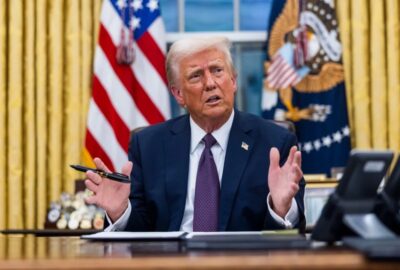
Put another way, the market is still pricing for U.S. President Donald Trump to deliver the TACO, the acronym for Trump Always Chickens Out.
Get the Latest US Focused Energy News Delivered to You! It’s FREE:
However, by keeping paper crude oil at price levels that factor in a fairly rapid return to normal flows from the Persian Gulf, it provides Trump room to keep the conflict going in the mistaken belief the global market for crude and refined products isn’t yet at a crisis point.
This is a Catch-22, the paradoxical no-win situation popularised by the 1961 novel of the same name by Joseph Heller.
Global benchmark Brent crude futures were trading around $111.81 a barrel in early Asian trade on Monday, having risen 54% since the close of $72.48 on February 27, the day before the U.S. and Israel launched an aerial campaign against Iran.
That may look like a huge gain but it’s worth noting that when Russia invaded Ukraine in February 2022, Brent spiked as high as $139.13 a barrel.
The difference between the Russian attack on Ukraine and the current conflict in the Middle East is that the Russian action didn’t result in a significant loss of supply of crude and refined products.
While European countries stopped buying Russian crude and products, the slack was taken up by China and India and the disruption was limited to a re-routing of flows and pricing.
The current situation is very different, with the loss of the vast majority of the 20 million barrels per day of crude and refined products that usually transit the Strait of Hormuz.
Even allowing for the increased flows from Saudi Arabia’s Yanbu port in the Red Sea and the United Arab Emirate’s Fujairah terminal on the Gulf of Oman, it is still likely the loss of supply of crude and refined products to the global market is at least 12 million barrels per day.
Moves by the member countries of the International Energy Agency to release stockpiles and U.S. waivers of its sanctions on Russian oil and Iranian crude on water are merely temporary bandages that do little to fix the problem.
HORMUZ IS THE ONLY GAME
The single key is the Strait of Hormuz, and the longer it remains closed to most vessel traffic the greater the strain that will be placed on global supplies.
The stress can already be seen in prices for refined products in Asia, with Singapore jet fuel hitting a record high of $225.62 a barrel on March 19, having more than doubled since the close of $93.45 on February 27.
It’s worth noting that during the price surge after Moscow’s attack on Ukraine, the highest jet fuel rose was to $173.69 a barrel, which shows physical traders at the time did not see as much of a risk to supplies as they see from the current war against Iran.
The question for the market becomes how high do crude oil futures have to rise to put unbearable pressure on Trump to actually deliver the TACO trade, rather than the current word salad of mixed messages being fed to the market.
Trump has in recent weeks swung from saying the conflict will be over soon to threatening to “obliterate” Iran’s energy facilities if the Strait of Hormuz isn’t re-opened.
Such a move, and the likely resulting Iranian attacks against energy infrastructure across the Gulf hardly sound like the de-escalation necessary to keep a lid on crude oil futures.
The problem is that de-escalation and a re-opening of the strait seem further away with each passing day.
History shows long-running and intractable conflicts are generally only resolved when one side wins a decisive military victory, which is unlikely in the present war, or when the interests in peace of most parties start to align.
Trump may want a rapid end to the conflict in order to boost the chances of his Republican Party in the November mid-term elections, but his ego will also need a victory, even if the win is only believed by his domestic political base.
Israel wants to permanently remove Iran as a threat, and seems to care little whether a severe global recession is the result of keeping the war going.
Iran’s authoritarian government, having met its initial goal of survival, may believe that keeping the conflict going for some time will boost its power to negotiate favourable terms in any settlement.
Russia is laughing all the way to the bank and probably wants the war to continue indefinitely.
China thinks it is insulated from the worst impacts given its huge crude stockpile, but the longer the conflict drags on the more likely the economic fallout will blow back on the highly trade-dependent Chinese economy.
Virtually every major Asian, African and European nation wants a rapid end to the war, fearing the economic consequences of a prolonged loss of crude supply from the Gulf, with fuel-importing nations especially at risk.
The lack of alignment means the risk of the war continuing and even worsening is real.
This means the global economy will likely have to deal with the loss of at least 10% of the supply of crude oil and refined products.
This is about how much demand dropped at the peak of the COVID pandemic in 2020, but this time the problem is supply, not demand.
The economic pain that will result from adjusting global demand down by 10 million bpd will not be evenly spread across the world, with regions like Asia and Africa likely to suffer more.
But even in wealthier countries, many governments lack the fiscal firepower to deal with an energy-led inflation spike and its accompanying economic slump.
Enjoying this column? Check out Reuters Open Interest (ROI), your essential new source for global financial commentary. ROI delivers thought-provoking, data-driven analysis of everything from swap rates to soybeans. Markets are moving faster than ever. ROI can help you keep up. Follow ROI on LinkedIn and X.
The views expressed here are those of the author, a columnist for Reuters.
Share This:
More News Articles