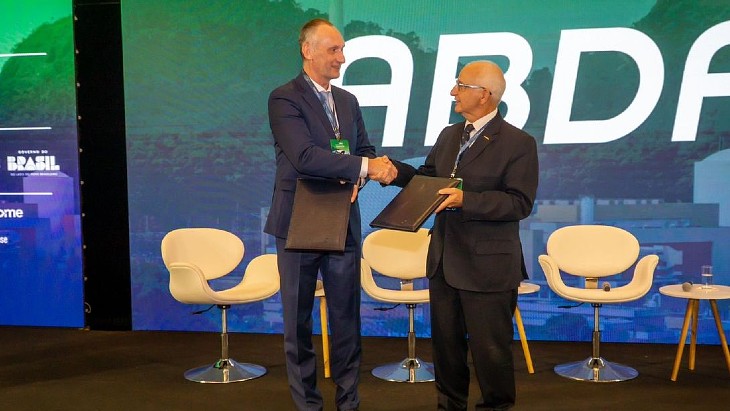
The signing ceremony for the new company, to be called Nadina Minerals, took place at the Nuclear Summit 2026 international forum in Rio de Janeiro, Brazil.
Rosatom said: “As part of their joint venture, the partners plan to obtain the necessary permits, conduct geological exploration at promising deposits, and build modern facilities for the extraction and processing of metals critical to the development of high-tech industries. The project is an important step in strengthening international cooperation and a strategic step for the development of Brazil’s national economy.”
It added that the Russian state nuclear corporation has “extensive experience collaborating with Brazil in the nuclear fuel cycle, primarily in the supply of enriched uranium for fuel production at the Angra Nuclear Power Plant, as well as services for the conversion of Brazilian uranium. The signed agreement lays the foundation for expanding this partnership”.
Based in São Paulo, privately owned Núcleo Brasil Energia Participações (NBEPar) was created in 2024 “to structure the nuclear sector of the Diamante Group, which has been operating in the area of thermoelectric power generation for six decades”. It describes its mission as “to build partnerships with public and private companies to guarantee a supply chain for nuclear power generation in Brazil”.
Brazil’s uranium plans
The Nuclear Summit 2026 featured discussion of the opportunities and potential for Brazil in terms of uranium resources and nuclear fuel production.
Reinaldo Gonzaga, director of Nuclear Fuel for Indústrias Nucleares do Brasil (INB), said that with the support of the publicly-owned holding company Empresa Brasileira de Participações em Energia Nuclear e Binacional SA (ENBPar), they were working to structure new business models with the objective of expanding national production, with input as well from the National Bank for Economic and Social Development (BNDES).
He said that developing mining, conversion and enrichment abilities was a way to reduce external dependence and add value to the uranium produced in the country. In addition to a number of international agreements relating to its critical mineral resources, Brazil has outlined its plans to return to uranium exploration and expand its nuclear fuel cycle capabilities.
A Request for Information was launched by BNDES in December for consulting firms interested in participating in the structuring of Indústrias Nucleares do Brasil’s uranium production expansion project.
Indústrias Nucleares do Brasil (INB) launched the Pró-Urânio programme in 2024 “with the aim of expanding and accelerating the exploration of new deposits, and which will involve BNDES in developing the model for partnerships with mining companies”.
Background
According to World Nuclear Association, following active exploration in the 1970s and 1980s, Brazil has reasonably assured resources of 210,000 tonnes of uranium. There has been little exploration since the mid-1980s.
The country’s three main deposits are: Pocos de Caldas in Minas Gerais state, where a uranium mine closed in 1997; Lagoa Real or Caetité in Bahia state, which has been operating since 1999; and Itataia, now called Santa Quitéria, in Ceará state, where the production of uranium as a co-product with phosphate is planned.
Uranium has been mined in Brazil since 1982, but the only operating mine is INB’s Lagoa Real/Caetité mine, with a capacity of 340 tU per year. The mine has known resources of 10,000 tU at 0.3%U.
INB commenced developing the adjacent Engenho mine in January 2017, a 200-300 tU per year open pit operation. Production was initially planned from October 2017, but did not commence.
In January 2020, the country’s energy minister reported that investment in INB would allow it to produce 150 tU annually from Caetité, starting in 2020, and expanding to 360 tU per year by 2023. The Santa Quitéria Consortium – a partnership between INB and privately owned fertiliser producer Galvani – expects to produce 2,300 tonnes of uranium concentrate annually from the Itataia deposit.
In 2022, Brazil produced 43 tU. All mined uranium is used domestically, after conversion and most enrichment abroad. The country’s uranium requirements are currently about 339 tU per year.