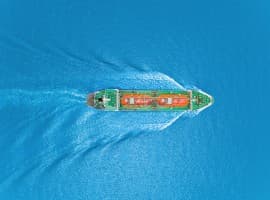
Two Chinese oil tankers carrying Iraqi and Saudi crude sped up on Thursday morning toward the exit of the Strait of Hormuz, before coming to a halt just at the entrance to the chokepoint, in a sign that Chinese vessel owners appear to be testing the terms of the supposed restart of transits.
The Cospearl Lake crude oil tanker, linked to Chinese state shipping Cosco, departed from Basrah in Iraq in early March and is openly broadcasting that it is Chinese-owned with a Chinese crew, according to data on MarineTraffic.
Another China-owned tanker, He Rong Hai, departed from Ras Tanura in Saudi Arabia on March 13, after picking up 2 million barrels of Saudi crude, the data showed. He Rong Hai is also broadcasting its Chinese ownership and crew, and like the Cospearl Lake, it was positioned at anchor at the eastbound entrance of the Strait of Hormuz on Thursday morning local time.
The Chinese vessels are among several tankers that have made maneuvers in the Persian Gulf toward potentially exiting via the Strait of Hormuz since the U.S. and Iran announced a two-week ceasefire on Tuesday night.
Despite the ceasefire, which is conditional on Iran reopening the Strait of Hormuz, there hasn’t been much change in traffic in the past 24 hours. Some vessels have been able to leave, but Iran continues to exert control, reportedly telling vessels via radio communication that they still need approval from Tehran to transit the Strait of Hormuz.
Shipowners and shipping giants appear very cautious in allowing their vessels to attempt to exit the chokepoint amid limited information on how safe the passage would be.
“Information and details available remain very limited, and we are working with urgency to obtain further clarity,” Denmark-based shipping giant Maersk said in a Wednesday advisory after the ceasefire was announced.
“The ceasefire may create transit opportunities, but it does not yet provide full maritime certainty, and we need to understand all potential conditions attached,” Maersk added.
“Any decision to transit the Strait of Hormuz will be based on continuous risk assessments, close monitoring of the security situation, and available guidance from relevant authorities and partners.”
According to maritime intelligence firm Windward, “Coordination with Iranian armed forces is still required for all transits.”
“Iran has confirmed this operates “within technical limitations” without specifying what those are, but all signs are that the Islamic Republic is seeking to retain its leverage over the waterway during ceasefire negotiations,” Windward said.
By Tsvetana Paraskova for Oilprice.com
More Top Reads From Oilprice.com
- Sanctioned Russian LNG Finds Buyers in Asia at Deep Discounts
- Goldman Cuts Oil Price Forecasts After Ceasefire Announcement
- India’s Coal Power Demand Set for 11.5% Jump in April-June