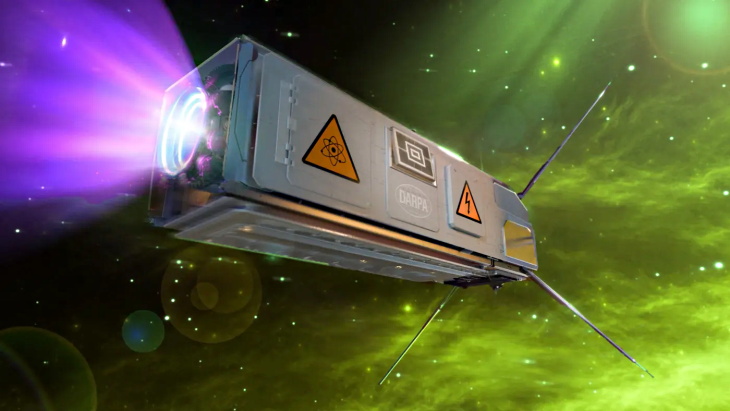
“The ultimate vision of Rads to Watts is to enable radiovoltaics that convert high-power nuclear radiation into kilowatts of electrical energy,” the Defense Advanced Research Projects Agency (DARPA) said. “Enabling the operation of radiovoltaics at higher radiation fluences (that is, number of radiation particles crossing a defined area or energy per unit area) will enable long-lived, unattended high-power sources for new operating domains that are power-starved and/or for which a logistics supply chain to replenish power sources does not exist.”
Under the 30-month contract, Avalanche will develop solid-state, micro-fabricated cells designed to convert the kinetic energy of the alpha particles from radioisotopes directly into electricity – analogous to how a solar cell converts photons into electricity. The system aims to deliver more than 10 watts per kilogram – enough to continuously power a laptop-class system for months from a device weighing only a few kilograms – while maintaining performance in the harsh radiation environment of space, where conventional electronics would rapidly degrade. Avalanche will validate the device’s operational resilience using both particle accelerators and active radioisotopes.
According to Seattle-based Avalanche Energy, the programme will mature technologies that directly support its mission to commercialise practical, portable fusion power.
“While the device being developed by Avalanche for DARPA uses radioisotopes, the underlying physics is directly relevant to Avalanche’s long-term fusion roadmap: converting energetic charged particles into electricity with high efficiency. The project will develop degradation-resilient micro-structures (micro-chips) that will first be used for radioisotope-produced alpha particles, but ultimately support direct energy conversion from the same particles produced in its fusion machines.”
Avalanche Energy has developed a device called an Orbitron, which utilises electrostatic fields to trap fusion ions in conjunction with a magnetron electron confinement scheme to overcome charge density limits. The resulting fusion burn then produces the energetic particles that generate either heat or electricity, which can power a high-efficiency propulsion system. According to the US Department of War’s Defense Innovation Unit, compared with other fusion concepts, Orbitron devices are promising for space applications as they may be scaled down in size and enable their use as both a propulsion and power source.
“The DARPA contract represents a critical milestone in our path to practical fusion power,” said Robin Langtry, co-founder and CEO of Avalanche Energy. “The direct energy conversion technologies we’re developing under Rads to Watts will be essential for extracting power from fusion reactions efficiently. We’re building the capabilities today that will enable tomorrow’s fusion systems to deliver reliable, portable energy for defence, space, and commercial applications.”