By
Key Takeaways
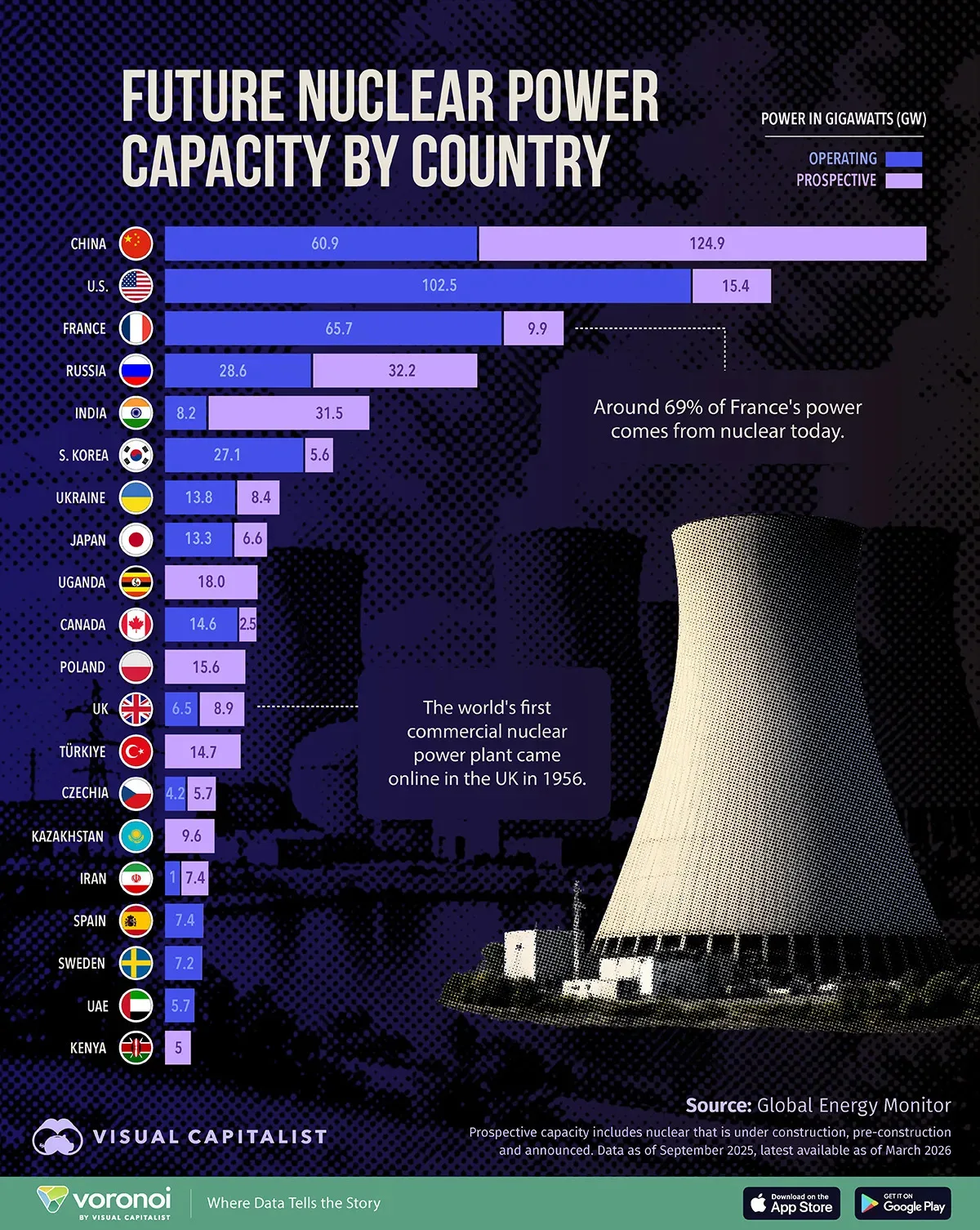
- China is on track to more than double U.S. nuclear capacity, reaching nearly 186 GW.
- The U.S. leads today but ranks second when planned projects are included.
- Emerging players like India and Uganda are rapidly scaling nuclear capacity from near zero.
Based on existing and planned projects, its total capacity could reach nearly 186 gigawatts, far surpassing the U.S., which currently leads globally. This shift reflects a broader push to secure reliable, low-carbon energy as electricity demand rises.
Get the Latest US Focused Energy News Delivered to You! It’s FREE:
This chart ranks countries by current and prospective nuclear capacity, using data from .
How Nuclear Energy Is Set to Scale by Country
The U.S. currently leads nuclear energy production with a capacity of 102,475 megawatts, exceeding France by more than 35,000 MW.
China ranks third today at 60,898 MW, but that is set to change as new plants come online.
Dive into the data, which includes sites of any capacity as of September 2025, below:
Based on existing and planned projects, its total capacity could reach nearly 186 gigawatts, far surpassing the U.S., which currently leads globally. This shift reflects a broader push to secure reliable, low-carbon energy as electricity demand rises.
This chart ranks countries by current and prospective nuclear capacity, using data from .
How Nuclear Energy Is Set to Scale by Country
The U.S. currently leads nuclear energy production with a capacity of 102,475 megawatts, exceeding France by more than 35,000 MW.
China ranks third today at 60,898 MW, but that is set to change as new plants come online.
Dive into the data, which includes sites of any capacity as of September 2025, below:
This shift has major geopolitical implications. Countries that expand nuclear capacity can reduce reliance on imported fossil fuels while strengthening energy security and grid stability.
If all planned projects are completed, China will lead with 185,812 MW, followed by the U.S. at 117,910 MW and France at 75,590 MW.
France remains a historic leader in nuclear energy, with around 69% of its electricity generated from the technology.
The UK was home to the world’s first commercial nuclear power plant, which came online in 1956, but later scaled back its use of nuclear. The government is now aiming for a “golden age of nuclear,” though current commitments totaling 15,394 MW would rank the country just 12th globally.
Of the 17 countries with zero installed capacity today, Uganda is set to scale up the most to 18,000 MW, followed by Poland with 15,612 MW and Türkiye with 14,700 MW.
Betting on Nuclear Fusion and Fission
Today’s nuclear expansion is centered on fission, the technology that powers all existing reactors and accounts for about . While mature, it is evolving through smaller, modular designs that aim to reduce costs, improve safety, and speed up deployment.
This helps explain why much of the prospective capacity in the chart includes not only large-scale plants, but also a growing wave of smaller reactors backed by governments and private capital.
At the same time, , the process that powers the sun, remains a long-term ambition. Despite rising investment and recent technical progress, it has yet to reach commercial scale.
For now, the global nuclear buildout is firmly rooted in fission, as countries prioritize reliable, low-carbon power that can be deployed within the next decade.
Share This:
More News Articles