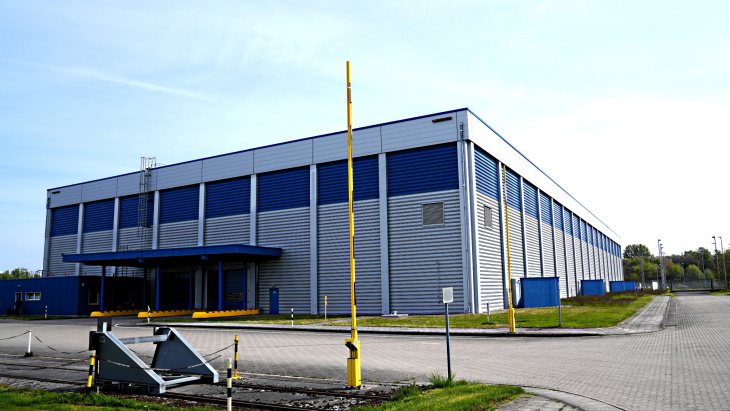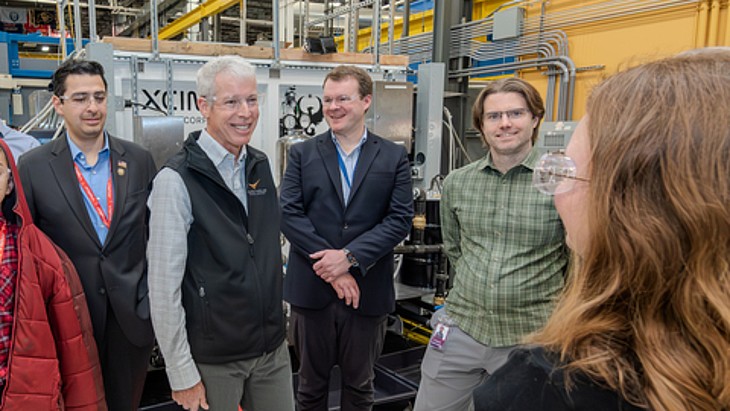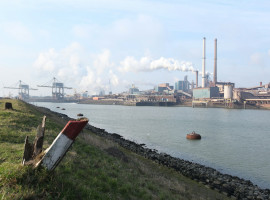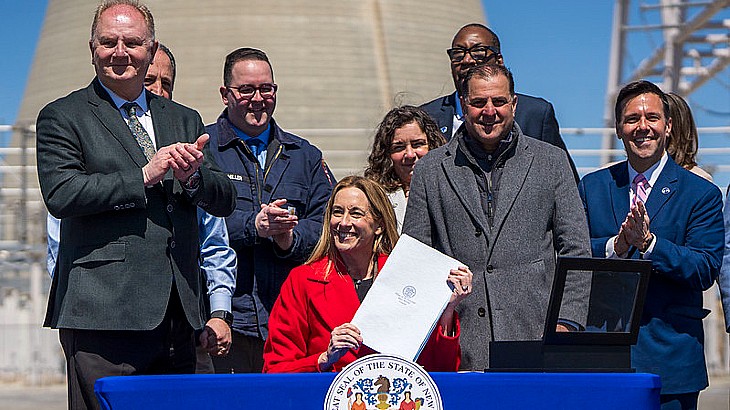
New Jersey Governor Mikie Sherrill signed the legislation to remove the permitting hurdle that has created a de facto moratorium and announced the launch of the state’s new Nuclear Task Force after a tour of PSEG’s Salem nuclear power plant.
“For costs to come down, we need more energy supply. New Jersey is well-positioned to be a leader in next-generation nuclear energy to help bring that supply, and we are open for business,” Sherrill said. “By lifting outdated barriers and bringing together leaders across government, industry, and labour, we’re setting the stage for our state to pursue new advanced nuclear power. This will help New Jersey secure a stronger, cleaner, more affordable, and reliable energy future – while keeping the state at the forefront of innovation, job creation, and economic growth.”
A nuclear moratorium is a state-imposed ban or restriction on building new nuclear capacity, but how this looks varies from state to state: for example, a state might set conditions related to legislative approvals, voter consent, or waste disposal requirements before construction can begin. , eight US states – California, Hawaii, Maine, Massachusetts, Minnesota, Oregon, Rhode Island and Vermont – have long-standing nuclear moratoriums. Connecticut has partially lifted its moratorium, and while New York conditionally lifted its moratorium many years ago a specific moratorium remains in parts of Long Island.
New Jersey’s Coastal Area Facility Review Act blocks new permits for the construction and operation of new nuclear energy facilities by requiring an approved method by the Nuclear Regulatory Commission (NRC) for radioactive waste disposal, which New Jersey says is an outdated standard that cannot be met. The new legislation – S3870/A4528 – resolves the issue by allowing the commissioner of New Jersey’s Department of Environmental Protection to approve permits that are “based on safe, NRC-compliant waste storage”, removing the de facto moratorium and clearing the path for new nuclear energy development.
The newly formed Nuclear Task Force, co-chaired by Elizabeth Noll, Senior Strategist for Energy at the Office of the Governor, and Christine Guhl-Sadovy, President of the New Jersey Board of Public Utilities, will be organised across five focus areas – Financing, Supply Chains and Technology Development, Workforce Growth and Training, Regulatory and Permitting Framework, and Public Trust and Confidence – with the goal of ensuring that New Jersey is “ready to capture the benefits of new nuclear power, while maintaining the highest standards of public safety and transparency.”
Two nuclear power plants – the two-unit Salem and the single-unit Hope Creek, all owned by PSEG – currently provide around 42% of New Jersey’s electricity.
Kentucky incentives
Legislation signed by Governor Andy Beshear on 8 April establishes the Kentucky Nuclear Energy Development Authority and, under it, the Nuclear Reactor Site Readiness Pilot Program “to facilitate the application for and procurement of early site permits, construction permits, or combined operating licences from the NRC for the siting of new nuclear energy generating facilities”.
Beshear said Senate Bill 57 would potentially lead to lower utility rates for Kentuckians over the long term. “Every step makes a difference when it comes to helping our people save their hard-earned dollars,” he said.
Kentucky does not currently have any nuclear generation capacity.
Texas funding
Texas has issued a request for applications for USD350 million of funding appropriated to the Texas Advanced Nuclear Development Fund (TANDF). Applications are being accepted for the TANDF’s Advanced Nuclear Construction Reimbursement Program and Project Design and Supply Chain Reimbursement Program.
The fund is under the Texas Advanced Nuclear Energy Office (TANEO), which was established by the Texas legislature to provide strategic leadership for the advanced nuclear industry and associated supply chain industries in Texas and to promote the development of advanced nuclear reactors in the state, amongst other things.
Eligible applicants must be businesses, nonprofit organisations, and governmental entities, including institutions of higher education “that have – or reasonably expect to have – a docketed construction permit or licence application for the project at the NRC on or before 1 December 2026”. Applications are due by mid-May.