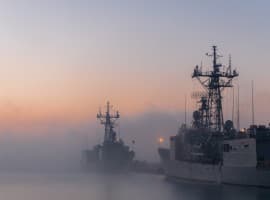
The U.S. blockade of the Strait of Hormuz appears to have passed its first real test, with the U.S. successfully turning back all vessels that attempted to break through.
Shipping data on Wednesday showed the Rich Starry, a Chinese-owned medium-range tanker, re-entering the Strait of Hormuz after briefly exiting the Gulf a day earlier. This was the first real test of the U.S. blockade announced by President Trump following the collapse of U.S.-Iran peace talks over the weekend.
U.S. Central Command claimed that it had “completely halted economic trade going into and out of Iran by sea”, adding that no vessels had made it past the blockade and six ships had complied with orders to turn back toward Iranian ports.
A U.S. destroyer intercepted two oil tankers attempting to leave Iran’s Chabahar port, while another sanctioned vessel, the VLCC Alicia, capable of carrying up to 2 million barrels of crude, was entering the Gulf on Wednesday en route to Iraq, highlighting the continued complexity of regional flows.
Tracking data also shows multiple vessels hesitating at or near the Strait of Hormuz amid uncertainty over enforcement rules. Several ships that had recently called at Iranian ports have been unable to progress beyond the mouth of the Gulf.
Before the outbreak of the U.S.-Iran war in late February, around 130 vessels transited the Strait daily. Traffic has since slowed to a trickle, and ships must now navigate both U.S. naval oversight and Iranian directives. For Iran, those directives include routing requirements along Iran’s coastline and transit fees reportedly reaching as high as $2 million per voyage.
China has called the U.S. action “irresponsible and dangerous,” warning of tightening energy markets, but oil prices dropped dramatically on Tuesday on hopes that the U.S. and Iran would return to the negotiating table.
Traders are currently balancing an ever-tightening oil market against hopes that a peace deal might be agreed and the Strait reopened in the coming days. In the meantime, oil markets are sure to experience yet more volatility.
By Josh Owens for Oilprice.com
More Top Reads From Oilprice.com
- Oil Traders Bet on Diplomacy Even as Physical Supply Tightens
- EU Considers Lower Energy Taxes as Hormuz Crisis Drives Costs Higher
- BP Joins Shell and TotalEnergies in Namibia’s Offshore Rush