© Hyundai Motor Company
Hyundai Motor Company could supply 400 hydrogen fuel buses to Seoul transport operators as the South Korean city looks to phase out compressed natural gas (CNG)-powered vehicles.
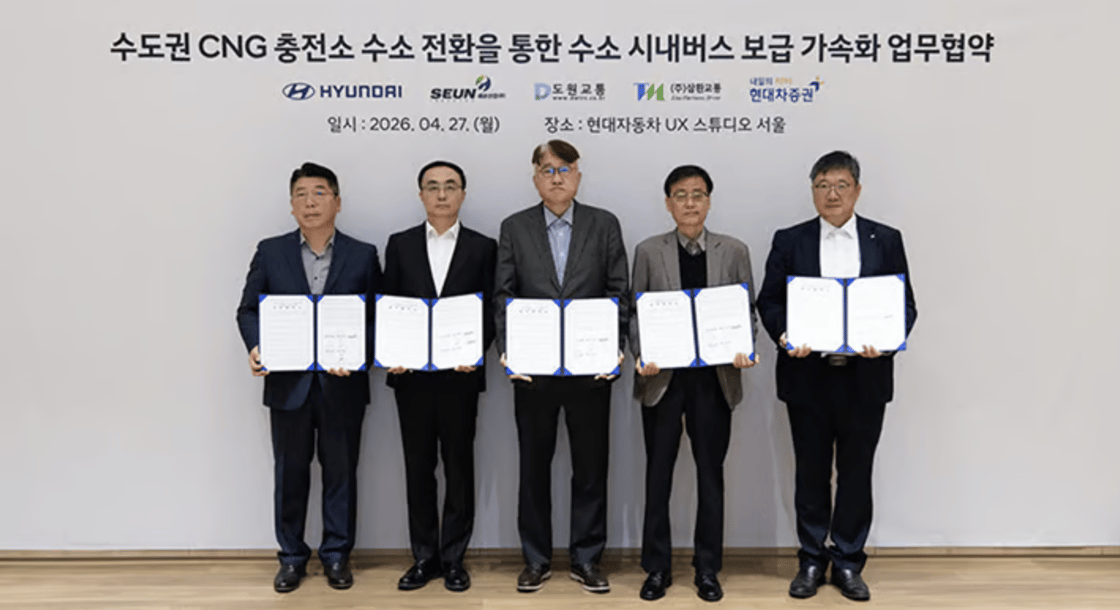
The auto major will supply its Elec City hydrogen fuel cell buses to operators Dowan Transportation and Samhwan Transportation, under a memorandum of understanding (MOU) aimed at introducing 400 hydrogen buses within five years.
This would represent around 5% of Seoul’s total bus fleet.
These new buses would replace the operators’ CNG buses and help expand hydrogen bus operations.
To support the plans, electric vehicle charging operator Seun Industry will help convert existing CNG refuelling stations to dispense hydrogen.
Seoul operates a comprehensive network of CNG stations for around 7,400 buses. However, since 2018, the city has been replacing those fleets with zero-emission vehicles like battery-electric or hydrogen fuel cell buses.
The city aims for the transition to be largely complete by 2028.
Hyundai’s financing arm is expected to advise and provide investment support for the plans.
A Hyundai official said the agreement provided a “practical solution” to accelerate hydrogen bus adoption.
The carmaker, which has invested heavily in hydrogen technologies, said its buses can travel over 750km on one tank of fuel and were “suitable” for city bus routes with “high power consumption rates.”
However, Seoul’s transition is currently led by battery-electric buses, with hydrogen deployment still limited.
Despite South Korea being one of the most supportive regions for hydrogen mobility, fuel cell vehicles make up just a small subset of Seoul’s large bus fleet.
Hydrogen buses in Seoul can receive subsidies of around $200,000 per vehicle, roughly double that of battery-electric, in addition to incentives for fuel.