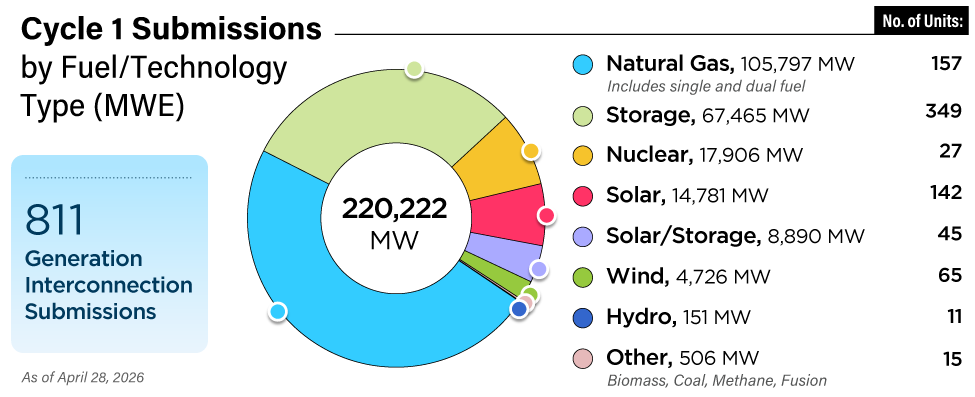
PJM Interconnection’s first interconnection “cycle” under its revamped, clustered review process has attracted 811 new generation projects representing roughly 220 GW of nameplate capacity. The effort now moves to a validation phase, under which the grid operator will confirm that applicants have met baseline technical and financial requirements—including site control and readiness commitments—before advancing qualified projects into clustered system impact studies.
In its , PJM said the Cycle 1 intake was led by 349 standalone storage projects and 157 natural gas plants, with 142 solar projects, 65 wind projects, 45 solar‑plus‑storage hybrids, 27 nuclear units, 15 “other” resources, and 11 hydro projects. On a capacity basis, that represents 105.8 GW of gas power, 66.5 GW of storage, 17.9 GW of nuclear, 14.8 GW of solar, 8.9 GW of solar‑storage hybrids, 4.7 GW of wind, about 150 MW of hydro, and 500 MW of “other” capacity, which PJM said includes biomass, coal, methane, and, for the first time, fusion projects.
Unlike the serial, first‑come approach PJM has used for decades—which allowed large volumes of speculative projects to accumulate and slowed studies for years—this first Cycle intake represents the initial application window under a reformed interconnection process launched in July 2023 to speed reviews and prioritize projects most likely to get built. Projects in the Cycle will be evaluated under a first‑ready, first‑served framework designed to screen for readiness early and prevent unviable megawatts from clogging the queue, PJM has said. But perhaps more significantly, “with the start of this Cycle, all generation seeking to connect to the PJM grid is now being processed,” it said.
“PJM and our stakeholders have created a process that gets as many projects approved as quickly and safely as possible,” Interim President and CEO David Mills said in announcing the results. “These numbers represent significant interest from developers resulting from strong market signals, and our reformed process is designed to prioritize viable projects that can move to construction and operations with greater speed and certainty.”
A Stacked Queue, By Design
For PJM Interconnection, Cycle 1 marks the first real‑world test of a reform package it began rolling out in July 2023 to clear a congested interconnection queue and focus staff time on projects most likely to get built.
Part of the market operator’s challenge stems from soaring load growth. “Between 2024 and 2030, PJM expects electricity demand to increase by more than 30 GW, driven largely by data centers,” it noted on Wednesday. “Demand growth is outpacing the addition of new supply, risking reliability and making the timely interconnection of new resources critical to keeping the lights on for 67 million people in 13 states and the District of Columbia.”
PJM says that since 2020 it has processed more than 300 GW of proposed generation through its interconnection studies, producing about 103 GW of signed interconnection agreements. “Many of these projects, however, are either not being built at all or are being slowed by hurdles such as state permitting and supply chain backlogs,” it said.
A notes that PJM processed roughly 140 GW of “transition” projects after shifting to the first‑ready, first‑served framework, cutting the remaining queue to about 63 GW scheduled to be completed in 2025–2026 and setting expectations that new projects will move through studies in roughly one to two years.
“PJM is working with stakeholders in the public and private sectors to help projects get built once they clear PJM’s process and to manage the reliable integration of data centers while new generation resources are being developed. Projects will be reviewed in the Cycle in what is designed to be a one‑ to two‑year process, depending on the impact of an individual project,” it said on Wednesday.
The results have been encouraging. The volume of applications “reflects strong developer interest and growing electricity demand across the PJM region, driven by data centers, advanced manufacturing, and broader electrification trends,” the grid operator noted.
“We are encouraged by the diversity of generation types that are seeking to join the PJM generation fleet,” said Mills. “That includes first‑time innovative technologies such as small nuclear reactors and fusion, more storage projects than any other technology, a resurgence in natural gas and continued strong participation by renewables and hybrids. This is good news because we need all the generation we can get.”
The next stage is validation, which will require PJM to confirm which projects have submitted the required technical and financial information to move forward. Once validation is complete, Cycle 1 will move onto a tight, three‑phase study clock that runs into 2028.
PJM’s Cycle 1 timeline shows a 91‑day application‑review period running from April 28 through July 27, 2026, followed by model posting on June 26 and the start of Phase I studies on July 28. Phase I—a 120‑day cluster assessment focused on high‑level system impacts and indicative upgrade needs—runs through Nov. 24, with a first “decision point” at the end of November where developers either post additional security and stay in the cluster or withdraw before costs and commitments escalate.
Projects that remain in the cluster will then enter Phase II, a 180‑day detailed system impact analysis now slated from Jan. 28 through July 26, 2027, with a second decision point at the end of July. Phase III, an 181‑day facilities‑level study window, is scheduled to run from Aug. 26, 2027, through Feb. 22, 2028, before a final decision point in February.
AI in the Queue
To keep Cycle 1 moving on its compressed timeline, PJM said it is leaning on HyperQ, an AI‑enabled document‑review and interconnection “intelligence” platform developed by Google’s grid software spin‑out Tapestry. In its April 29 announcement, PJM said HyperQ is already being used on Cycle 1 applications, where it is “identifying and helping to assess sections of documents for further review,” and that it expects the tool to reduce study times as the Cycle progresses.
Tapestry has described that ingests large volumes of interconnection data, rapidly parses complex application materials and surfaces issues for planners rather than acting as a chatbot. A key goal is to “free” engineers from “combing through thousands of pages looking for evidence. It’s our hope that the tool may also help establish a fully consistent standard for application readiness across reviewers, without requiring them to undergo intensive training or cross‑check with others.”
PJM is “using Tapestry’s HyperQ tool to help process a deluge of applications from energy developers,” in a LinkedIn post after the Cycle 1 window closed. She called interconnection “a complex, often misunderstood challenge” in which one of the first steps is validating “site control” information, a task that has historically required experts to be “manually hunting through thousands of pages of disparate—and dense—legal documents and property records” to confirm that developers hold enforceable rights to build on proposed sites. HyperQ, she said, uses “agentic AI and machine learning” to “rapidly parse complex documentation to verify site control data across a massive volume of inputs,” with the aim of automating data‑heavy checks so that “PJM’s staff [can] focus their time on high‑value technical analysis”—a “real‑world example of how AI can help address today’s grid planning challenges.”
The Cycle 1 deployment builds on a multiyear collaboration PJM announced in April 2025, as POWER reported in , under which Google and Tapestry agreed to develop AI‑enhanced tools to “intelligently manage and optimize” PJM’s generation interconnection process and “significantly cut processing times for reviewing new interconnection applications,” including by unifying dozens of planning databases into a single model. PJM has not yet released quantitative data on how much time HyperQ is saving in Cycle 1, but says it will evaluate the tool’s impact as the studies progress.
—Sonal C. Patel is a POWER senior editor (, ).