In conventional reactors, active safety measures such as water spray systems, which require pumps and valves, provide cooling in the event of an emergency. They dissipate heat and keep the pressure in the containment vessel under control. However, these systems depend on a reliable power supply. If that fails, their function can be impaired.
A key feature of many small modular reactors (SMRs) is their safety concept: instead of relying on active systems that require external energy, they use passive cooling. Physical effects such as condensation, gravity, and density differences can keep the reactor safe in an emergency.
Up to now, however, the simulation of such complex cooling processes has required experimental data that have so far been limited, according to the Paul Scherrer Institute (PSI). A new study at the institute now provides important contributions to help close this gap. At the institute’s PANDA test facility, researchers have for the first time investigated passive cooling systems for SMRs under realistic conditions. The experiments, carried out with scientific support from cooperation partners in more than ten countries, provide high-resolution measurement data that can be used to validate such systems in simulations. The results have been published in the journal .
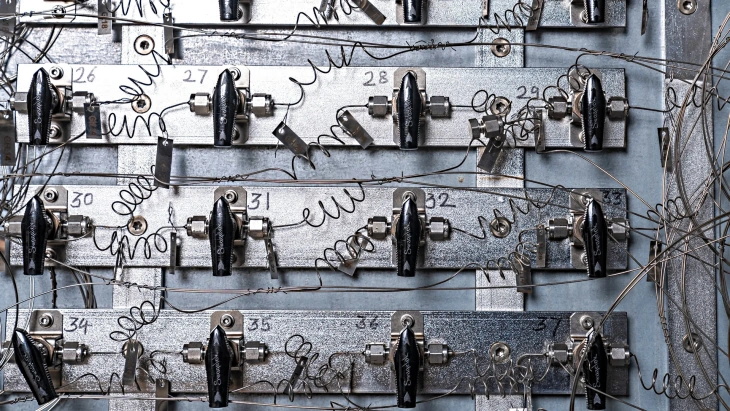
The PANDA test facility extends over five floors, reaching a height of 25 metres. It consists of several containers, with a total volume of about 500 cubic metres, in which processes that occur in nuclear reactors can be realistically simulated. PANDA contains no radioactive material. The steam, which reaches temperatures of up to 200 degrees Celsius and pressures as high as 10 bar, is generated by an electric heater with a power output of 1.5 MW. At more than 80 different points, gas mixtures from different areas of the facility can be extracted and analysed with a mass spectrometer.
A project team at the Paul Scherrer Institute tested a closed cooling circuit. This consists of a vertical pipe, approximately six metres high, through which cold water flows. If steam were to escape into the containment vessel during an incident, it would strike the cold surface of the pipe, condense there, and drip back into the reactor as liquid water. The heat released in this process is transferred to the water inside the pipe. Because warm water is less dense than cold water, it naturally rises and releases its heat to a water reservoir. The cooled water then flows back down. This creates a natural cycle based solely on the density difference between warmer and colder water – entirely without pumps or electricity.
Although previous experiments had already shown that such systems work, the PSI team has presented, for the first time, highly detailed measurement data showing precisely how the physical processes inside a system on the scale of a nuclear power plant would unfold. Using high-speed cameras, the researchers even documented in detail tiny droplets of water that condense on the surface of the pipe. For the first time, the researchers were able to observe how gases inside the containment vessel separate: more air collects in the lower section, while more steam remains at the top. This finding is important for both reactor design and computer simulations. If this effect were not taken into account, the system would be less effective at dissipating heat.
Furthermore, the researchers tracked tiny particles in the gas and demonstrated that it moves very slowly near the pipe. In this area, therefore, condensation is determined not by larger currents, but primarily by diffusion: the water vapour reaches the surface of the pipe only slowly and condenses there. This means that the cooling process is highly dependent on local conditions.
Many SMR design concepts can be replicated in this experimental facility, the Paul Scherrer Institute noted. There are roughly 1,450 sensors ready to provide valuable data.
“Until now, researchers developing simulations couldn’t be certain that their calculations matched reality,” said Yago Rivera Durán from the PSI Centre for Nuclear Engineering and Sciences. “We’re closing the gap with PANDA.”
This will make data crucial for safety assessments and the licencing of future reactors available for the first time, the institute said.
“The latest publication marks the launch of an international benchmarking initiative based on PANDA data,” PSI said. “Twenty-five institutions are already participating in this global collaboration, using the experimental results to verify and improve their simulation methods. A follow-up project, PANDA-2, will build on this work and focus even more intensely on complex scenarios as well as the long-term autonomous operation of passive safety systems. This international project is currently expected to run until 2030, while national and EU projects are already planned well into the 2030s.”