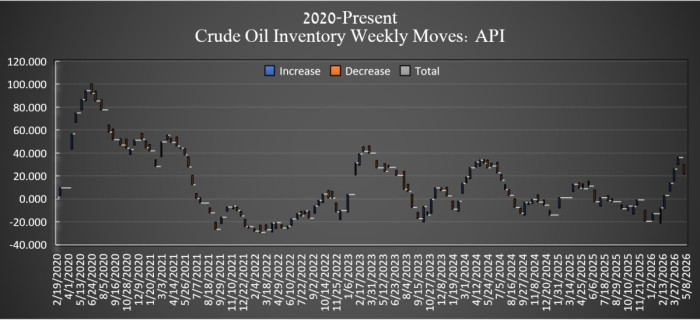
The American Petroleum Institute (API) estimated that crude oil inventories in the United States fell by 2.188 million barrels in the week ending May 8. In the week prior, US crude oil inventories fell by 8.1 million barrels.
Analysts had expected a 1.65 million-barrel draw for the current reporting period.
US crude inventories are up 35 million barrels so far this year, according to API data.
Inventories in the US Strategic Petroleum Reserve (SPR) continue to draw down in an attempt to alleviate the pressure on prices. For week ending May 8, 8.6 million barrels left the SPR, bringing the new total to 384.1 million barrels—the lowest level since October 2024 and 341 million barrels shy of maximum capacity.
US production declined slightly to 13.573 million bpd for the week ending May 1, down from 13.586 million bpd in the week prior, according to the latest EIA data, but up 206,000 bpd from a year earlier.
At 4:28 pm ET on Tuesday, moments before data release, Brent crude was trading up on the day at $108.10 (+3.72%). This is also down $1.80 week over week. WTI was also trading up on the day, by $3.89 per barrel (+3.97%) at $102, down roughly $0.40 per barrel week over week.
Gasoline inventories saw a surprise build this week of 502,000 barrels in the week ending May 8. In the week prior, gasoline inventories fell by 6.1 million barrels. As of last week, gasoline inventories were already 4% below the five-year average for this time of year, according to the latest EIA data.
Distillate inventories fell by a modest 319,000 barrels, after shedding 4.6 million barrels in the week prior. Distillate inventories were already 11% below the five-year average as of the week ending May 1, the latest EIA data shows.
Cushing inventory—the inventory kept at the delivery hub for the WTI Crude futures contract—were unavailable at the time of writing.
By Julianne Geiger for Oilprice.com
More Top Reads From Oilprice.com
- Morgan Stanley: Oil Buffers Could Run Out Before Hormuz Reopens
- Japan Receives First Central Asian Crude Since Iran War Began
- Australia’s Biggest Untapped Gas Field Just Got a Lot More Expensive