Oil Prices Fall After Trump Pauses Planned Iran Strike

Oil prices dropped in early Asian trade on Tuesday after President Trump said he had paused a planned military strike on Iran to allow negotiations to continue.

At the time of writing, Brent front-month futures were trading at $109.70 per barrel, down 2.11%, while West Texas Intermediate front-month futures were changing hands at $102.80, down 1.55%.

The decline comes after oil prices surged on Monday due to drone strikes on the UAE and Saudi Arabia after the Trump-Xi summit had failed to produce any breakthrough on reopening the Strait of Hormuz.

In a social media post on Monday afternoon, Trump claimed that the planned attacks on Iran had been postponed at the request of the leaders of Saudi Arabia, Qatar, and the UAE. He then went on to suggest that “serious negotiations are now taking place”, although it remains to be seen if his comments will result in any tangible development. The announcement came with its usual threat, with Trump adding that a full-scale attack could still be carried out at a “moment’s notice”.
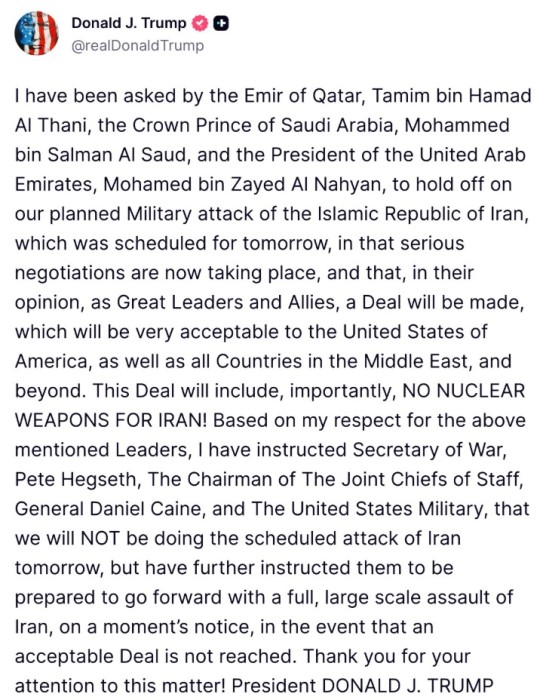
Trump social media post on Iran

Iran’s Foreign Ministry confirmed on Monday that Tehran had communicated its position to Washington through Pakistan, although there are limited details on how negotiations are progressing.

Adding to downward pressure on oil prices, the U.S. Treasury secretary extended a sanctions waiver that allows certain countries to continue purchasing Russian seaborne oil for another 30 days.

While the latest pullback reflects the market’s ongoing hopes for de-escalation, prices will continue to trend higher unless more oil is able to pass through the Strait of Hormuz in the coming weeks.

By Josh Owens for Oilprice.com

More Top Reads From Oilprice.com


  • Related Posts

    Can Middle East Oil Producers Meaningfully Bypass the Strait?

    Can Middle East oil producers meaningfully bypass the Strait of Hormuz? According to Chris Newton, a Senior Early Warning Analyst at the International Crisis Group, “some of them can”. “In…

    Grid Bottlenecks Could Slow Southeast Asia’s Power Demand Surge  

    Data centers, electric vehicles (EVs), and green industrial clusters are expected to lead to about 100 terawatt-hours (TWh) of incremental power demand in Southeast Asia by 2030, but slower grid…

    Have You Seen?

    DATA CENTER INSIGHT – The New Infrastructure Race in North America and Why Communities Don’t Want Them

    • May 19, 2026
    DATA CENTER INSIGHT – The New Infrastructure Race in North America and Why Communities Don’t Want Them

    NextEra CEO Says He Feels ‘Very Good’ About Dominion Offshore Wind Project

    • May 19, 2026
    NextEra CEO Says He Feels ‘Very Good’ About Dominion Offshore Wind Project

    BP Fails to Reach Deal with Union as Indiana Refinery Lockout Drags On

    • May 19, 2026
    BP Fails to Reach Deal with Union as Indiana Refinery Lockout Drags On

    SOL Group expands home care footprint with UK and Brazil deals

    • May 19, 2026
    SOL Group expands home care footprint with UK and Brazil deals

    Air Liquide to invest €20m in Oberhausen syngas plant expansion

    • May 19, 2026
    Air Liquide to invest €20m in Oberhausen syngas plant expansion

    Hyundai advances waste-to-hydrogen project in Hong Kong

    • May 19, 2026
    Hyundai advances waste-to-hydrogen project in Hong Kong

    Green hydrogen developers can’t remove all risk – but can reduce uncertainty: Shell

    • May 19, 2026
    Green hydrogen developers can’t remove all risk –  but can reduce uncertainty: Shell

    Can Middle East Oil Producers Meaningfully Bypass the Strait?

    • May 19, 2026
    Can Middle East Oil Producers Meaningfully Bypass the Strait?

    K Line signs FjordH2 hydrogen shipping agreement

    • May 19, 2026
    K Line signs FjordH2 hydrogen shipping agreement

    European electrolysers can beat China on LCOH if demand emerges, says Nucera boss

    • May 19, 2026
    European electrolysers can beat China on LCOH if demand emerges, says Nucera boss