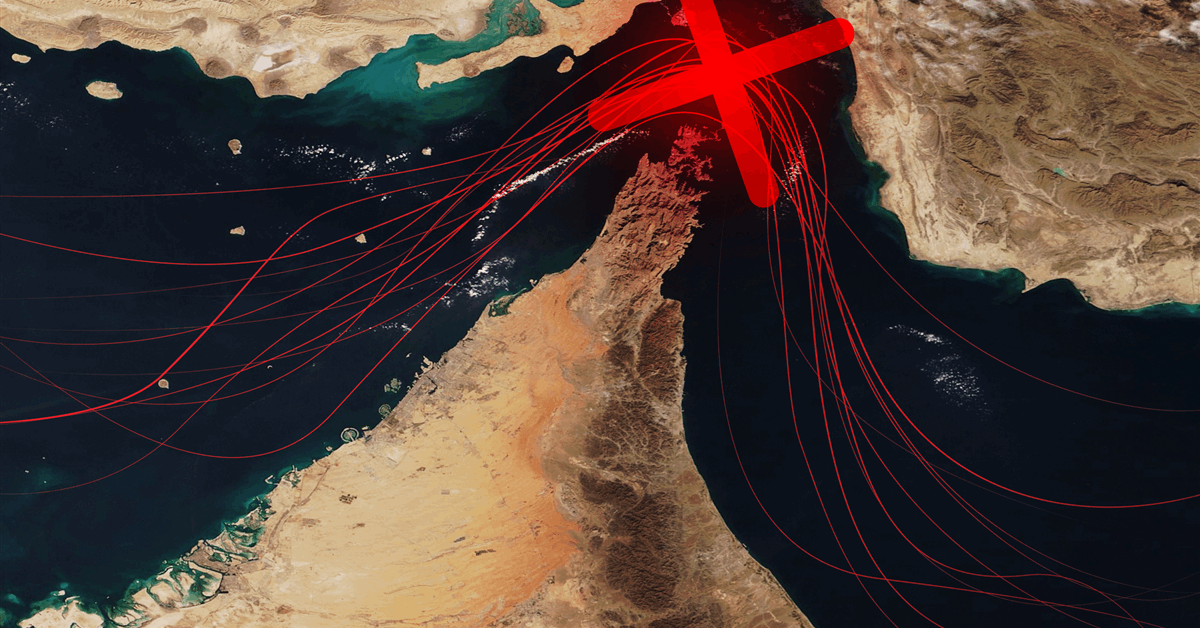
Can Middle East oil producers meaningfully bypass the Strait of Hormuz?
According to Chris Newton, a Senior Early Warning Analyst at the International Crisis Group, “some of them can”.
“In theory, three alternative pipelines across Saudi Arabia, the United Arab Emirates (UAE), and Iraq are capable of accommodating approximately half of what typically crossed through Hormuz (albeit at elevated prices),” Newton told Rigzone.
He warned, however, that these too are vulnerable to attack, blocked sea lanes, and domestic politics.
Newton highlighted that Saudi Arabia’s East-West pipeline can carry up to seven million barrels per day across the kingdom to the Red Sea port of Yanbu. From here, up to five million barrels per day can be made available for export, he pointed out.
“Though the pipeline is buried, the production facilities feeding it, the pumping stations along it, and the terminal facilities at its end could all be targeted,” he warned.
“Indeed, a pumping station was struck by Iran just after the start of the 8 (Gulf time) or 7 (U.S. time) April ceasefire, briefly knocking out some 700,000 barrels per day of throughput,” he added.
“Riyadh’s main customers are also in east Asia, meaning Red Sea cargoes mostly head south and would therefore fall within range of the Iran-backed Houthis, which could choose to attack commercial shipping should the conflict escalate,” he continued.
“Some traffic could also be rerouted north to the Suez Canal and the Sumed pipeline, but this would be unlikely to accommodate the full volume of the east-west pipeline,” he said.
Newton went on to highlight that the Habshan-Fujairah pipeline connects UAE production facilities to its Fujairah port just east of Hormuz. He pointed out that this allows up to 1.5 million barrels per day to bypass the strait.
“The port is within range of Iran’s weapons, however, and Iran has attacked it repeatedly during the war – most recently when the U.S. briefly tried to open its own corridor through the strait,” he said.
“Additionally, the Kirkuk-Ceyhan pipeline runs from Iraq to Turkiye but it too has been operating well-below its official capacity of 1.6 million barrels per day,” he noted.
Newton told Rigzone that other Middle East producers like Kuwait lack a bypass and have been hit much harder by the closure of the strait. He went on to note that Iran lacks oil pipelines and has instead repeatedly attempted to use deceptive shipping practices to run the U.S. blockade.
“This worked a bit in the first week of the blockade and then tapered off for oil, though some other cargoes like LPG have slipped through,” he said.
Rigzone contacted the White House and the Iranian Foreign Ministry for comment on Newton’s statement. The White House directed Rigzone to the U.S. Department of War (DOW), which Rigzone also contacted for comment on Newton’s statement. At the time of writing, the Iranian Foreign Ministry and the DOW have not responded to Rigzone.
Newton went on to tell Rigzone that “Iran’s capacity to export oil to China by rail is unclear”.
“Iran is having challenges with export by rail to China though it’s still happening in part because of the geopolitical utility,” he added.
The Senior Early Warning Analyst highlighted to Rigzone that, in addition to the pipelines outlined above, shipping oil out of the region via trucks is possible but usually not economical at the distances required.
Delving deeper into the use of the Red Sea as an alternative export route to the Strait of Hormuz, in particular the safety of the passage, Newton told Rigzone that this varies by the ship and the states and private sector actors involved.
“Russia and China have had little trouble [transiting the Red Sea], while may others still avoid that route,” he said.
“Traffic remains suppressed even though the Houthis stopped attacking commercial shipping in late 2025. Some companies are more averse than others, and some types of ships have avoided the Red Sea more than others (bulk carriers are using the route more than say, VLGCs),” he added.
“It is still possible that the Houthis begin attacking commercial shipping, and that risk has been enough to keep ship transits down compared to before October 2023 for now,” Newton warned.
Dalia Salem, Senior Research Analyst of Middle East Upstream at Wood Mackenzie, told Rigzone that Saudi Arabia and the UAE are the only two countries that can meaningfully bypass Hormuz but highlighted that, for both countries, the volumes that can be exported via the alternative routes are smaller, “limiting their export capacity compared to pre-conflict”.
Salem noted that Iraq is also able to export some volumes via the Kurdistan section of the Iraq-Turkey pipeline but noted that volumes are minimal.
The Wood Mackenzie analyst outlined that the export capacity of the East-West Petroline, which Salem pointed out enables the export of crude through Yanbu on the Red Sea, “is at ~five million barrels per day”. At the ADCOP pipeline in the UAE, which Salem highlighted enables the export of onshore crude through Fujairah, export capacity “is at ~1.8 million barrels per day”, Salem outlined.
Looking at Iraq, Salem pointed out that the Kurdistan section of the Iraq-Turkey pipeline typically exports crude from Kurdistan and said a March agreement allowed up to 250,000 barrels per day of Federal Iraq crude to be exported via the pipeline. Salem outlined, however, that recent volumes have been smaller.
Salem also stated that trucking via Syria could add 150,000 barrels per day and that trucking via Turkey could add 40,000 barrels per day. The renewal of an Iraq-Jordan export agreement, which was suspended since February, could also contribute 10,000 barrels per day, according to Salem.
Looking more closely at the Red Sea, Salem told Rigzone that, so far, it has remained a viable export route but warned that security risks remain, “particularly around transit through the Bab al-Mandeb Strait, where geopolitical tensions could pose potential disruptions”.
To contact the author, email