Holtec’s Enterprise Unit Director Rafael Marin said: “Through this agreement, Holtec and the Rwanda Atomic Energy Board will work together to deploy SMR-300 units in Rwanda, with a potential total capacity of up to approximately 5 GW, supporting the country’s strategy to deploy reliable baseload power without carbon emissions which will serve as an engine for long-term economic growth in the nation. Holtec is proud to help navigate Rwanda transition to a nuclear power generator and to help position the country as a pioneer in the field of SMR (small modular reactor) deployment in Africa.”
Jacob Helberg, US Under Secretary of State for Economic Affairs, said: “We look forward to working with Rwanda and Holtec to bring this transformative SMR project to fruition, ensuring that American nuclear leadership continues to light the way forward for nations seeking to achieve their energy security and economic development goals.”
The conference also saw the signing of a memorandum of understanding between the USA and Rwanda, which the US embassy in Rwanda said “marks an important step toward strengthening cooperation on civil nuclear energy and expanding opportunities for collaboration in support of reliable and secure energy development. The United States and Rwanda are committed to promoting the highest standards of nuclear safety, security and non-proliferation as the two countries advance this partnership”.
Nuclear Energy Innovation Summit for Africa
The conference, taking place in Kigali, was opened by Rwanda’s President Paul Kagame, who said: “For Africa, energy is not simply a development issue. It is the foundation of industrial growth, and competitiveness. At the centre of this endeavour is the question of investment. Too often, investors hesitate because they perceive many risks in Africa. We must work to strengthen regulation, ensure consistency and accountability, in order to build confidence and attract long-term capital.
“Nuclear energy is increasingly recognised as part of the clean energy transition and that creates new opportunities. What Africa cannot afford is fragmentation. If countries work in isolation, progress will be slow and far more costly. Cooperation on regulation, financing, and regional power integration is essential. This is precisely why NEISA matters. We are moving the conversation beyond ambition to practical coordination, and financing mechanisms that can sustain deployment at scale. Rwanda will continue supporting these efforts, because this is larger than any one country.”
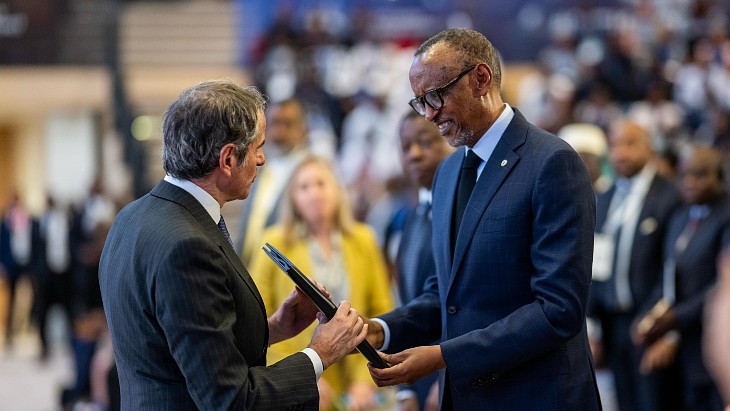
(Image: Rwanda Atomic Energy Board/X)
Director General of the International Atomic Energy Agency (IAEA) Rafael Mariano Grossi delivered the agency’s Integrated Nuclear Infrastructure Review (INIR) Phase 1 report during the first day (see picture above). The report, the Rwanda Atomic Energy Board said: “Affirms Rwanda’s readiness to advance to Phase 2 of its nuclear power programme development, reflecting continued commitment to building the infrastructure, regulatory capacity, human capital, and partnerships needed to deploy nuclear energy in support of long-term energy security, industrial growth, and sustainable socio-economic transformation.”
Grossi, posting on the social media site X, said the IAEA and Rwanda had also signed an agreement which was an “important step forward for Rwanda’s nuclear energy plans … to strengthen cooperation on integrating nuclear energy into Rwanda’s energy mix, including SMRs. The agreement covers support on energy planning, infrastructure development, training, stakeholder engagement, financing and capacity building.” He added: “Rwanda can count on the IAEA as it moves forward with its nuclear energy programme.”
Grossi added that, “for years, finance was a red line separating Africa from the benefits of nuclear energy. Today, that wall is coming down as nuclear projects become bankable and the doors of international financing open up”.
The Rwanda Atomic Energy Board reported Paula Ingabire, Minister of ICT and Innovation, as saying that: “As we think about industrial off-takers, whether it’s the mines, smelters, data centres, what lenders are looking for is predictability. They’re looking for 24/7 credit-worthy baseload demand. The natural anchors for that are going to be sectors where you know that a simple power outage is going to cost billions of dollars in revenues lost. That’s why even for Rwanda, as we announced that in the next decade, we should be able to have an SMR, we have already started thinking about those off-takers as a government and making sure that those are going to be ready when these facilities up and running.”
Background
Rwanda has been developing plans to adopt nuclear energy for a number of years, with President Kagame saying at the Nuclear Energy Conference in Paris in March that it plans to have its first small modular reactor operational in the early-2030s.
He said at that conference: “Nuclear energy is not too complex or risky for developing countries. The standards developed by the IAEA provide a universal framework that can be applied by countries at every income level … nuclear technology is evolving in ways that benefit countries with small grids, allowing Africa to be among the early adopters. Small modular reactors in particular are especially suited to Africa’s requirements.”
Holtec has been developing its SMR unit since 2011. The SMR-300 is a pressurised water reactor producing about 300 MW of electrical power or 1050 MW of thermal power for process applications. It plans to deploy two SMR-300 reactors – named Pioneer 1 and 2 – at the Palisades Nuclear Generating Station site in Michigan, demonstrating viability for additional orders both domestically and abroad.