The Construction Permit Application was submitted on 31 March by The Grainger College of Engineering at the University of Illinois Urbana-Champaign, NANO Nuclear Energy Inc’s partner for the KRONOS MMR deployment at the University of Illinois.
The NRC has now announced it has formally accepted the application after determining it contains sufficient information for the regulator to begin its formal safety, environmental, and technical review process.
“NRC technical staff have begun a rigorous evaluation of the proposed reactor’s safety and environmental impacts,” the NRC said. “Within days, the agency will also publish a Federal Register notice opening a 30-day window for members of the public and nearby communities to request a formal legal hearing on the application.”
“Acceptance of the Construction Permit Application for review confirms that the NRC has determined the submission contains the information necessary to begin detailed technical evaluation,” said Florent Heidet, Chief Technical Officer at NANO Nuclear. “Advancing to this stage reflects years of engineering, regulatory engagement, and disciplined execution, as well as the substantial work required to support formal review of an advanced reactor design.”
Caleb Brooks, Professor and Donald Biggar Willett Faculty Scholar of Nuclear, Plasma and Radiological Engineering at the U of I’s Grainger College of Engineering, said: “The NRC’s acceptance of our Construction Permit Application marks a significant step forward for the Illinois Microreactor Demonstration Project and for the future of advanced nuclear energy in the United States. At Grainger Engineering, we believe universities play a vital role in accelerating innovation, developing the next generation workforce, and demonstrating technologies that can address critical energy and national needs. We look forward to continuing our work with NANO Nuclear and our engagement with the NRC throughout the review process as we work to further position U of I as a leader in future advanced energy technologies.”
NANO Nuclear said it estimates the NRC formal review will be completed in 2027, “providing the opportunity for the company to begin nuclear construction activities at the U of I in the second half of 2027”.
NANO Nuclear acquired the Micro Modular Reactor Energy System technology through its USD85 million acquisition of Ultra Safe Nuclear Corporation’s nuclear technology, which was completed in January last year. At that time, NANO Nuclear renamed the technology as the KRONOS MMR. The MMR is a 45 MW thermal, 15 MW electrical high-temperature gas-cooled reactor, using TRISO fuel in prismatic graphite blocks and has a sealed transportable core.
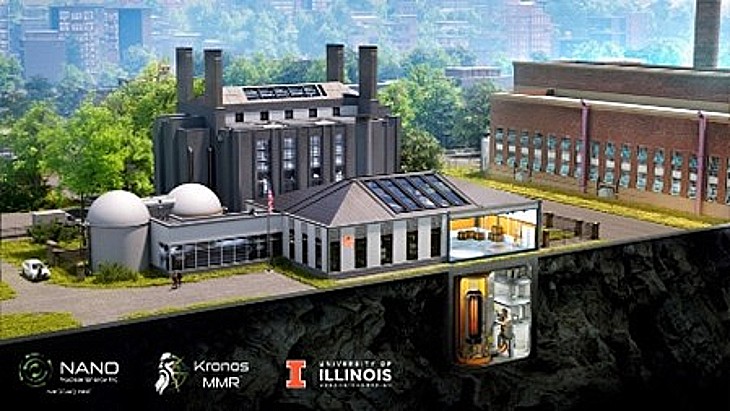
NANO Nuclear signed a strategic collaboration agreement with the University of Illinois Urbana-Champaign in April 2025 to construct the first research KRONOS micro modular reactor on the university’s campus. The agreement formally established the University of Illinois Urbana-Champaign as a partner in the licensing, siting, public engagement, and research operation of the KRONOS MMR, while also identifying the university campus as the permanent site for the reactor as a research and demonstration installation.
The university plans to re-power partially its coal-fired Abbott power station with the KRONOS MMR, providing a zero-carbon demonstration of district heat and power to campus buildings as part of its green campus initiative. The project team aims to demonstrate how microreactor systems integrate with existing fossil fuel infrastructure to accelerate the decarbonisation of existing power-generation facilities.