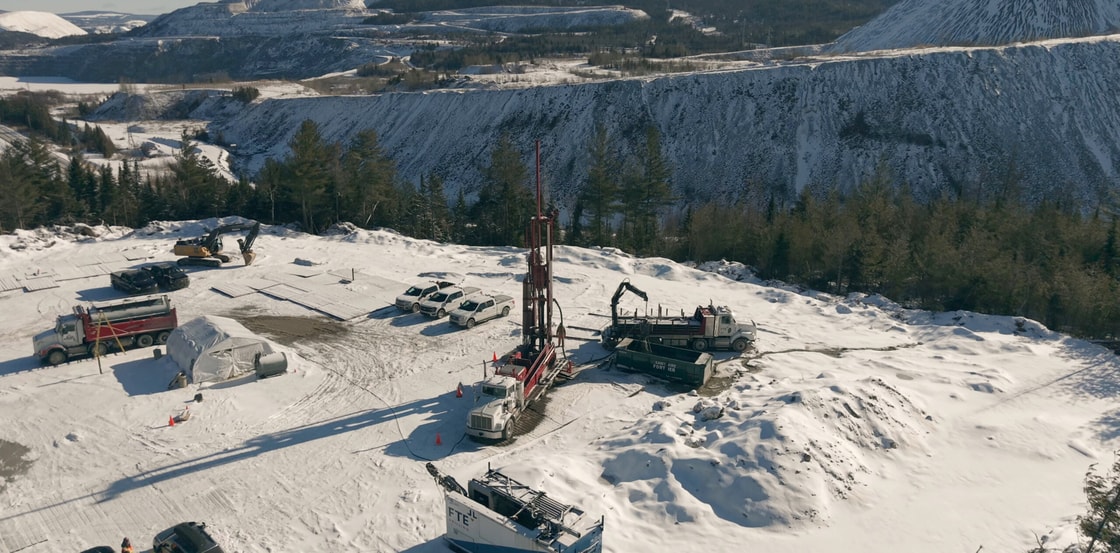
Vema’s Quebec field trials © Vema Hydrogen
Subsurface hydrogen start-up Vema Hydrogen could launch a joint venture with a Canadian mineral exploration firm to produce hydrogen alongside nickel and cobalt mining in Newfoundland.
The California-based firm signed a letter of intent to jointly develop an “engineered mineral hydrogen” (EMH) project at First Atlantic Nickel & Cobalt’s Pipestone XL critical mineral exploration development in central Newfoundland.
Vema’s EMH process injects water into iron-bearing subsurface rocks to trigger hydrogen-producing reactions, like those that drive naturally occurring geologic hydrogen generation.
The Pipestone XL project covers a 30km iron-rich rock belt. Over the past year, Vema and First Atlantic evaluated the site’s geology and geophysics to confirm hydrogen production through serpentinization.
“Given the link between awaruite formation and hydrogen, we’re excited about the potential for Vema’s technology to maximise the value of our unique nickel-cobalt alloy project,” said First Atlantic CEO Adrian Smith.
While a timeline for the development was not revealed, Vema CEO Pierre Levin said the Pipestone project could allow the firm to expand across North America.
“With validated rock sample and permitting in place, we have a clear path to advance EMH at Pipestone and to expand the model across North America,” he said.
Expected hydrogen production volumes were also not announced.
It comes after Vema for its technology in Quebec in February to validate the process, which it claims could produce hydrogen at the well-head for less than $1/kg.
The start-up has scaled quickly. After raising $13m , Vema went on to sign non-binding offtake agreements with on-site to fuel Californian data centres. It was also recognised as a “qualified supplier” by the California hydrogen utility First Public Hydrogen Authority.