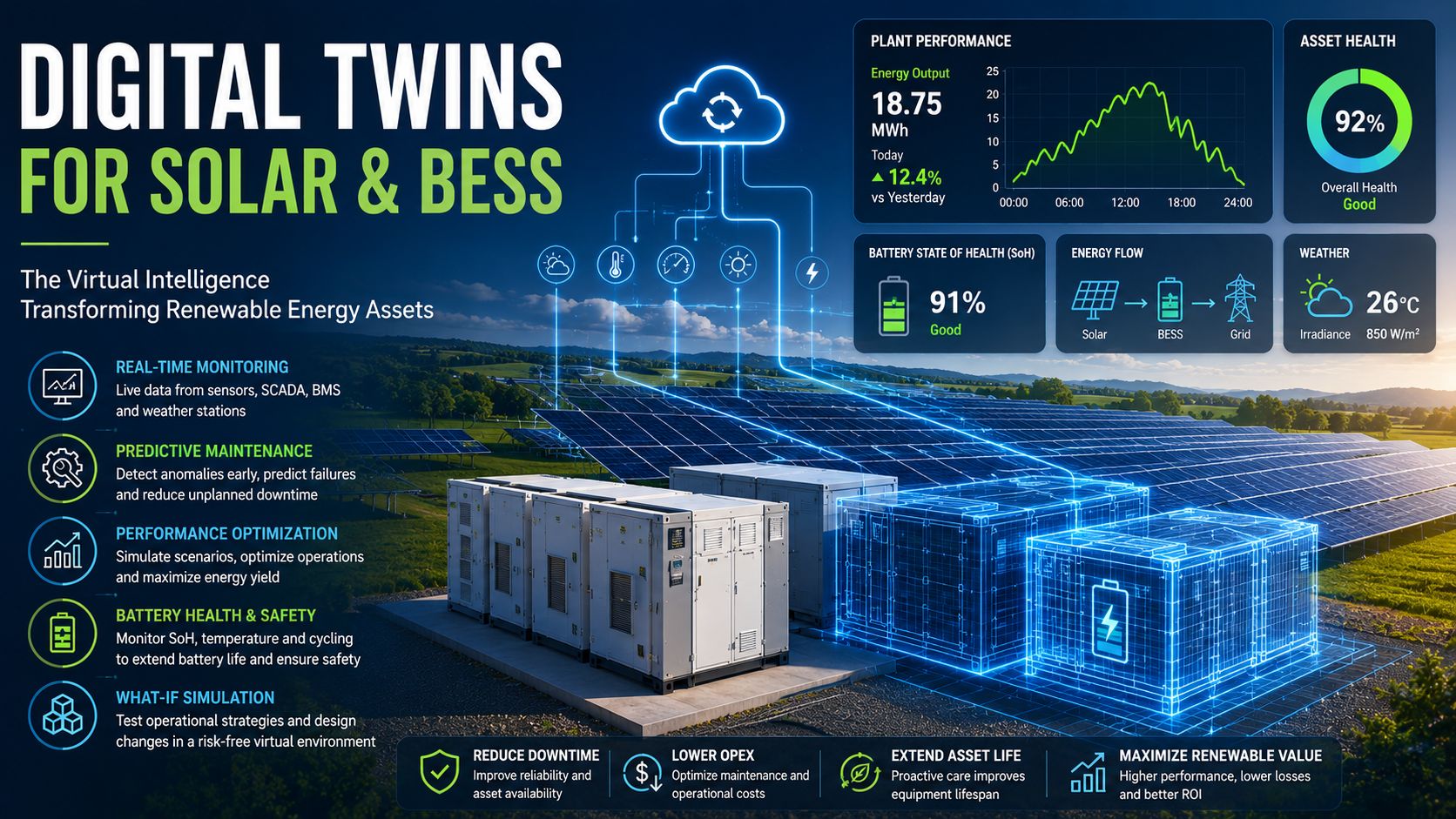
As renewable energy systems become larger, more complex, and increasingly integrated with Battery Energy Storage Systems (BESS), operators are turning to digital twins to enhance performance, reliability, and operational efficiency. A digital twin is a dynamic virtual representation of a physical asset that continuously mirrors its real-world condition using live operational data. Unlike conventional monitoring systems, it not only displays asset performance but also simulates future behaviour and supports intelligent decision-making.
In a utility-scale solar plant or BESS, a digital twin combines information from SCADA systems, inverters, weather stations, battery management systems (BMS), sensors, and historical performance records. By continuously synchronizing with real-time data, it creates a living digital model of the asset, enabling operators to visualize equipment behaviour, identify anomalies, and test operational scenarios without affecting the actual plant.
One of the most valuable applications of digital twins is predictive asset management. Rather than relying on fixed maintenance schedules, operators can detect early signs of module degradation, inverter faults, battery ageing, thermal imbalances, or equipment inefficiencies before they develop into failures. This condition-based approach minimizes downtime, lowers maintenance costs, and improves asset availability.
For Battery Energy Storage Systems, digital twins provide even greater value. By modelling battery chemistry, temperature distribution, charge-discharge cycles, and State of Health (SoH), they help optimize battery utilization, extend operational life, and improve safety by identifying conditions that may lead to thermal runaway or accelerated degradation.
Digital twins go beyond real-time monitoring by enabling “what-if” simulations. Operators can assess how weather variability, module soiling, equipment upgrades, or different battery dispatch strategies would affect energy generation and project revenues before implementing changes. When combined with Artificial Intelligence (AI) and machine learning, digital twins can automate fault detection, improve forecasting accuracy, and recommend optimal operating strategies based on continuously evolving plant conditions.
As renewable energy systems become increasingly digitalized, digital twins are evolving into a core technology for solar plants and BESS. They also support grid integration by optimizing charging schedules, reducing renewable curtailment, and improving operational flexibility. While successful deployment depends on reliable data, interoperable platforms, and strong cybersecurity, digital twins are expected to become an essential component of next-generation renewable energy infrastructure—enabling smarter, more resilient, and data-driven clean energy operations.
Subscribe to get the latest posts sent to your email.