Antares Nuclear’s Mark-0 reactor became the first to do this, reaching initial criticality in early June, closely followed by Valar Atomics’ Ward 250 reactor.
Antares’ and Valar’s reactors achieved their first criticality under the Department of Energy (DOE) Reactor Pilot Program. Deployable Energy completed the Unity criticality experiment under the Nuclear Energy Launch Pad, an initiative launched in March under the Idaho National Laboratory (INL)-based National Reactor Innovation Center to build on the Reactor Pilot Program, leveraging authorisation from the DOE – rather than the conventional US Nuclear Regulatory Commission licensing route – to expeditiously certify and construct first-of-a-kind advanced nuclear technologies for demonstration.
Unity was the first selection under the Launch Pad initiative, in April this year. Reaching the criticality milestone so soon has set a new benchmark for execution speed in the advanced nuclear sector, according to INL Laboratory Director John Wagner: “Achieving criticality in roughly 150 days is a remarkable accomplishment, and Idaho National Laboratory is proud to have provided the facilities and expertise that helped make this milestone possible,” he said.
“Having instrumental partners in the Department of Energy, INL, and our suppliers has been crucial to the success of this criticality test,” Deployable Energy co-founder and CEO Bobby Gallagher said. “This accomplishment demonstrates the dedication of our team and partners and moves us collectively one step closer to delivering reliable, resilient, and deployable nuclear energy solutions by leveraging the expertise and capabilities at INL and the existing fuel supply chain.”
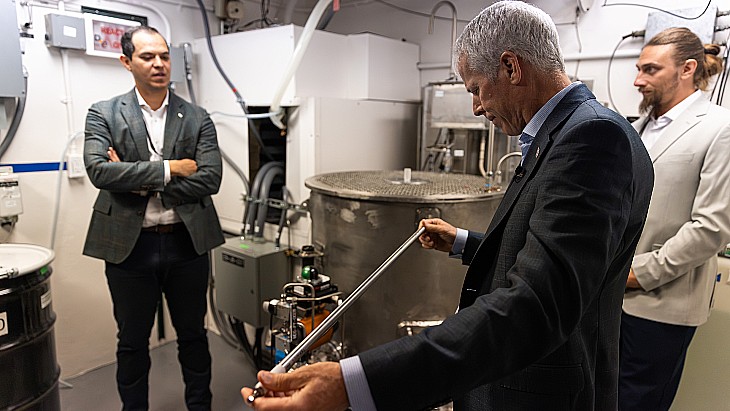
“Last week, I had the opportunity to see the Unity demonstration reactor firsthand and meet with the talented teams from Deployable Energy, INL and DOE whose work made this historic moment possible on the eve of our nation’s 250th anniversary,” Secretary of Energy Chris Wright said, describing the achievement as “a significant milestone on a timeline many thought was unachievable. Advanced nuclear technologies like Unity will help power the next generation of American industry, strengthen our energy security, and ensure the United States remains the world’s nuclear innovation leader”.
The Unity microreactor is envisaged by Deployable Energy as a compact, 1 MWe water-moderated, gas-cooled “nuclear battery” designed to provide reliable, carbon-free power where conventional energy infrastructure is unavailable, impractical, or vulnerable. It says the technology aims to support a wide range of applications, including remote communities, emergency response operations, defence missions, critical infrastructure resilience, and industrial energy needs.
Criticality is the point at which a nuclear reactor sustains a controlled, self-supporting chain reaction. Although the initial criticality was achieved with a full-scale core load, this was a zero-power criticality. Now this has been achieved, the next steps for Unity will be a phased testing programme that includes further validating reactor physics, load following, inherent safety, and full-power operations. These tests will provide additional data to verify reactor performance and support future licensing and commercialisation efforts, and to support continued system validation, performance optimisation, and future deployment planning.