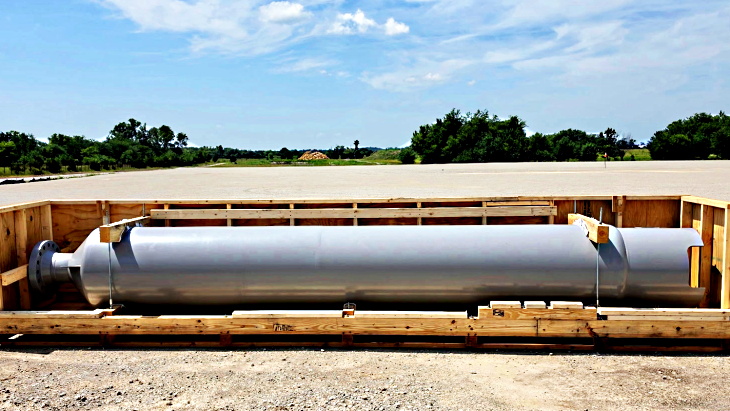
Deep Fission said the arrival of the canister “marks a key milestone in the company’s proof-of-concept well programme and its Gravity Nuclear Reactor development … the factory-built prototype canister completed fabrication, hydrostatic testing, and delivery to Kansas, representing tangible progress toward validating installation, infrastructure readiness, and operational sequencing for the company’s first commercial demonstration well”.
The proof-of-concept well is Deep Fission’s nearly full-scale validation programme, designed to demonstrate a larger-diameter borehole and end-to-end installation workflow using commercial-grade, non-nuclear components prior to fuel loading. The programme is intended to validate each stage of underground deployment under real-world conditions while confirming engineering assumptions at scale and supporting the company’s broader commercialisation timeline.
Deep Fission broke ground in December at the Great Plains Industrial Park in Parsons for its pilot project and plans to build a full-scale commercial plant there following the test reactor demonstration. The company said it is advancing permitting with the Kansas Department of Health and Environment for the non-nuclear borehole.
“The arrival of our prototype reactor canister at the Kansas site is a clear step forward in moving from design to deployed infrastructure,” said Mark Pérès, Deep Fission’s Chief Nuclear Officer. “Successfully manufacturing, testing, and delivering this hardware demonstrates performance of our design and supply chain capabilities. Upcoming testing using this hardware will validate our approach and provide valuable learnings as we assemble, install and test key systems under non-nuclear conditions in our large diameter borehole.”
The company is also progressing development of its full-scale nuclear demonstration borehole and advancing design of its primary heat exchanger. “These parallel efforts support a phased strategy to accelerate iterative validation of the most unique aspects of Deep Fission’s commercial deployment model,” it said.
Background
Deep Fission’s Gravity reactor is a small modular reactor designed to be placed underground in an optimised borehole one mile (1.6 km) deep. Using traditional pressurised water reactor technology and low-enriched uranium (LEU) fuel, each reactor will generate 15 MWe, the company says, while its small footprint and dense power output means it will need a fraction of the land needed for traditional surface nuclear: ten reactors on the same site would deliver 150 MWe, or 100 reactors would produce 1.5 GWe. In this design, thermal energy is transferred through a closed-loop system from the reactor canister to a heat exchanger, then rises to the surface in a secondary closed-loop for conversion into electricity, like a geothermal system. The company says passive shielding and natural containment offered by the surrounding geology, and the combination of mature technologies from the nuclear, oil and gas, and geothermal industries, while using off-the-shelf parts and readily available LEU fuel, aims to improve safety and security and enable a faster, more cost-effective path to deployment.
In August last year, Deep Fission was one of 10 companies selected by the US Department of Energy to receive support under its Nuclear Reactor Pilot Program.
Deep Fission was founded in 2023 by father-daughter team Elizabeth and Richard Muller, who also co-founded Deep Isolation in 2016 to develop the concept of placing canisters of radioactive waste hundreds of metres underground via a borehole.