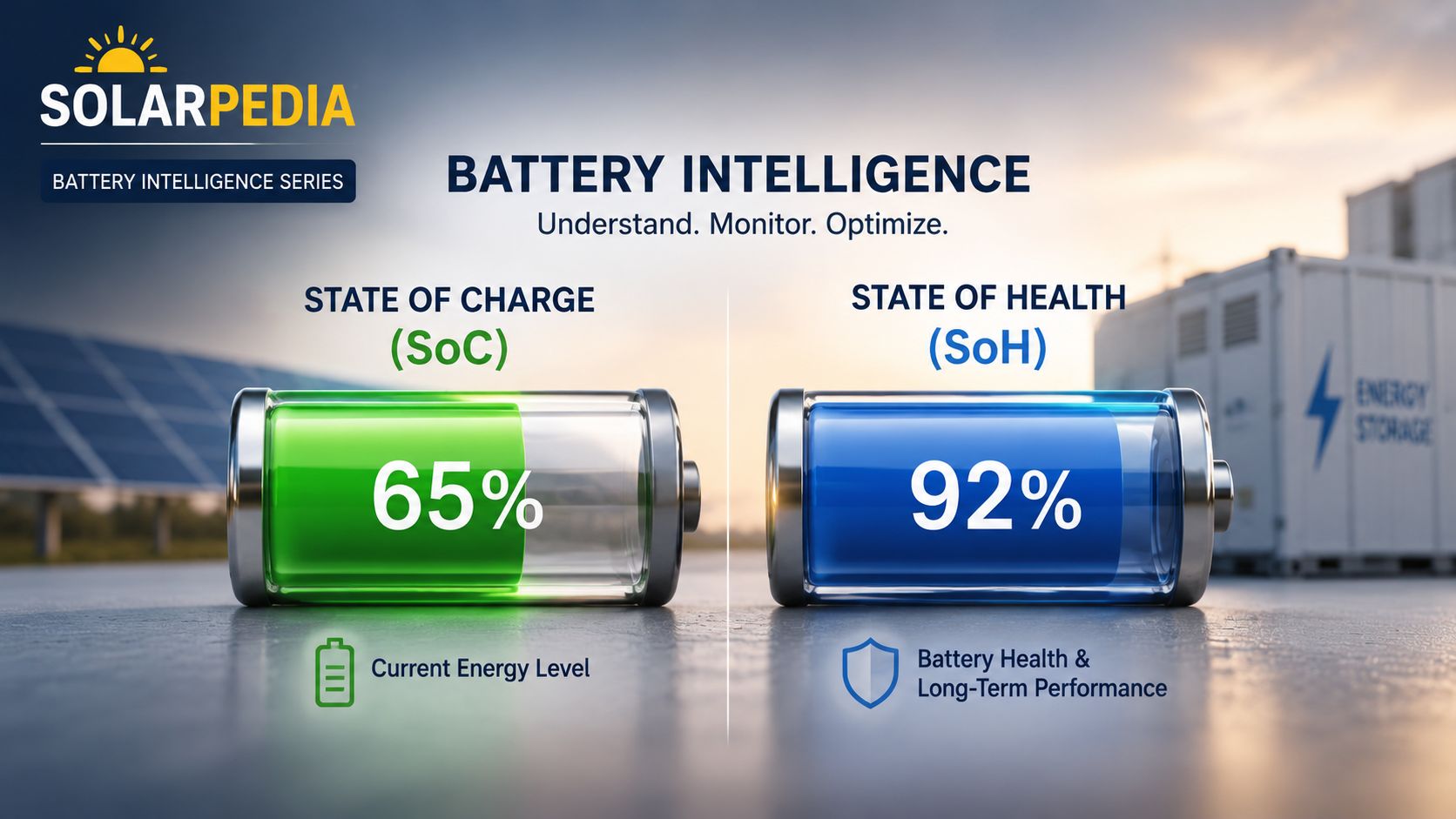
This month, Solarpedia explores Battery Intelligence—the key concepts and metrics that determine how Battery Energy Storage Systems (BESS) operate safely, efficiently, and reliably. Following last week’s discussion on , this edition explains State of Health (SoH)—a key indicator of a battery’s long-term condition and remaining performance.
State of Health (SoH) is a measure of a battery’s overall condition compared to when it was new. Expressed as a percentage, SoH indicates how much of the battery’s original capacity and performance remains after months or years of operation. A battery with an SoH of 100% is considered to be in its original condition, while a lower SoH reflects the effects of ageing, repeated charge-discharge cycles, temperature exposure, and other operating conditions.
In Battery Energy Storage Systems (BESS), SoH is a critical metric for evaluating battery reliability, safety, and remaining service life. As batteries age, their ability to store and deliver energy gradually declines, while internal resistance typically increases. Monitoring SoH enables operators to assess asset performance, schedule maintenance, optimize battery utilization, and make informed decisions regarding refurbishment, replacement, or second-life applications.
Unlike physical parameters such as voltage or current, SoH cannot be measured directly. Instead, the Battery Management System (BMS) estimates SoH by analysing multiple indicators, including available capacity, internal resistance, charge-discharge behaviour, operating temperature, and historical cycling data. Modern BMS platforms increasingly leverage artificial intelligence and machine learning to improve the accuracy of SoH estimation and predict future battery degradation.
For solar-plus-storage projects, maintaining a high SoH is essential for ensuring predictable system performance over the battery’s operational lifetime. As SoH declines, the battery stores less energy, delivers lower power, and may require more frequent charging. Continuous SoH monitoring allows operators to optimize dispatch strategies, maximize asset value, improve financial planning, and ensure reliable support for renewable energy integration and grid services.
Although often used together, State of Health (SoH) and State of Charge (SoC) represent different aspects of battery performance. SoC indicates how much usable energy is currently stored in the battery, while SoH reflects the battery’s long-term ability to retain and deliver that energy. A battery may be fully charged with an SoC of 100%, yet still have a reduced SoH if ageing has diminished its original capacity.
- State of Health (SoH) measures a battery’s long-term condition relative to its original performance.
- It helps assess battery ageing, degradation, remaining useful life, and overall reliability.
- SoH is estimated by the Battery Management System (BMS) using capacity, resistance, temperature, and operational data.
- Accurate SoH monitoring enables predictive maintenance, optimized battery utilization, and better lifecycle management of Battery Energy Storage Systems.
Subscribe to get the latest posts sent to your email.