There was a need for at least 18 more studies to cover topics such as regulatory and legislative frameworks, environmental protection, human resource capacity building, and supply chains, the Energy Ministry said.
The minister highlighted the preliminary study carried out by France’s EDF on the potential use of nuclear energy in Serbia. The Preliminary Technical Study on the Peaceful Use of Nuclear Energy was publicly presented to the Serbian Chamber of Commerce and media in March. It identified 19 key steps in three phases – phase 1 involves examining the feasibility and steps to take a decision to launch a nuclear power programme. Phase 2 includes activities related to the selection of a nuclear reactor type, contracting and construction of a nuclear facility. Phase 3 is when construction takes place.
She said: “Our decision is that the French company (EDF) will produce four more studies in the first phase, while the other 14 will be the subject of further consideration with various companies from which we have gathered interest, which have extensive experience in developing nuclear programmes at the European and global level and which have participated in the development of nuclear programmes in other countries.”
Serbia’s plan is to make an informed decision on implementing a nuclear power programme in 2027, and by 2032 “to be ready, in an institutional, regulatory and professional sense, to select the technology – and begin the construction process by 2035”. The most recent target date for a nuclear power plant to be online is 2040.
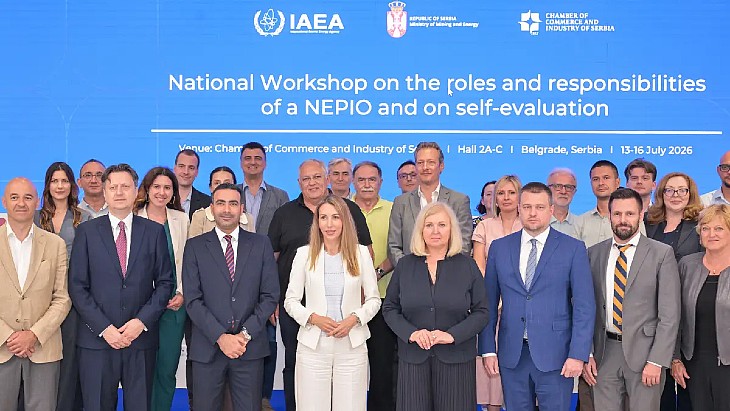
The comments came at the opening of a workshop on the role and responsibilities of the National Nuclear Energy Programme Implementation Body, which was organised by the Ministry of Mining and Energy with support from the Directorate for Radiation and Nuclear Safety and Security of Serbia and the International Atomic Energy Agency.
“I am convinced that we have a generational opportunity that we must not miss in order to leave behind something that is of capital value and that gives Serbia the opportunity to develop and be more energy secure,” she said.
Background
Serbia had a longstanding law banning the construction of nuclear power plants, but in December 2024 the National Assembly voted through amendments to the energy law ending that 35-year prohibition.
In October 2024 EDF and French engineering consultancy Egis were awarded the contract by Serbia’s Ministry of Mining and Energy to conduct the preliminary technical study on the potential use of nuclear power in the country.
There have also been talks with Russia’s Rosatom about cooperation on nuclear energy and President Aleksandar Vučić has previously discussed the option of Serbia acquiring 5 to 10% of Hungary’s Paks nuclear power plant, as well as saying at 2024’s multinational Nuclear Energy Summit in Brussels, that the country was seeking support from other countries in terms of know-how and financing to achieve its aim of getting 1,200 MW of capacity from small modular reactors.