The new board of directors of Kozloduy Nuclear Power Plant-New Build EAD, which is state-owned via its parent company Kozloduy NPP EAD, which operates the existing nuclear power plant, held talks with the US Chargé d’Affaires in Bulgaria, H Martin McDowell, and Patrick Thilou, Political and Economic Officer, at the embassy.
“The two sides declared their common commitment to the project for new nuclear power capacities in Kozloduy, which remains a strategic priority in the bilateral cooperation between Bulgaria and the United States of America,” the project company said.
“The main topic of the discussion was the progress on the construction of units 7 and 8, the next stages of implementation, and the possibilities for financing from US export banks.
“In conclusion, the delegations expressed mutual readiness to continue active dialogue and close cooperation throughout all subsequent stages of the project’s implementation.”
The meeting came the week after Bulgarian Prime Minister Rumen Radev – a former president who became prime minister with a new government in May – met with representatives of Westinghouse.
According to the government press service: “During the meeting, the implementation of the preliminary engineering activities for the project to build units 7 and 8 of the Kozloduy NPP was discussed. Issues related to the completion of the feasibility study for the time frame for the construction of the new units and the expected final price were also considered.”
Background
Kozloduy units 1-4 were VVER-440 models which the European Commission classified as non-upgradeable and Bulgaria agreed to close them during negotiations to join the European Union in 2007. Units 5 and 6 feature VVER-1000 reactors that were connected to the grid in 1987 and 1991, respectively. Both units have been through refurbishment and life-extension programmes to enable extension of operation from 30 to 60 years. The country’s two operable reactors generate about one-third of its electricity.
Westinghouse’s AP1000 has been selected as the technology for the two proposed new units and in November 2024 Hyundai Engineering & Construction, Westinghouse and Kozloduy NPP-New Build signed an engineering contract for the new capacity, with ministers saying that signing the contract meant that schedule and finance details would be firmed up for the new capacity. The Ministry of Energy and the USA’s Citi bank agreed on a partnership in July last year to secure funding for the construction of the new units, and site location applications were submitted.
In December Kozloduy NPP-New Build EAD and a consortium comprising Laurentis Energy Partners, its subsidiary Canadian Nuclear Partners SA (CNPSA) and BWXT Canada, signed an owner’s engineer contract to advance the two new AP1000 units.
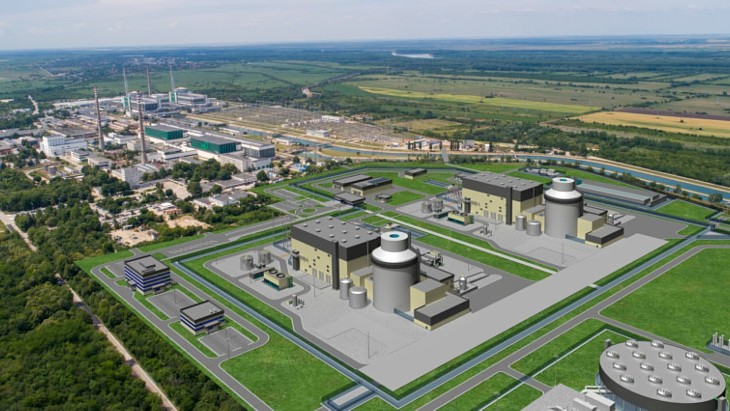
The aim is for the first new Westinghouse AP1000 unit – unit 7 at Kozloduy – to be operational in 2035 and the second one – unit 8 – to be operational in 2037. The 2,300 MWe capacity of the two new units would exceed the 1,760 MWe capacity of the closed first four units. The Bulgarian government has also said that further units will be needed to replace units 5 and 6 by 2050. It has also been considering the deployment of small modular reactors in the country.