Mars in 30 days? Russia unveils prototype of plasma rocket engine

Friday, 7 February 2025
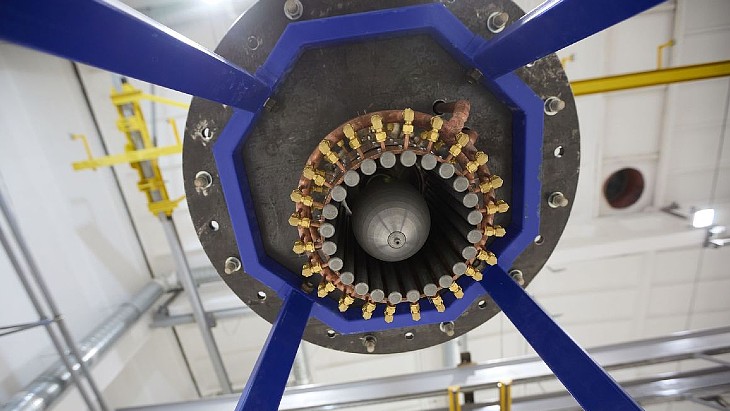
Mars in 30 days? Russia unveils prototype of plasma rocket engine
(Image: Rosatom)

Rosatom says that the average power of the engine, operating in pulse-periodic mode, reaches 300kW making it possible to accelerate the spacecraft to much higher speeds than conventional engines.

Alexey Voronov, first deputy director general for science at the Rosatom Research Institute in Troitsk, said: “Currently, a flight to Mars using conventional engines can take almost a year one way, which is dangerous for astronauts due to cosmic radiation and exposure to radiation. Using plasma engines can shorten the mission to 30-60 days, meaning it will be possible to send an astronaut to Mars and back.”

He said that creating a prototype was “one of the most important stages of the project” as it seeks to determine whether it will be suitable for spacecraft, and to get an idea on the costs of their production.

A large-scale experimental stand is being assembled to test the prototype, featuring a 14-metre-long/4-metre-diameter vacuum chamber to simulate the conditions of outer space for the tests.

Mars is about 140 million miles from Earth. To cover that distance in 30 days would require an average speed of about 195,000 miles per hour. Other countries, including the European Space Agency and the USA have on-going projects relating to cutting journey times and conditions that will make it possible for astronauts to travel to Mars and back.

According to Russia’s Izvestia newspaper the engine thrust will be about 6N and researchers say “the propulsion system will be able to accelerate particles (charged electrons and protons) to a speed of 100 km/s. This will allow spacecraft to make interplanetary flights and even go beyond the solar system”.

It describes a plasma rocket motor as “a type of electric motor. It is based on two electrodes. Charged particles are passed between them, and at the same time a high voltage is applied to the electrodes. As a result, the current creates a magnetic field that pushes the particles out of the engine”. It adds that the launch into orbit would be using traditional methods, and the aim is that “the flight model of the unit will appear in 2030”.

   

  • Related Posts

    First San’ao unit connected to the grid

    “At 17:28 on 12 March, the first Hualong One nuclear power unit in the Yangtze River Delta region – unit 1 of the CGN Zhejiang San’ao Nuclear Power Project –…

    Infrastructure work under way for Namaru uranium deposit

    JSC Khiagda, part of Rosatom’s mining division, is Russia’s leading uranium producer with operations at five deposits “in the challenging permafrost conditions of the Bauntovsky Evenki District”, in a region which…

    Have You Seen?

    Crude Futures Turn Positive on Continued Hormuz Closure

    • March 14, 2026
    Crude Futures Turn Positive on Continued Hormuz Closure

    Hormuz Crisis Forces Massive Saudi Oil Shut-In

    • March 14, 2026
    Hormuz Crisis Forces Massive Saudi Oil Shut-In

    California Hit By Much Higher Oil Prices as Iran War Stresses Refiners

    • March 13, 2026
    California Hit By Much Higher Oil Prices as Iran War Stresses Refiners

    CHARTED: The Energy Mix of the World’s 10 Largest Economies – Visual Capitalist

    • March 13, 2026
    CHARTED: The Energy Mix of the World’s 10 Largest Economies – Visual Capitalist

    RANKED: The Top Buyers of U.S. Oil in 2025 – Visual Capitalist

    • March 13, 2026
    RANKED: The Top Buyers of U.S. Oil in 2025 – Visual Capitalist

    US Drillers Add Oil and Gas Rigs for Second Week in a Row, Says Baker Hughes

    • March 13, 2026
    US Drillers Add Oil and Gas Rigs for Second Week in a Row, Says Baker Hughes

    19 Million Barrels of Russian Crude Cleared for Sale in Asia

    • March 13, 2026
    19 Million Barrels of Russian Crude Cleared for Sale in Asia

    Banks Hike Oil Price Forecasts, and Some See $150 Crude

    • March 13, 2026
    Banks Hike Oil Price Forecasts, and Some See $150 Crude

    Middle East Conflict Halts 15% of TotalEnergies Oil and Gas Production

    • March 13, 2026
    Middle East Conflict Halts 15% of TotalEnergies Oil and Gas Production

    Kazakhstan’s Tengiz Oilfield Supply Uninterrupted Despite New Incident

    • March 13, 2026
    Kazakhstan’s Tengiz Oilfield Supply Uninterrupted Despite New Incident