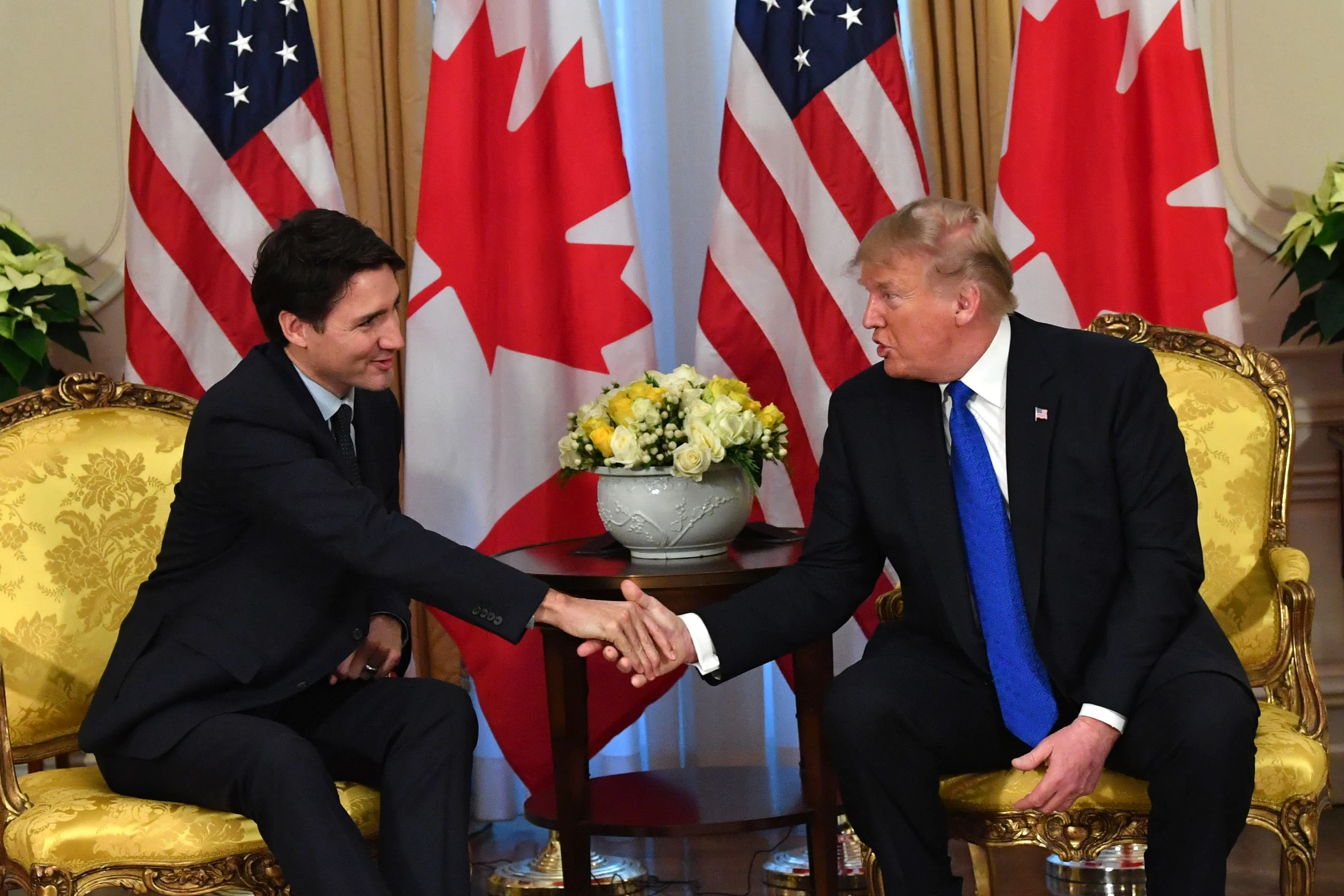
Canada is in that awkward position where a usually friendly, if erratic, neighbor has suddenly started hammering on the walls. Should it politely ask them to lay off, or bang back? In dealing with President Donald Trump’s threat of US economic warfare, Canada’s approach is especially tricky when it comes to the biggest battlefield: energy.
Canada’s energy exports to the US, especially oil, flip what would otherwise be a US trade surplus to a Trump-troubling deficit. As I wrote , the two countries’ oil industries are tethered together by pipelines in a peculiarly symbiotic, and rewarding, relationship. Canada has limited outlets for its oil exports other than US refiners in the Midwest, and those same refiners lack other options for getting the heavy, sour crude oil they like and which Canada produces in large quantities. This is energy codependence.
That means if Trump imposes his threatened, if delayed, tariffs, some of the burden will blow back on the US. Thus, energy offers Ottawa its most obvious potential source of leverage. This is especially obvious because Trump, ever the artful dealmaker, signaled so by setting a lower tariff for Canadian energy, 10% rather than the 25% level for other imports.
That betrayal of nervousness offers a rationale for Canada to brandish the energy weapon. A new poll conducted on behalf of Bloomberg News finds 82% of Canadians support unilaterally raising the price of oil exports to the US. Even in the western Prairie provinces, economically more dependent on those energy exports and with governors against the idea of export taxes, support polled at a solid 72%. Thus far, Canada has played Trump’s game well, offering cosmetic concessions in return for a delay. But if tariffs do materialize, calls to punish the US will intensify.
Ottawa’s proposed tariffs on an eclectic range of imports from the US are politically useful but economically rather futile. The US economy is more than 10 times the size of Canada’s and far less dependent on trade as a share of that economy. If the objective is to force the US to shift its stance, Canada simply doesn’t have enough heft.
Energy is a special case because Canada supplies about half of US oil imports and is also an important source of natural gas and electricity in various border states. Canada should take advantage of this, but must do so very judiciously.
The nuclear option would be to cut off energy flows, an idea raised by Ontario’s Premier Doug Ford in December. This could offer immediate gratification — of sorts — if Canada sparks blackouts in regions like New England. As for oil, all else equal, the Midwest would burn through its stockpiles feeding gasoline pumps in about 10 weeks, and panic buying would send prices soaring straightaway.
While that probably would scare Trump, it would also swing the blame in many American minds from his ridiculous trade war to Canada itself, especially if anyone died amid winter energy cutoffs. Meanwhile, zeroing out exports that are equivalent to almost 6% of Canada’s GDP would inflict damage on its own economy, especially in Alberta. And while it would take many months or even years for the US to reconfigure its infrastructure, especially pipelines, to reduce dependence on Canadian energy, a cutoff would provide the “energy emergency” Trump is groping for in order to steamroll new projects over environmental review.
A less drastic option would be an export tax. This is essentially the inverse of an import tariff, only with Ottawa collecting the duties instead of Washington. However, as with US import tariffs, a significant portion of the burden would be borne by Canadian oil producers because of their limited alternative export options. They would need to reduce the amount they charge for barrels in order to absorb at least some of the export tax and stay competitive. US refiners would also absorb some of it, yes, but Canada would still face reduced oil revenue — also reducing the mooted tax take — especially if the export tax came in addition to US tariffs.
A more interesting option, specific to oil, is curtailment, whereby Canadian producers would reduce their output (similar to what OPEC+ does). While this would seem to entail a self-inflicted reduction in revenue, it could actually offer a shield against US tariffs according to economist Kent Fellows of the University of Calgary. Speaking on a recent podcast, he points out that reducing production would serve to raise the price of Canadian oil, potentially leaving overall revenue intact.
It should also mean more of the impact of Trump’s tariffs falling on US consumers, since Canadian oil prices would prove more resilient, and without the optics of outright retaliation. Fellows frames this option as being like a temporary reversal of antitrust law, which exists to shield consumers from artificially high prices. Since most of Canada’s oil gets used in the US rather than at home, those laws effectively protect more US consumers than Canadians.
Moreover, this has worked before. In 2017 and 2018, rising Canadian oil production ran into pipeline constraints, causing local prices to drop precipitously. In response, Alberta’s government ordered a coordinated production cut of about 9%. Within a week, before cuts had even gone into effect, prices surged by about 70%. Think of Trump’s tariff as an analogous restriction on Canada’s oil exports working to drive down the price received by Canadian producers.
Oil Curbs Can Mean Less is More
Western Canada Select crude oil’s discount to West Texas Intermediate, dollars per barrel
Production curbs could be palatable across Canada’s famously fissile inter-provincial politics. That is critical. Trump’s threats and insults should be message enough that Canada must overcome prior infighting and secure new energy export routes as insurance. The benefits of comparative advantage that have shaped the US-Canada energy relationship rested on an assumption of mutual rationality and respect, which can no longer be taken for granted. That opinion poll suggests the opportunity for unified action is there, precisely because Trump has provoked it.
Share This:
More News Articles