He said that brings the total of Russian specialists at the site to 25 with more due to return in the next two weeks if there is no escalation of military action.
In comments reported by the in-house Strana Rosatom publication, Likhachev said: “If all goes well, we’ll increase our project staff to 100 people by the autumn. Of course, we plan to return all the specialists previously evacuated from the Islamic Republic as soon as possible. However, a return to pre-war conditions is only possible after final agreements between the US and Iran on a cessation of hostilities are reached.”
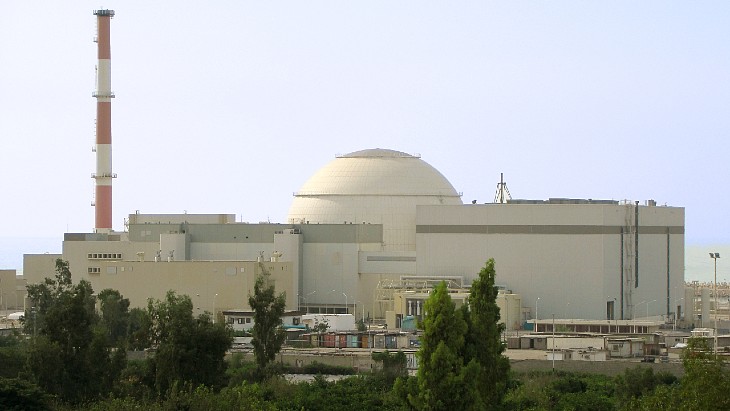
The publication says that construction activities on the main and auxiliary buildings for Bushehr 2 and 3 are continuing, as well as preparatory work on hydraulic structures.
Background
The USA and Israel launched attacks on Iran on 28 February, saying they were targeting Iran’s leadership and its military infrastructure. Iran retaliated – there is currently a ceasefire and talks taking place aimed at ending the conflict. International Atomic Energy Agency (IAEA) Director General Rafael Mariano Grossi has said that diplomacy and negotiations are the way “to achieve the long-term assurance that Iran will not acquire nuclear weapons and for maintaining the continued effectiveness of the global non-proliferation regime”.
The first unit at the Bushehr plant was connected to the grid in 2011. It is a Russian-designed VVER unit with a capacity of 915 MWe. Two further units featuring VVER-1000 units are under construction – unit 2 had first concrete poured in 2019 and the core catcher installed in 2024. In January the third tier of the inner containment building for unit 2 was installed.
In May, Likhachev said the reactor for Bushehr 2 was more than 60% complete and the steam generators 50% complete, and “we plan to begin shipping the key equipment next year”. He said at that time that about 2,200 employees of Iranian contractors had already returned to the construction site.
At an event at the IAEA’s General Conference in September 2024, Iran suggested unit 2’s then target date for operation was 2029.
In September 2025, Rosatom and the Atomic Energy Organisation of Iran signed a memorandum of understanding for cooperation in the building of small modular reactors in Iran. The country says it has an ambition for 20 GW of nuclear energy capacity by 2041.