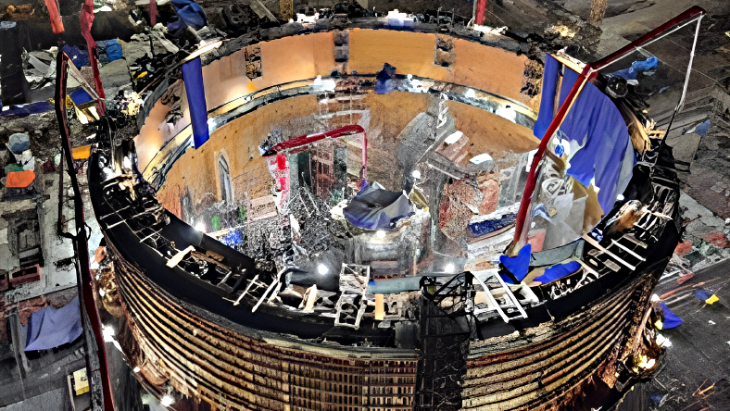
The Authority said concreting work continued non-stop for 30 hours, using five concrete pump trucks with boom distributors. About 80 specialists participated in the work during the day shift, another 80 during the night shift, and 20 people continued working around the clock to ensure the smooth operation of construction equipment and machinery.
The total volume of concrete poured was 1,608 cubic metres, and this work contributed to increasing the height of the reactor building from a level of 24.4 metres above ground to a level of 34.0 metres.
“The successful completion of the concreting work for the fourth tier of unit 1 is a new strategic step, reflecting the ongoing progress of the project, said Sherif Helmy, chairman of the NPPA board of directors. “This achievement is the result of fruitful cooperation and full coordination between all work teams of the Nuclear Power Plants Authority, the project’s customer and operator, and Atomstroyexport JSC, the project’s general contractor.”
Alexey Kononenko, vice president of Atomstroyexport JSC and director of the El Dabaa NPP construction project, added: “The completion of the installation of the fourth tier of the El Dabaa NPP reactor building’s internal containment vessel marks a new, important milestone in the construction of unit 1 and reflects the high level of professionalism and dedication of the entire project team. By mid-August, we plan to begin work on installing the fifth tier, which will subsequently serve as a support for the polar crane.”
Background
El Dabaa will be Egypt’s first nuclear power plant, and the first in Africa since South Africa’s Koeberg was built nearly 40 years ago. The Rosatom-led project, about 320 kilometres north-west of Cairo, will comprise four VVER-1200 units, like those already in operation at the Leningrad and Novovoronezh nuclear power plants in Russia, and the Ostrovets plant in Belarus.
VVER-1200 reactors have two containment buildings – an inner one and an outer one – which provide extra safety and protection from external impacts.
Under the 2017 contracts, Rosatom will not only build the plant, but will also supply Russian nuclear fuel for its entire life cycle, including building a storage facility and supplying containers for storing used nuclear fuel. It will also assist Egyptian partners in training personnel and plant maintenance for the first 10 years of its operation. Rosatom has said it is aiming for a future service life of up to 100 years for nuclear power plants.
The four units are being built almost concurrently, with first concrete at unit 1 in July 2022, followed in turn by the others, concluding with first concrete at unit 4 in January 2024. Egypt’s aim is for 9% of electricity to be generated by nuclear by 2030, which would be achieved by the commercial operation of the first two units by that time, directly displacing oil and gas.