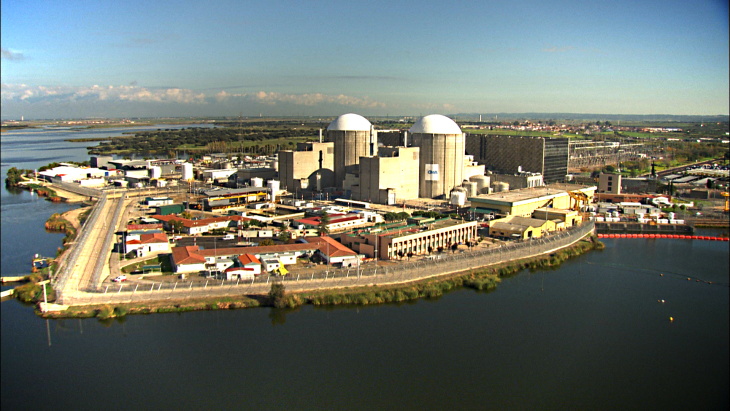
In June 2020, the Nuclear Safety Council (CSN) approved the operation of Almaraz until June 2030, as licence renewals are for 10 years. However, given the agreed-upon closure schedule as part of Spain’s phase-out of nuclear energy, it was decided to extend operations only until October 2027 for Almaraz unit 1 and October 2028 for unit 2.
On 30 October last year, the board of operator Centrales Nucleares Almaraz-Trillo (CNAT) officially requested an extension to the operating licence for both Almaraz units. The decision, taken at an extraordinary meeting of the board of directors and the general assembly of shareholders, sought to extend the life of the two units to June 2030. CSN received a request on 17 November from the Ministry for Ecological Transition and the Demographic Challenge (MITECO) for a mandatory report on the application to modify the operating licence of the Almaraz plant.
Last month, CSN issued a favourable report on the renewal of the operating licence, saying the plant meets the conditions to operate safely until June 2030.
An has now been published in the Official State Gazette, granting the renewal of the operating licence for Almaraz.
“The limited extension is adopted considering the energy situation marked by uncertainty in international energy markets that have caused the armed conflict in the Middle East and the continuation of the war in Ukraine,” the ministry said. “This limited and temporary extension may help to moderate the exposure of Spanish consumers to previously unforeseen price spikes resulting from the crisis, while measures already underway to promote renewables and storage continue to be deployed as structural solutions to the exposure and vulnerability caused by dependence on imported fossil fuels.”
It noted that the licence extension for Almaraz “does not alter the closing date of the entire nuclear park in 2035”.
Industry response
The government’s decision to extend the operating licence was welcomed by Spain’s nuclear industry forum, Foro Nuclear, whose president, Marta Ugalde, said: “It is great news that a strategic infrastructure like Almaraz can continue operating, since nuclear energy is essential in the electricity generation mix. It provides firm, synchronous, and inertial power, and strengthens energy independence from fossil fuels, as recognised by the European Commission. The continued operation of Almaraz provides certainty for the region and highlights the value of safe, emission-free, competitive nuclear energy that complements renewable energies.”
Foro Nuclear noted that the resolution concludes that the licence renewal does not compromise national renewable energy targets or European decarbonisation goals, while contributing to moderating the exposure of the electricity system to the volatility of fossil fuels. The continued operation of Almaraz “is also framed within an international context of growing recognition of nuclear energy as a tool to strengthen energy security, reduce emissions and accompany the advance of electrification,” it said.
“Foro Nuclear believes it is necessary to use this new perspective to address, calmly and rigorously, the role that nuclear energy should play in Spain’s future energy model,” the organisation said. “Likewise, it is essential to review the regulatory, economic, and tax conditions that will allow it to maintain its contribution, in line with European priorities of strategic autonomy, industrial competitiveness, and decarbonisation.”
Sama Bilbao y León, Director General of World Nuclear Association, commented: “I am very encouraged by the decision to extend the operation of Almaraz until 2030. This is great news for Spain’s economy, energy security and grid stability, helping preserve a reliable source of electricity that supports the prosperity of Spanish families and businesses. I hope this is the first step towards the recognition of the strategic value of nuclear energy in Spain, including the extension of Almaraz and the rest of the Spanish nuclear fleet to 60 years of operation, securing these benefits for decades to come.”
Phase-out plan
Spain’s seven operating nuclear power reactors – Almaraz I and II, Ascó I and II, Cofrentes, Trillo and Vandellós II – generate about 20% of its electricity. Under the country’s nuclear phase-out plans, agreed in 2019, four reactors are scheduled to close by the end of 2030 – including the two Almaraz ones – while the remaining three reactors will shut by 2035.
The Almaraz plant currently supplies more than 7% of the electricity consumed in Spain, equivalent to 4 million homes, and employs about 4,000 people. Almaraz units I and II are pressurised water reactors with a net capacity of 1,011 MWe and 1,006 MWe, respectively. Unit I entered commercial operation in 1983 with unit II following the next year. The plant is owned by Iberdrola (53%), Endesa (36%), and Naturgy (11%).