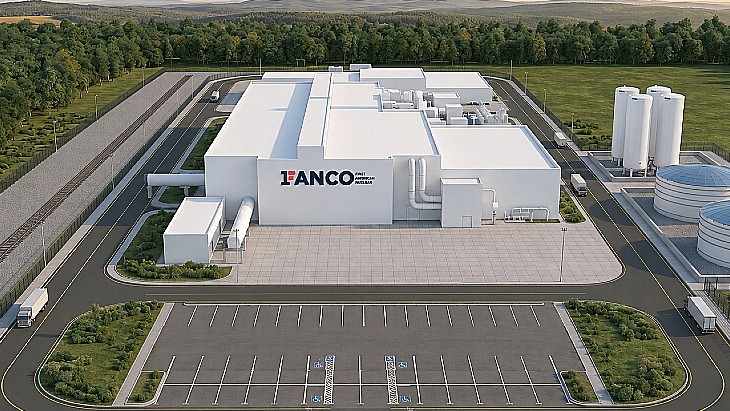
First American Nuclear Co (FANCO) notified the US Nuclear Regulatory Commission (NRC) of its plans to submit an application for a licence to possess and use special nuclear material for the operation of a Category II high-assay low-enriched uranium (HALEU) fuel fabrication facility in a letter of intent dated 6 August. (Category II facilities are licensed by the NRC to handle “special nuclear material of moderate strategic significance” such as HALEU.)
“This fuel facility will support the EAGL-1 lead-bismuth eutectic-cooled fast reactor and other advanced reactor customers,” the letter stated. “It is FANCO’s intent to engage with the NRC in order to obtain a licence under 10 CFR Part 70 and all other regulations applicable for the construction, ownership and operation of this facility.
“The proposed facility will be designed, constructed, and operated to fabricate uranium oxide fuel using licensed material within the limits and conditions requested in the application and approved by the NRC. In addition, the facility will include the capability to process uranium oxide into other fuel forms.”
According to the Regulatory Engagement Plan, the fuel facility will process HALEU uranium oxide pellets using uranium enriched to less than 20% uranium-235. The technology specifications have been redacted from , in which the company says it acquired the technology portfolio originally developed by Columbia Basin Consulting Group, a nuclear engineering firm established in 1998. This foundation is supported by a leadership and senior engineering team with “direct operational and engineering experience from major US fast reactor programmes, including the Fast Flux Test Facility (FFTF), Experimental Breeder Reactor-II (EBR-II), Versatile Test Reactor, Advanced Burner Reactor, and the Global Nuclear Energy Partnership (GNEP).”
The technology portfolio is based on technology developed within the US advanced liquid-metal fast reactor programmes and data available through the International Atomic Energy Agency and various US sources, and the design was advanced with support from the Pacific Northwest National Laboratory through Gateway for Accelerated Innovation in Nuclear (GAIN) awards and with a grant award under the Department of Energy Advanced Reactor Demonstration Program.
FANCO said it is “currently finalising contracts with primary Engineering/Design contractors”. Earlier this year, the company announced a strategic partnership with AtkinsRéalis to serve as the exclusive engineering, procurement, and construction management provider for EAGL-1 projects in North America, including the integrated EAGL-1 reactor, fuel fabrication, and recycling facilities.
“America’s ability to deploy advanced nuclear energy at scale depends on more than innovative reactor technology – it requires a secure, capable and American fuel supply,” FANCO CEO Mike Reinboth said. “The submission of our Regulatory Engagement Plan is an important step in building that capability. It reflects the deliberate way we are advancing FANCO’s integrated commercial strategy: pairing disciplined regulatory execution with a fuel-cycle platform designed to support our EAGL-1 programme and, over time, other advanced-reactor developers.”
FANCO Executive Vice President, Regulatory Affairs, Licensing, and Quality Michelle Catts said the Regulatory Engagement Plan provides a structured framework for engaging the NRC well in advance of the anticipated licence application. “Our objective is to ensure that the regulatory path is informed by early, substantive technical dialogue and is supported by a comprehensive understanding of the facility’s design and operating plan. This submission reflects the readiness and discipline of our licensing organisation, as well as the quality of the technical work underway across FANCO’s fuel programme,” she added.
EAGL-1 is a 240 MWe, lead-bismuth-cooled fast-spectrum small modular reactor designed for factory fabrication and scalable, multi-unit deployment.