By
48 min ago 3 min read
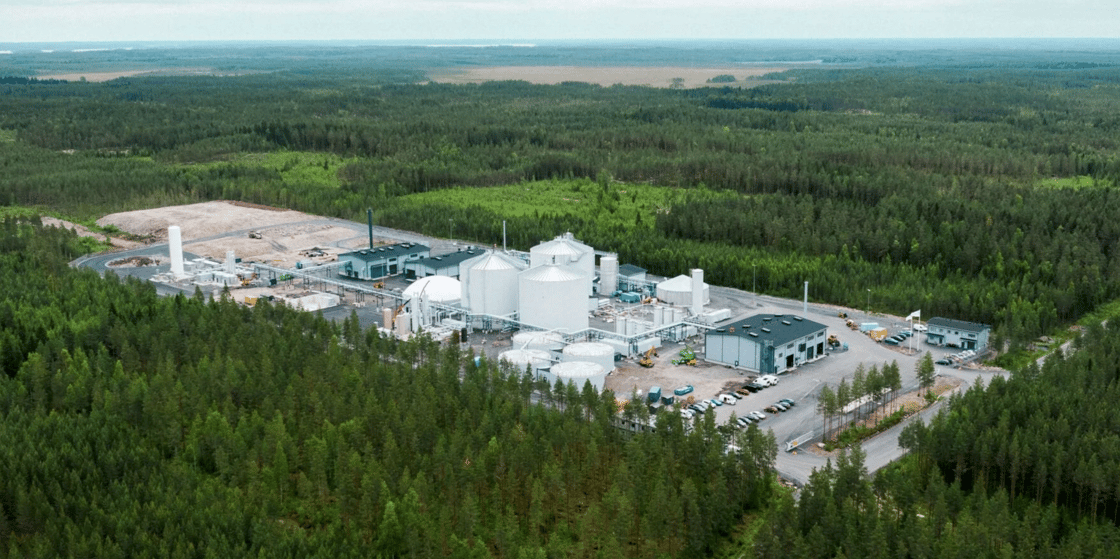
Suomen Lantakaasu – a joint venture between biomethane firm St1 Biokraft and food company Valio – has inaugurated Finland’s first industrial-scale liquefied biogas (bioLNG) plant in Nurmo, western Finland.
The commissioning of the plant marks the start of a new biogas production ecosystem in one of Finland’s key food-producing regions. It was developed by Nurmon Bioenergia, which is majority-owned by Suomen Lantakaasu, with Atria Finland as a minority shareholder.
At the Nurmo plant, manure from local farms, along with other agricultural and food industry by-products, is processed into renewable fuel for transport and biofertilisers that recycle valuable nutrients.
The reception of manure from local farms has started, with more than 30,000 tonnes received to date. The plant is currently producing raw biogas, and the next phase will be to begin liquefaction, which is scheduled to start later this autumn.
The plant will have an annual production capacity of approximately 100 gigawatt hours of liquefied biogas, equivalent to around 10 million litres of diesel.
Suomen Lantakaasu aims to build a nationwide biogas ecosystem and produce a total of one terawatt hour of domestic renewable energy annually.
Thanks to its high energy density, liquefied biogas is particularly well suited to heavy-duty transport and provides a fossil-free alternative to diesel.
Leena Helminen, CEO of Suomen Lantakaasu, said the project brings together food and energy production in a way that strengthens both security of supply and domestic renewable energy production.
“At the same time, we are creating new business opportunities around Finnish food production, improving the profitability of agriculture and reducing dependence on fossil fuels,” she said.
Tuomas Salusjärvi, Executive Vice President, Expansion Businesses and Renewal at Valio, said Nurmo demonstrates how working together with farms can create solutions that strengthen the competitiveness of Finnish food production, improve nutrient recycling and generate renewable energy.
“It is particularly important to us that biogas production turns manure from Valio dairy farms into a valuable resource,” he said. “By participating in biogas production, farms gain access to recycled fertilisers that are easier for crops to utilise, while also reducing emissions and achieving significant cost savings.”
Miika Johansson, CEO of St1 Biokraft, said Finland has strong potential to build a more self-sufficient renewable energy system, reduce import dependence and provide competitive alternatives to fossil fuels.
“By producing liquefied biogas at industrial scale from local feedstocks, the Nurmo plant contributes to all three. For St1 Biokraft, it is also an important step in scaling the Nordic biogas market by connecting production with growing demand from transport, maritime and industry,” he said.
Tauno Perälä, Executive Vice President, Industrial Operations, Atria Finland, said the plant provides concrete support for Atria’s sustainability targets and its efforts to reduce emissions from food production, and strengthens the vitality of the entire South Ostrobothnia region and creates new opportunities for collaboration between agriculture, food, energy production and transport.
The Ministry of Economic Affairs and Employment granted €9.4m ($10.9m) in energy investment and the Ministry of the Environment provided €101,800 ($118,071) in support for the biofertiliser loading tank.
Finnish state-owned energy firm Gasum saw its rise to 12.3% in 2025, up from 0.8% in 2024.