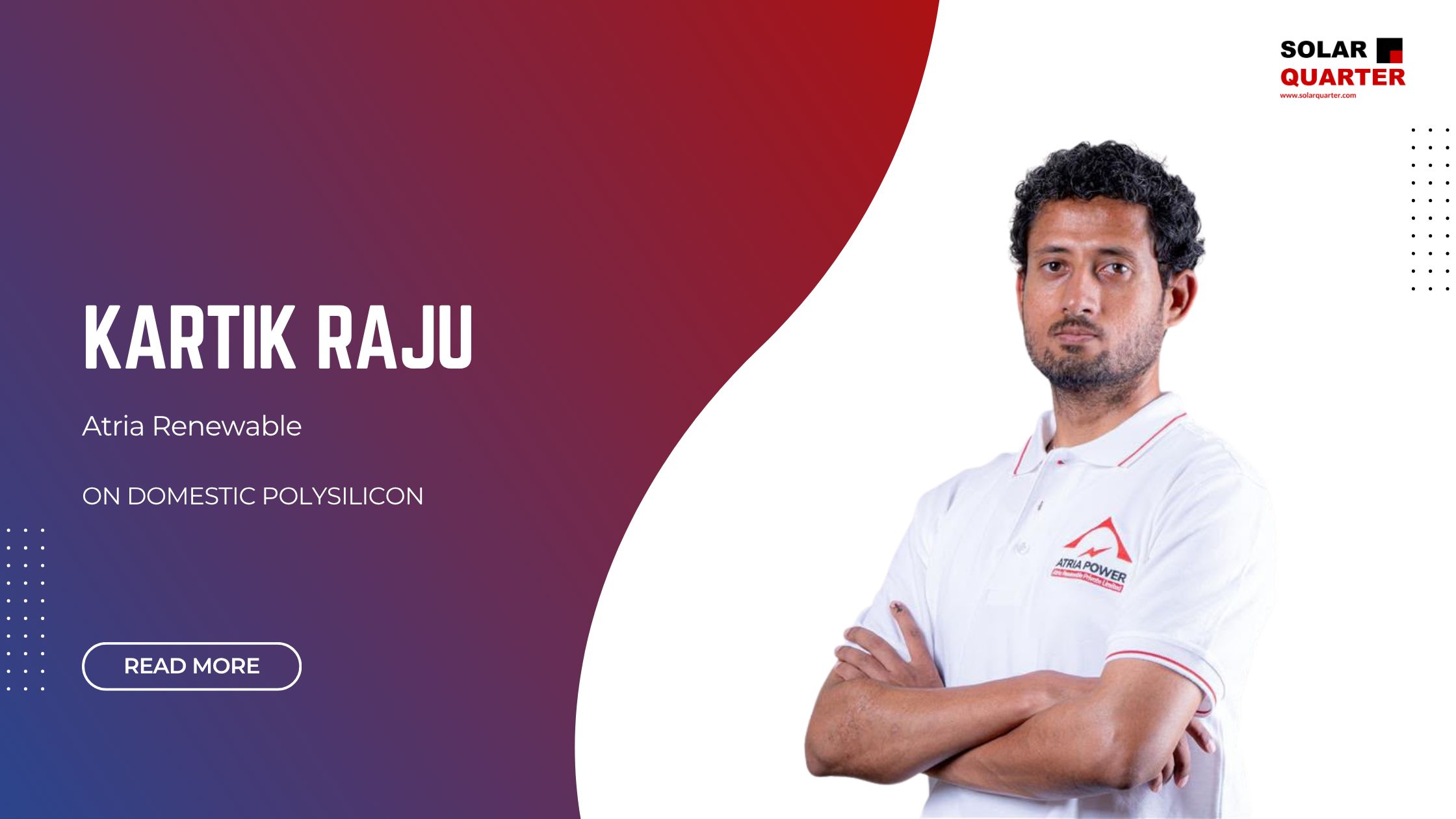
Kartik Raju, Executive Director, Atria Renewable, shares his perspective on domestic polysilicon manufacturing and the need to develop a competitive, resilient and integrated solar value chain in India.
As India looks to deepen domestic solar manufacturing and strengthen its position across the global clean energy value chain, upstream localisation is becoming increasingly important. Developing domestic polysilicon capacity represents a significant step towards reducing supply-chain dependencies and creating a more integrated solar manufacturing ecosystem.
However, establishing manufacturing capacity is only one part of the equation. Long-term competitiveness will depend on production costs, quality, scale, access to energy, technology, skilled resources and a policy environment capable of supporting commercially sustainable investments.
Sharing his perspective on the opportunity and the priorities for India’s domestic polysilicon industry, Kartik Raju, Executive Director, Atria Renewable, said “Building domestic polysilicon capacity is an important step towards creating a more integrated and resilient solar manufacturing ecosystem in India. However, the success of this effort will depend not just on creating capacity, but on building production that is competitive on cost, consistent in quality and capable of scaling with India’s rapidly growing solar demand in addition to ensuring there is adequate well trained resource available to work with and on the technology. Given the capital and energy intensity of polysilicon manufacturing, the design of the support mechanism will be critical to enabling investments that are commercially sustainable over the long term.
For the broader solar industry, greater upstream localisation can improve supply-chain resilience and provide greater visibility on availability, pricing and execution. A policy framework that supports upfront investment, access to competitive energy and technology advancement, while encouraging scale and long-term efficiency, can help India build a more robust domestic value chain and strengthen its ability to compete in global solar manufacturing.”
Subscribe to get the latest posts sent to your email.