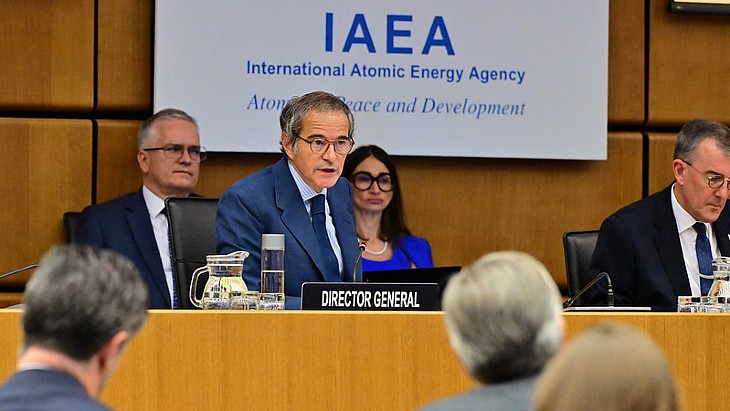
In a speech to the agency’s board of governors on Monday, Director General Rafael Mariano Grossi said “both sides have engaged constructively with the IAEA to help make this localised ceasefire possible, showing that practical steps can be taken, even in extremely difficult circumstances, to improve nuclear safety”.
The last remaining external power line was disconnected on 20 August “after military activity on the northern side of the Dnipro River”, which has left the plant relying on its fleet of emergency diesel generators to provide the power required for the six-unit plant.
Grossi said: “As the ZNPP’s emergency generators drained the available diesel to little more than a week of supplies, forcing its cooling pumps to be run only intermittently, I continued my persistent efforts to broker a ceasefire so that the Ferosplavna-1 power line could be repaired.”
That ceasefire began at the weekend with International Atomic Energy Agency (IAEA) staff on site monitoring the demining and repair work, which he said should be completed “shortly”.
Repairs were carried out on a second line in June during another ceasefire, but it remains unavailable because of damage at a substation, he said.
“It goes without saying that nuclear power plant staff must be able to carry out their essential work without being attacked or placed at risk. I solemnly call on all military commanders in the region to stop attacks on nuclear power plants and their staff, and to exercise maximum military restraint. I say this because last month a drone explosion at a bus stop used by plant staff and subcontractors travelling to Zaporizhzhia nuclear power plant caused multiple casualties. The ZNPP informed the IAEA team at the plant that the explosion caused 20 casualties, including one death and three serious injuries.
“The loss of life is a tragedy. Endangering personnel is a clear violation of the IAEA’s Seven Indispensable Pillars for ensuring nuclear safety and security during armed conflict.”
He said IAEA teams “continue to report frequent military activity in the vicinity of the site and of Energodar, including incidents affecting critical infrastructure and plant personnel” and IAEA teams stationed at nuclear power plants across Ukraine reporting military activity in their areas.
Grossi added: “Military activity near nuclear power plants and on the electricity grid continues to pose risks that must be avoided. I renew my call for maximum military restraint from all sides.”
The Zaporizhzhia nuclear power plant has been under Russian military control since early March 2022. It is located on the frontline of Russian and Ukrainian forces and has lost offsite power on 26 occasions since the war began, including 10 times since June.