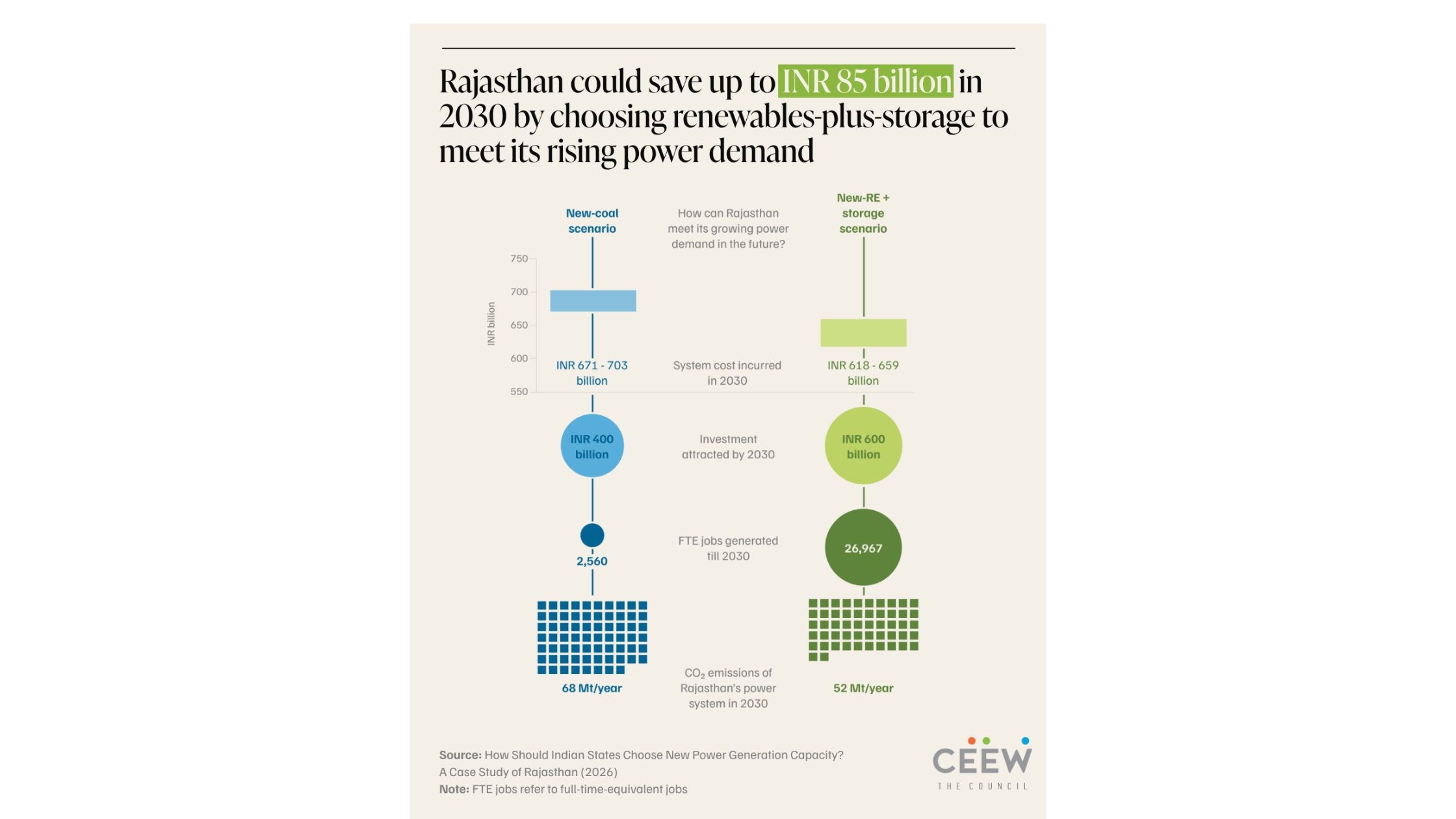
Rajasthan could save up to INR 85 billion in power procurement costs in 2030 by meeting its emerging electricity reliability requirements through renewable energy and storage instead of developing new coal capacity, according to a study by the Council on Energy, Environment and Water (CEEW).
The study, titled How Should Indian States Choose New Power Generation Capacity? A Case Study of Rajasthan, evaluates a February 2025 proposal by Rajasthan’s distribution companies (discoms) to procure 3,200 MW of new coal capacity to address projected power shortages.
According to CEEW, Rajasthan’s projected 2030 power shortfall is primarily a timing and flexibility challenge rather than a capacity shortage. Nearly 90% of the projected 5.5 billion-unit deficit is expected to occur during non-solar hours, when the state requires power sources capable of responding quickly to changes in demand.
The study used 15-minute production-cost simulations for 2030 to compare three scenarios: business-as-usual, adding 3,200 MW of new coal capacity, and deploying an equivalent energy supply through a combination of solar, wind and battery storage.
RE-Plus-Storage Could Deliver Significant Savings
CEEW estimates that replacing the proposed new coal capacity with renewable energy and storage could generate net savings of INR 11.4 billion to INR 85 billion in 2030. The clean-energy pathway could also enable Rajasthan’s discoms to earn approximately INR 35 billion in additional revenue by selling surplus electricity through power exchanges.
The study also estimates that the renewable energy and storage pathway could attract around INR 600 billion in clean-energy investment and create approximately 27,000 full-time-equivalent jobs by 2030, compared with around 2,560 jobs under the new coal pathway.
The clean-energy scenario could reduce Rajasthan’s power-sector carbon dioxide emissions by 24%, bringing emissions down to around 52 million tonnes, compared with approximately 68 million tonnes under the new coal scenario.
Rajasthan’s electricity requirement has grown at a compound annual growth rate of around 8% between FY22 and FY25, with demand projected to reach 1.5 times FY25 levels by FY30.
CEEW Highlights Reliability Concerns With New Coal
CEEW said the proposed 3,200 MW of coal capacity would generate more than 20 billion units of electricity annually to address a projected 5.5 billion-unit deficit. However, the study found that this pathway could still leave around 1% of demand unmet, compared with the Central Electricity Authority’s reliability benchmark of 0.05%.
The study also points to recent procurement decisions in other states. Bihar and Assam contracted 5,600 MW of new coal capacity in 2025 at fixed costs of INR 4.17–4.54 per unit, despite planning assumptions that indicated fixed costs below INR 2.55 per unit for the same technology.
CEEW Fellow Disha Agarwal said state discoms should assess generation options based on overall grid requirements and system-level costs rather than comparing technology-level costs alone. She added that changing technology costs, capabilities and demand patterns require states to continuously update their power-planning exercises.
CEEW Calls for Integrated Resource Planning
CEEW has recommended that state discoms institutionalise scenario-based integrated resource planning to evaluate future power requirements under different demand and technology conditions.
The study also recommends that procurement frameworks focus on least-cost system-level outcomes by allowing mainstream generation and storage technologies to compete on an equal basis. State electricity regulators should also strengthen their technical capacity to independently assess power procurement proposals.
The findings were discussed during a webinar involving policymakers and power-sector stakeholders, including representatives from the Ministry of New and Renewable Energy, the Solar Energy Corporation of India, AIDA member distribution utilities and other industry experts.
Subscribe to get the latest posts sent to your email.