

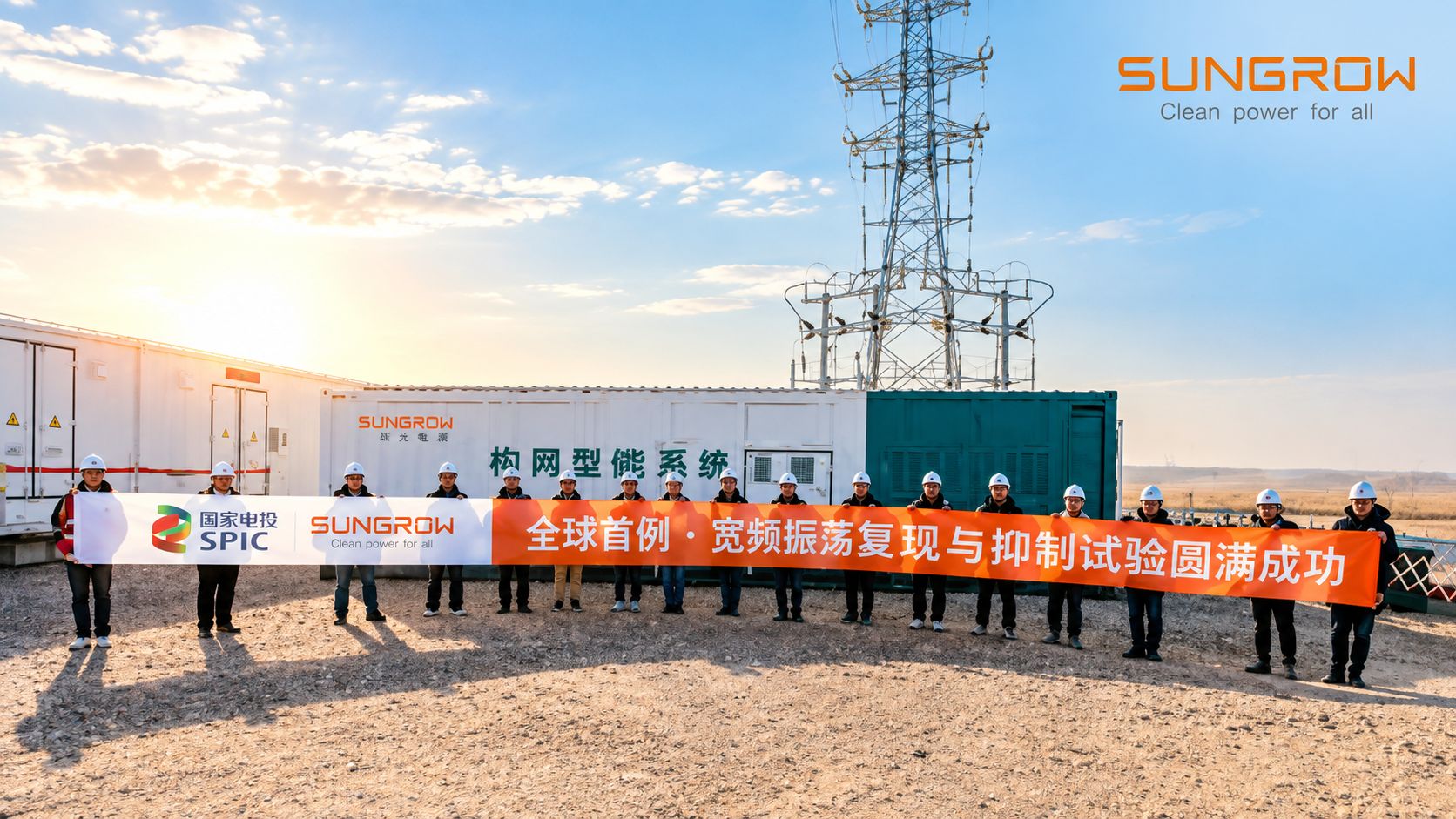
Sungrow has announced what it describes as a world-first achievement in controllably reproducing and successfully suppressing wideband oscillation at a real-world 500 MW solar-plus-storage plant in Qinghai, China. The field test demonstrates the application of inverter-based control technologies to address oscillation challenges in renewable power systems operating under weak-grid conditions.
As renewable energy penetration increases, wideband oscillation has emerged as an important grid stability concern. Severe oscillations can potentially lead to renewable power plants disconnecting from the grid or shutting down. However, their complex and unpredictable nature has made it difficult to safely reproduce such conditions at operational plants and validate suppression technologies outside laboratory and simulation environments.
To address this challenge, Sungrow and its industry partners conducted a field test using Sungrow PV inverters deployed across the 500 MW plant.
The test established weak-grid conditions and identified three key factors contributing to oscillation behaviour: power output, system short-circuit ratio (SCR), and control parameters. Based on these conditions, the team successfully achieved the controlled reproduction of a localized system oscillation.
According to Sungrow, the test provided an opportunity to evaluate inverter response and oscillation suppression technologies under actual plant operating conditions rather than relying solely on simulations.
The field test subsequently evaluated the oscillation suppression performance of Sungrow’s PV inverters under different grid conditions.
Using the company’s patented grid-strength adaptation technology, the inverters identified grid strength within 40 milliseconds and adjusted their control strategies accordingly to stabilize voltage and frequency.
The test also evaluated grid-forming control as a method for suppressing wideband oscillation. According to Sungrow, its grid-forming control strategy supports stable operation across an SCR range of 1–40 while helping mitigate transient overvoltage.
The results demonstrate how adaptive inverter controls and grid-forming technologies could support renewable plants connected to extremely weak grids. Such capabilities could help reduce oscillation-related grid disconnections, improve plant stability, increase power export capability, and limit associated generation losses.
Commenting on the development, Pan Nian’an, Chief Engineer and Chief Expert for Utility PV BU at Sungrow, said, “For renewable energy to become a truly stable and reliable source of power, it is essential to develop autonomous fault self-healing and grid-support capabilities.”
Sungrow said it will continue research and development in grid technologies, including wideband oscillation suppression, grid-forming control, and multi-energy coordination, with the aim of supporting stable grid integration and efficient utilization of renewable energy.
Subscribe to get the latest posts sent to your email.









)