By
43 min ago 2 min read
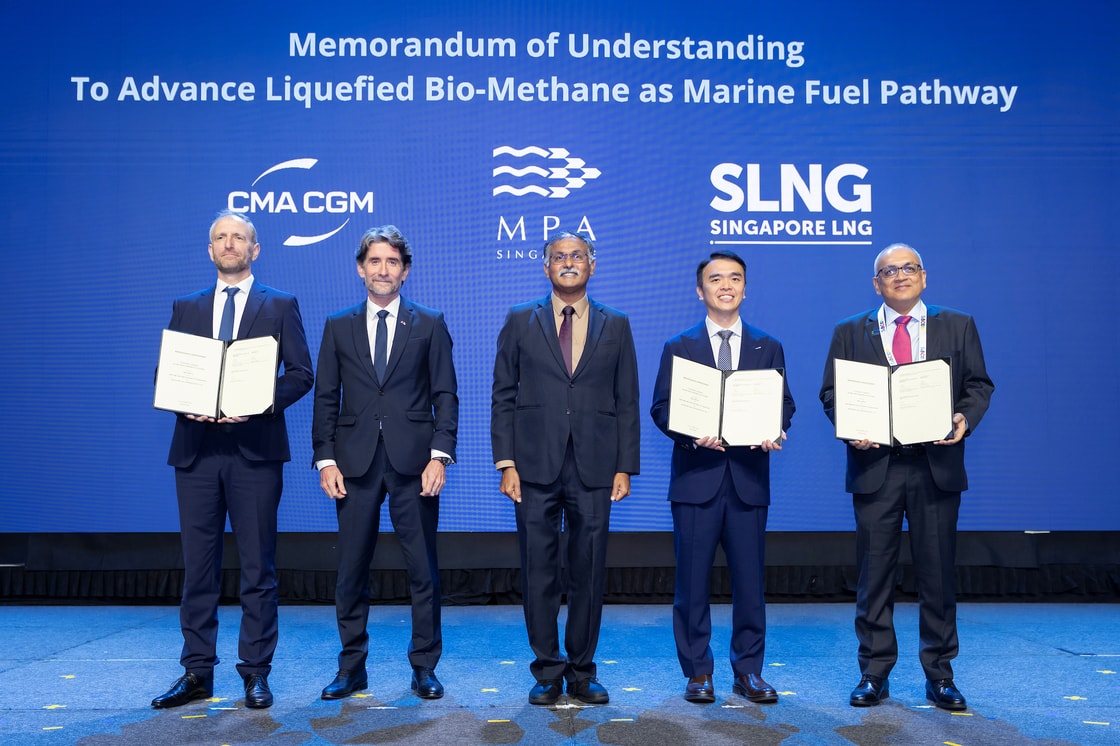
Singapore’s Maritime and Port Authority (MPA), French shipping operator CMA CGM, and Singapore LNG (SLNG) will explore using existing gas infrastructure for bioLNG in Singapore’s maritime industry.
Under a memorandum of understanding (MOU), the trio will aim to develop Singapore’s bioLNG bunkering capabilities through the certification and adoption of bioLNG as a marine fuel.
The partners will complete pilots and trials to evaluate how bioLNG’s greenhouse gas emission savings can be attributed when mixed with natural gas in shared infrastructure.
Biomethane, liquefied as bioLNG, is fully compatible with LNG-ready ships and existing bunkering infrastructure.
This builds on MPA and CMA CGM’s . In May 2025, Singapore and France signed a collaboration agreement to develop a biomethane bunkering trial in Singapore with CMA CGM.
In July, CMA CGM also the first bioLNG bunkering of the Notre Dame, its 24,000 TEU LNG-powered container ship and currently the world’s largest LNG-powered container vessel.
BioLNG market
BioLNG is increasingly being viewed as a near-term fuel to help decarbonise shipping.
In 2025, the World Biogas Association (WBA) forecasted that bioLNG could cover up to 3% of the total energy demand for shipping fuels by 2030, and up to 16% if used as a drop-in fuel blended with fossil fuel LNG.
But the global trade association said a raft of policy support measures are needed to spur biomethane’s adoption.
According to market research, the global bioLNG market was valued at $3.61bn in 2025, which is projected to increase to $83.15bn by 2034.
Europe holds a global market share of 34%, and Asia-Pacific has a 24% share, respectively.
Europe’s bioLNG market is supported by the European Commission’s FuelEU maritime regulation, which targets the greenhouse gas intensity of maritime fuels to be reduced by up to 80% by 2050, starting from a 2% target in 2025.