By
57 min ago 2 min read
New helium prospects are often located far away from established power infrastructure, opening up logistical and economic challenges for companies looking to complete the drilling, well-testing, and gas purification operations associated with helium production.
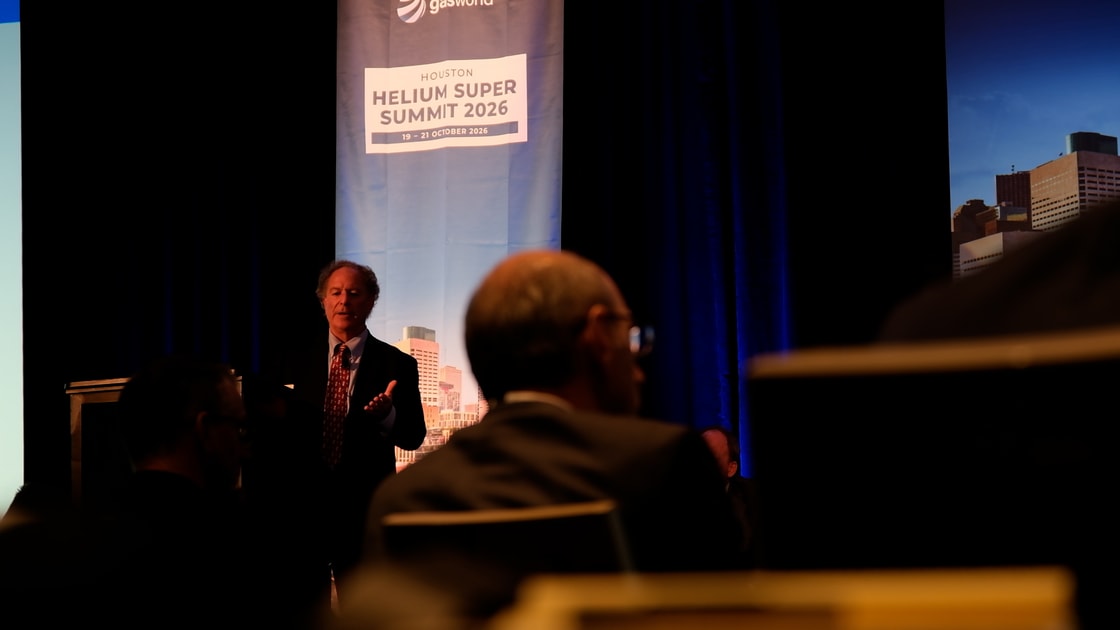
These challenges were highlighted by companies with US-based helium activities during a panel at gasworld’s Helium Super Summit in Houston.
Trent Spry, Managing Director and CEO of Australian exploration firm Blue Star Helium, named power as the company’s largest operating expense.
He said three-phase power is nearby to Blue Star’s Colorado-based operations. However, due to the weak local grid, the company has to connect further back at a substation to prevent potential damage to the network.
Ryan Smith, CEO of US industrial gas and carbon management company Big Sky Industrial, also said the company powers its infrastructure through gas-powered generators.
Big Sky Industrial’s flagship Carbon Hub in Toole County, Montana, is estimated to hold 1.3 billion cubic feet (Bcf) of helium and 444 Bcf of carbon dioxide (CO2) resources.
Smith highlighted the economic challenge of sourcing this technology in competition with data centres and the largest companies globally.
He noted that without the funding for power infrastructure, such as gas-powered generators, projects become delayed and extra costs result in further loss of capital.
In line with Spry’s argument, he said, “[In fairly remote locations] you start running into significant infrastructure hurdles that you have to solve…in my opinion, the biggest one is power”.
Spry said Blue Star assessed alternative power-generation options.
CO2 infrastructure has been completed at Blue Star’s Galactica project in Colorado. The company hopes to secure markets for its helium and CO2.
“We produce CO2, so we looked at producing our own natural gas through the methanol process…it’s a power in, power out [process]…it doesn’t really…work economically,” he shared.
Moving forward, Spry emphasised the important of building relationships with generator suppliers.
“Don’t ever underestimate your power needs and requirements and how difficult that may be,” he advised the delegates.
For Smith, “Once you are comfortable with your resource… this entire play flips very quickly to an infrastructure play and controlling your costs.”