Biomethane producers could reduce their reliance on government subsidies by up to a third through the sale of biogenic carbon dioxide (CO2) for permanent storage according to a new report from UK gas distribution network Cadent.
Early evaluations from the network suggest biomethane producers could generate additional income equivalent to around £20 ($27) per megawatt hour of biomethane produced by selling the biogenic CO2 for carbon capture and storage (CCS).
The report estimates that producers currently require around £60 ($81) per MWh in government support, alongside approximately £30 ($40)/MWh in revenue from gas sales.
Selling the separated CO2 for permanent storage could generate a further £20/MWh, reducing the subsidy needed to around £40/MWh – a reduction of around one-third.
The findings come amid wider concerns over government support for the UK’s biomethane sector, with the Anaerobic Digestion and Biogas Association that funding restrictions on the Green Gas Support Scheme risk stalling investment in new projects.
More than a dozen projects ready for construction were awaiting approval, according to the trade association.
The additional revenue would come from capturing the biogenic CO2 separated during the production of biomethane.
During the upgrading process, biogas produced through anaerobic digestion is purified to remove CO2, leaving biomethane that can be injected into the existing gas network.
The separated CO2, known as biogenic CO2, is typically sold for industrial applications or vented when producers cannot find a buyer.
Cadent’s proposal is for producers to capture and liquefy the gas before transporting it to CCS facilities for permanent geological storage, generating greenhouse gas removal (GGR) credits that can be sold.
The report argues that biogenic CO2 offers a relatively low-cost source of GGRs, as the gas is already separated during biomethane production and is available as a concentrated, high-purity stream.

©Cadent
However, capturing and storing the CO2 at scale presents an infrastructure challenge. Biomethane plants are typically smaller and geographically dispersed, making direct connections to carbon transport and storage pipelines impractical or too expensive.
Instead, Cadent proposes transporting liquefied CO2 by road tanker to aggregation facilities, where volumes from multiple producers could be combined before entering CCS networks.
The company identifies the Government’s recently launched Non-Pipeline Transport (NPT) Pathfinder as an important step towards opening up access to CCS infrastructure for smaller CO2 producers. The process enables the East Coast Cluster to source CO2 transported by means other than pipelines for the first time.
Further work is needed
However, Cadent said further work was needed to expand the initiative across other CCS clusters and streamline the process through which smaller producers secure storage capacity.
CCS policy has typically focused on larger industrial emitters, with minimum project-size thresholds and allocation processes that have limited opportunities for smaller, geographically dispersed sources, said the report.
Cadent said the potential reduction in biomethane subsidy requirements would depend on market design, regional access to CCS infrastructure and future policy arrangements.
It added that producers unable to access storage facilities because of their location or the associated costs would need to remain economically viable.
The report also highlighted the potential for biomethane production to strengthen UK CO2 supplies following shortages in 2026.
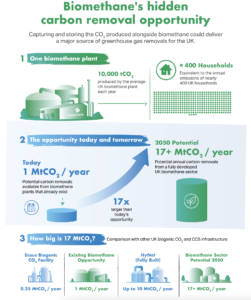
It estimated that just 20 additional biomethane sites capturing their CO2 could produce around 250,000 tonnes annually, equivalent to the output of the Ensus facility.
The report estimates that the UK’s biomethane sector could generate around 17 million tonnes of biogenic CO2 annually by 2050, based on potential production of 120TWh of biomethane per year.