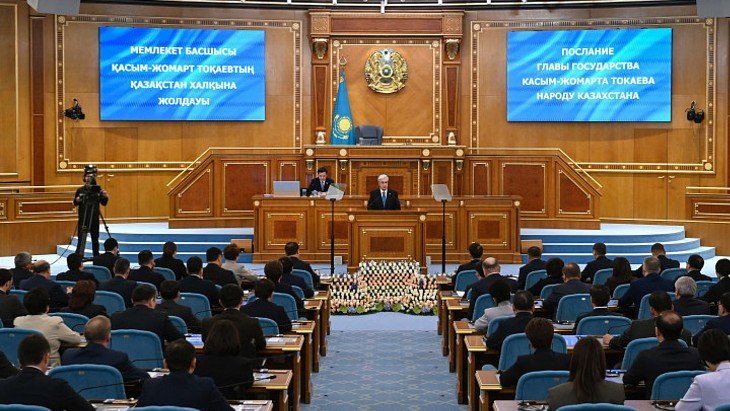
President Kassym-Jomart Tokayev set out the ambition in an address to the nation last week, saying: “As a result of a nationwide referendum, the right decision was made to build several nuclear power plants in our country. We need to start thinking now about how we will supply these stations with uranium raw materials in 50 years, and even beyond.
“The proposal to create a state strategic reserve of uranium for the next 100 years to meet the needs of nuclear power plants in Kazakhstan is very reasonable. I believe that this initiative needs to be comprehensively developed.”
On Tuesday, according to the official presidential press service, he was briefed by Kazatomprom’s Chairman Meirzhan Yusupov “on the measures to create the State Strategic Uranium Reserve”. This includes the company “conducting geological exploration in six areas with a total area of more than 1,000 square kilometres. It is also planned to explore the promising Kyzyltu area with an area of 124 square kilometres”.
The official Kazinform news agency reported that the Chairman of the Atomic Energy Agency, Almassadam Satkaliyev, told a committee on economic policy, industry, and energy that the country’s development strategy calls for the reserving of at least 150,000 tonnes of uranium by 2050, and work was on-going to develop and approve a conceptual framework for establishing the strategic reserve.
He added: “The strategic reserve is expected to be developed as a comprehensive, multi-level system covering the entire nuclear fuel supply chain, from reserving uranium deposits underground to building physical stockpiles of natural uranium, reserves of ready-to-use nuclear fuel, and other mechanisms.”
New nuclear capacity
An intergovernmental agreement setting out the key principles – and export loan financing – for Kazakhstan’s first nuclear power plant project – the Balkhash Nuclear Power Plant – was signed in May during Russian President Vladimir Putin’s state visit to the country.
Further details of the financing was not included in the official announcements, although Kazinform said that preliminary estimates put the cost of the two units at about USD14.4 billion, with another USD2 billion earmarked for physical security systems and social infrastructure. It reported that the construction start was targeted for 2027, and the aim was for operation of the first unit in 2034.
An engineering, procurement and construction contract was signed by Russia’s Rosatom in September for the plant, which is set to feature two of its VVER-1200 pressurised water reactors.
Kazakhstan has been preparing for a nuclear power programme to reduce its reliance on fossil fuels, diversify its energy mix and reduce CO2 emissions for some time. Kazakhstan Nuclear Power Plant, a subsidiary of Kazakhstan’s Samruk-Kazyna National Welfare Fund JSC, was set up in 2014. In a referendum in 2024 more than 70% of the 7.8 million people who voted answered ‘yes’ to the question: “Do you agree with the construction of a nuclear power plant in Kazakhstan?”
In addition to the initial nuclear power plant, China National Nuclear Corporation is lined up to build a second one, at a site also in the Zhambyl district, adjacent to the site selected for the first plant. The government has set a target for nuclear to produce a 5% share of the national generation mix by 2035.
According to the Kazinform report on Satkaliyev’s comments, sites are currently being examined for a third nuclear power plant in the country. It said that in terms of technology, “medium-sized nuclear power plants are considered – from 300 to 600 MW … in addition to electricity production, such plants can provide heat supply and desalination”.
Kazakhstan has 14% of the world’s uranium resources and has been the world’s leading uranium producer since 2009. In 2025 Kazakhstan produced about 25,839 tU, which was about 40% of the world’s total.