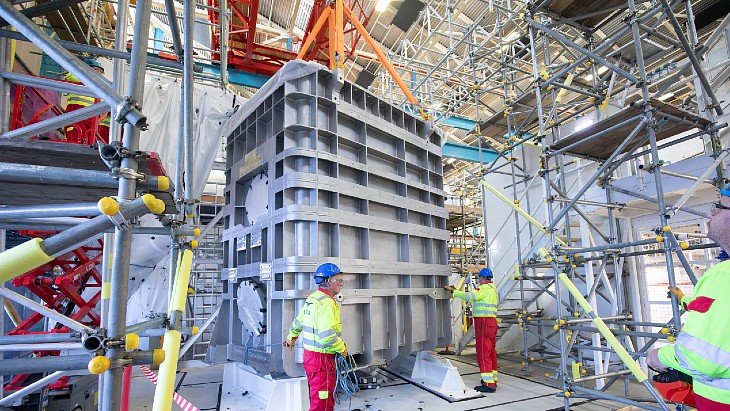
The UK Atomic Energy Authority (UKAEA) said the double beam box has a “double decker” layout with two neutral beam injectors – injectors fire high-energy neutral atoms into the plasma raising its temperature to more than 30 million degrees Celsius.
It says that adding two more injectors to the machine, at UKAEA’s Culham campus near Oxford, doubles its heating power to 8.8 MW and doubles the plasma temperatures, which “will enable researchers to investigate the technologies and physics needed for future fusion power plants”.
The double beam box vessel, which has a volume of 20 cubic metres, is made of 316L stainless steel which “offers good vacuum compatibility, essential for the ultra-high vacuum conditions required inside the vessel”.
UKAEA says that all major hardware is due to be manufactured and fitted inside it by the end of Autumn 2027 with scientific experiments to use it from 2028.
Andrew Thornton, Head of MAST Upgrade Operations at UKAEA, said: “The lift of the double beam box is a huge step forward for MAST Upgrade. By doubling our heating power, we will explore plasma conditions we simply couldn’t reach before. We will be able to study the stability of higher-pressure plasmas while testing how the MAST Upgrade exhaust system copes with these hotter, higher-performance plasmas.”
The MAST (Mega Amp Spherical Tokamak) Upgrade has three key aims: to investigate novel exhaust concepts; to de-risk/advance the spherical tokamak design, as a future power plant; and to extend physics knowledge in support of the broader fusion programme.
UKAEA says the machine’s core focus is on the exhaust system, known as the tokamak’s ‘divertor’ which “takes the particles and heat ejected from the plasma and directs it onto surfaces within the tokamak. To achieve commercial fusion power, we must solve the key issue of plasma exhaust. There will be intense power loads in the large fusion machines in future power plants. This has the potential to damage the divertor components which would require replacement every few years. It would make it difficult for fusion to become an economically competitive energy source. The challenge is to develop a divertor which can reduce the power loads to a manageable level. This would be about the same as in a car engine.”
MAST Upgrade, which in August completed its fifth round of experiments during which it achieved the highest plasma pressure it has ever attained while overcoming plasma instability issues considered essential prerequisites for commercial fusion power, is funded by the Department for Energy Security and Net Zero and is part of the EUROfusion European Medium-Sized Tokamak Programme.
Other enhancements this year include the installation of an electron Bernstein wave (EBW) system that will provide an additional 1.6 MW of heating power. EBW technology is planned for use in the Spherical Tokamak for Energy Production (STEP), the UK’s prototype fusion power plant to be based in West Burton in Nottinghamshire. The current MAST Upgrade work also includes the “transfer and repurposing of power supply equipment from the Joint European Torus (JET)” machine, which was retired after 40 years in 2023.
STEP is due to begin operating by 2040. The technical objectives of STEP are: to deliver predictable net electricity greater than 100 MW; to innovate to exploit fusion energy beyond electricity production; to ensure tritium self-sufficiency; to qualify materials and components under appropriate fusion conditions; and to develop a viable path to affordable lifecycle costs.