Production of the reactor internals and the VVER-1200 reactor head for the unit were produced at Rosatom’s Izhora site in St Petersburg.
Rosatom, Russia’s state nuclear corporation, says the total weight of the reactor vessel internals and the reactor head to be shipped to Egypt is about 340 tonnes. Including the already assembled reactor vessel the total weight will be more than 670 tonnes.
“Completion of the internals and reactor head is a crucial step in the construction of the power unit, paving the way for the next stages. Once they are installed, construction workers will be able to proceed with the installation of the remaining reactor hall equipment and move forward with commissioning,” Rosatom said.
“The internal reactor vessel devices (including the shaft, baffle, and protective tube block) and the reactor lid form the basis of the reactor core, ensure the correct placement and fixation of the nuclear fuel, as well as the tightness and safety of the entire reactor installation.”
Background
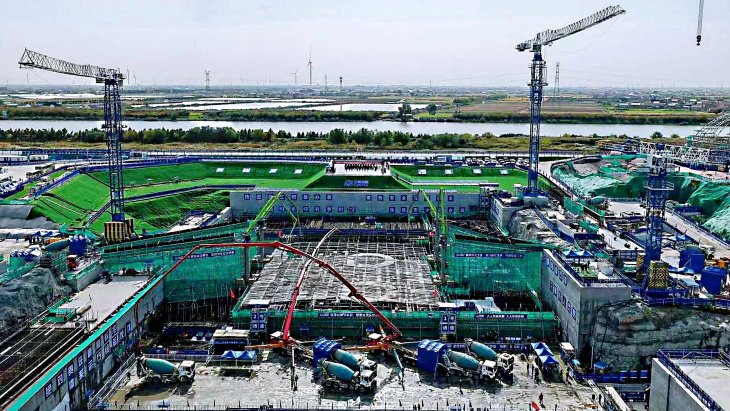
The reactor pressure vessel was installed in unit 1 in November last year, following a ceremony which included speeches from the Egyptian and Russian presidents (see picture below). Among the construction landmarks this year, concreting work on the fourth tier of the reactor building’s inner containment was completed in August.
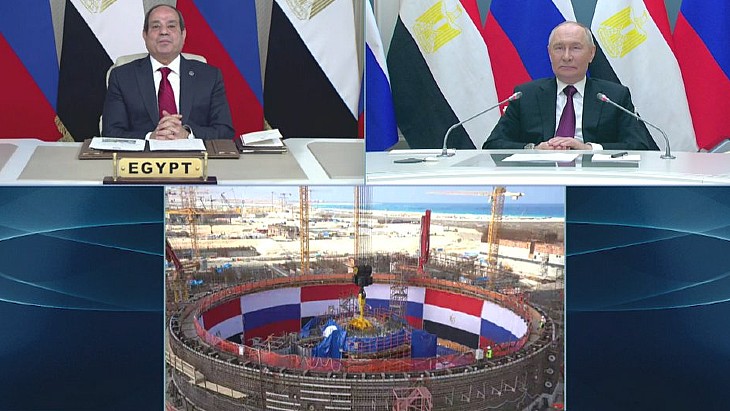
(Image: Kremlin.ru)
El Dabaa will be Egypt’s first nuclear power plant, and the first in Africa since South Africa’s Koeberg was built nearly 40 years ago. The Rosatom-led project, about 320 kilometres north-west of Cairo, will comprise four VVER-1200 units, like those already in operation at the Leningrad and Novovoronezh nuclear power plants in Russia, and the Ostrovets plant in Belarus.
Under the 2017 contracts, Rosatom will not only build the plant, but will also supply Russian nuclear fuel for its entire life cycle, including building a storage facility and supplying containers for storing used nuclear fuel. It will also assist Egyptian partners in training personnel and plant maintenance for the first 10 years of its operation. Rosatom has said it is aiming for a future service life of up to 100 years for nuclear power plants.
The four units are being built almost concurrently, with first concrete at unit 1 in July 2022, followed in turn by the others, concluding with first concrete at unit 4 in January 2024. Egypt’s aim is for 9% of electricity to be generated by nuclear by 2030, which would be achieved by the commercial operation of the first two units by that time, directly displacing oil and gas.