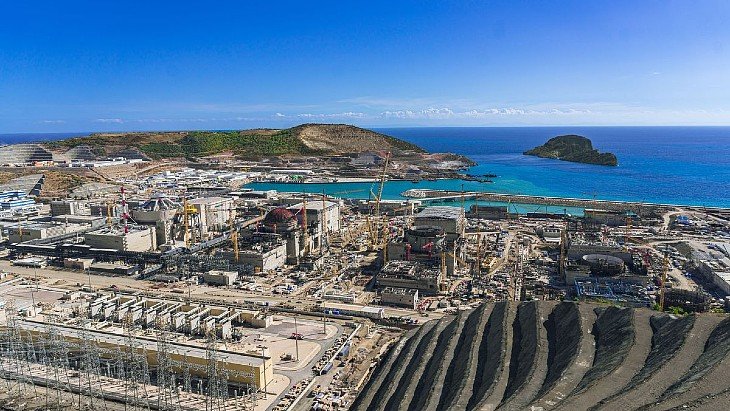
Hot tests see the unit’s equipment and safety systems being tested under standard conditions, but using an external power source rather than nuclear fuel.
According to Strana Rosatom, the in-house publication of Rosatom, Russia’s state nuclear corporation, its Director General Alexei Likhachev said: “I very much hope that we will pass these tests successfully, and that loading real fuel into the first reactor vessel will begin as early as December, and that Turkey will receive this long-awaited nuclear electricity in January-February.”
He was speaking at World Atomic Day at the UN’s COP31 climate summit in Turkey.
The report also said he had been discussing potential investors in the project, with the intergovernmental agreement allowing such stakes up to 49% from companies approved by the Turkish government.
Strana Rosatom says that Likhachev said Turkish entities had already expressed an interest, with confidential negotiations taking place. He believes that Turkish investors’ participation “will strengthen the project’s organisational and financial sustainability”.
As the unit gets closer to starting up, it has also hosted a pre-start-up peer review visit by the World Association of Nuclear Operators. This lasted more than two weeks and involved 17 experts from Belarus, Bulgaria, China, Russia, Slovakia and the USA.
Akkuyu NPP said: “The experts reviewed operating documentation, observed personnel at work and conducted plant walkdowns. The assessment covered equipment condition, arrangements for operations and maintenance, organisational structure and personnel training, emergency preparedness and response, fire and radiation protection, and engineering support.”
Background
Akkuyu, in the southern Mersin province, is Turkey’s first nuclear power plant. Rosatom is building four VVER-1200 reactors, under a so-called BOO (build-own-operate) model. According to the terms of the 2010 Intergovernmental Agreement between the Russian Federation and the Republic of Turkey, the aim was for the commissioning of the first power unit of the nuclear power plant to take place within seven years from receipt of all permits for the construction of the unit.
The licence for the construction of the first unit was issued in 2018, with construction work beginning that year. Nuclear fuel was delivered to the site in April 2023. The aim has been for unit 1 to begin supplying Turkey’s energy system by the end of 2026. First concrete was poured for unit 4 in July 2022.
When the 4,800 MWe plant is completed, it is expected to meet about 10% of Turkey’s electricity needs.
Turkey has plans for a second nuclear power plant, at Sinop, and has also been in talks with China about plans for a third plant, in the Thrace region in the country’s north-west.
According to a Bloomberg report last week, Turkey’s Energy Minister Alparslan Bayraktar said the country was in talks with Canada and South Korea about new nuclear power projects and expected to finalise its partners in the next few months.
On Thursday AtkinsRéalis’s Candu Energy Inc and state-owned Türkiye Nükleer Enerji Anonim Şirketi signed a memorandum of agreement which includes a feasibility study for a potential 4.5 GW plant featuring up to six Candu reactors.
The country is also developing plans for small modular reactors, with the aim of adding 5 GWe of capacity by 2050 – which would mean the equivalent of at least 16 individual SMRs.